

The content below is from episode 168 of the Who’d a Thunk It? Podcast
RECOMMENDATION SEGMENT
- This week I recommend you get a world map.
- Whether it is a poster, a globe, or perhaps the background on your phone… doesn’t matter.
- I recommend you have a world map somewhere in your life that you see it on a regular basis.
- I have one right above my office computer and I think having it there helps me keep a global perspective.
- It is easy for us to get into a SUPER local mindset where the things right in front of us become the only things we worry about and try to fix.
- On a practical level it makes sense and I’m not saying it is a bad thing to focus on your home and the people in your daily life.
- But I think it is healthy to realize every once in awhile that the world is BIG place. All 8.1 Billion of us inhabit this Earth and having that fact in the back of my mind has allowed me to be more empathetic to strangers (my fellow humans).
- It also helps me ease my anxiety that stems from my everyday problems.
- Because yes, I have X amount of tasks to do for work, yes the grass needs mowed, yes I need to get groceries today… all those things need to get done. That is a fact.
- But realizing the other fact That our world is huge and the entire world map is filled with 8.1 Billion other people dealing with similar every-day problems (some easier than mine and A LOT being worse than mine) gives me peace of mind. Because my problems seem a lot smoaller in the big scheme of things.
- IDK, maybe having a world map hanging on your wall won’t have the same effect on your as it does me… or maybe it will.
- Allow me to take you to a corner of our wonderful globe that you may not have heard much about. The Island of Sumatra is where this week’s main event begins…
NOW FOR THE MAIN EVENT

- The Indonesian island of Sumatra has a native plant that can only be found there: the Titan Arum (AKA the Corpse Flower)
- the technical name is Amorphophallus titanum has also been dubbed the corpse bride, corpse plant, and the world’s smelliest flower.
- Unfortunately, the very common story of habitat loss has caused this awe-inspiring plant to become very rare to spot in its natural habitat.
- The corpse flower is classified as endangered, with fewer than 1,000 individuals left in the wild.
- Thankfully, due to its spectacular nature and advances in horticultural technology in recent decades, it has found homes in botanical gardens all around the world.

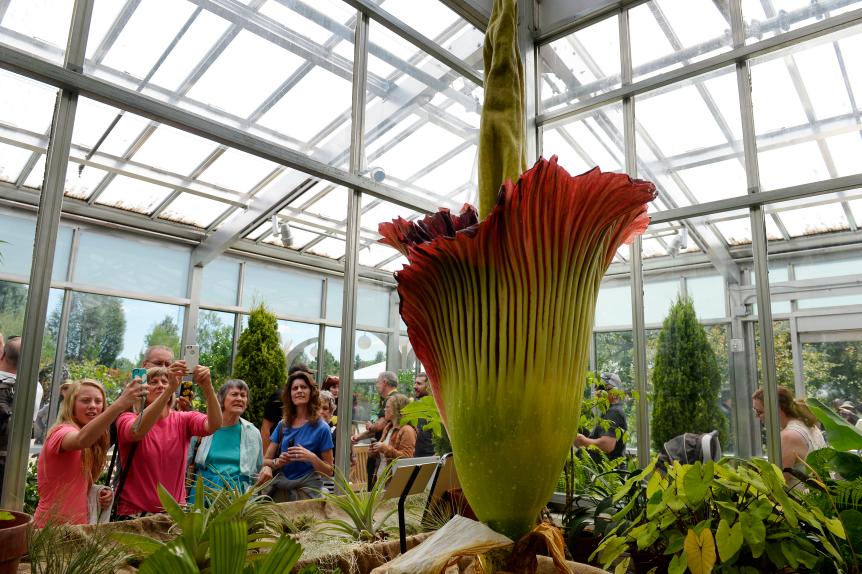
- The corpse flower is huge, we’re talking up to 12 feet tall.
- The titan arum’s inflorescence can reach more than 10 feet in height. And just the leaf structure alone can reach up to 20 feet tall and 16 feet across. The plants underground stem, or corm, can weigh up to 110 pounds.
- It is called the Corpse Flower because when its flower unfurls it has little male and female flowers at the base of its immense spike gives off a nasty smell that mimics the stench of rotting flesh (some say it smells like really stinky laundry).
- The plant’s smell has also been likened to “Limburger cheese, garlic, rotting fish, and smelly feet.
The corpse flower’s scent is a chemical combination of dimethyl trisulfide, isovaleric acid, dimethyl disulfide, benzyl alcohol, indole, and trimethylamine. The odor is meant to mimic decomposition in order to attract its native pollinators– carrion beetles and flesh flies– who are drawn to the smell of decaying meat.
The potency of the stench gradually increases from late evening until the middle of the night– when pollinators are most active. The smell tapers off in the morning.
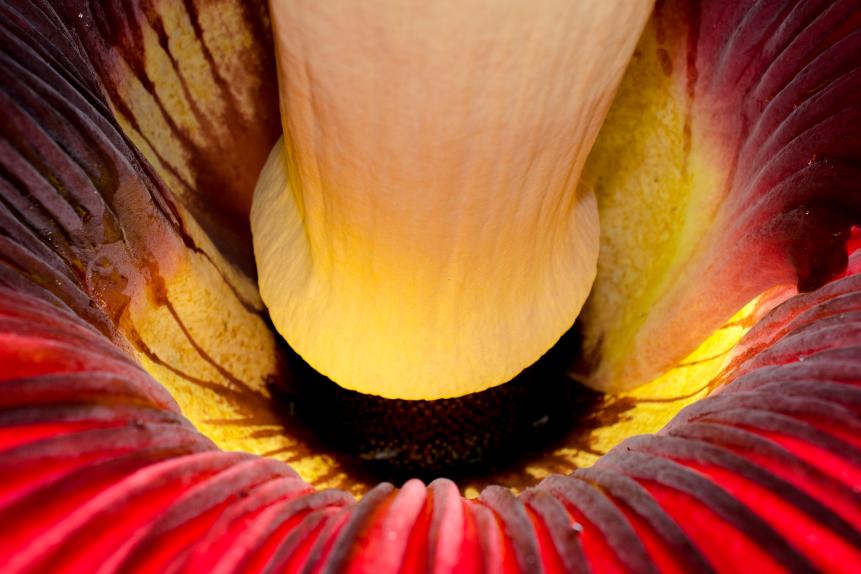
- The Titus Arum doesn’t abide by your typical flowering cycle. Young plants can take up to a decade for their first bloom to occur and mature Corpse Flowers take years to bloom again. They aren’t easily predicted and that makes plant nerds really excited when they do bloom… that and its gigantic size… and its really rare smell.
- The Titus Arums is a bit of a rockstar in the botanical world.
- People wait in huge lines with expensive cameras at the ready whenever these things bloom.
- Flower enthusiasts travel from all over the world to witness this infrequent occurance. Visitors will return day after day to conservatories, greenhouses, and botanical gardens with a predicted corpse flower bloom so as not to miss the short window.

- Right now there are two of these Titus Arums blooming in California
- One is in SanFrancisco at the San Fran Conservatory of Flowers
- San Fran’s corpse flower named Scarlet bloomed in 2019 and “she” began blooming again earlier this week.
- the other in San Diego Botanic Gardens.
- This plant wasn’t named to my knowledge and has already shriveled. it last bloomed in 2021.
- One is in SanFrancisco at the San Fran Conservatory of Flowers

What are people saying? Ari Novy, president and CEO at the San Diego Botanic Garden, spoke to NPR’s Daniel Estrin about witnessing the symphony of stench in real time.
His own description of the corpse flower’s perfume:
The way I describe it is it smells like if you took your teenager’s dirty laundry and you put it in a big black garbage bag, and then you added in some hamburger meat, maybe some fish, a little garlic and some parmesan cheese. And you left that by the side of the road on a very hot desert day for about 24 hours. And then you came back to it. That’s not even exaggerating. That is really what the smell was.
On why the corpse flower has evolved to smell this rank:
There are insects out there that really like the smell of rotting flesh or other fetid or rotting odors. And those insects can pollinate plants. There are several plants that utilize this strategy of using rotting flesh odors that humans find repulsive to attract a bunch of insects who actually love that smell.
On the public reaction to the bloom:
This is like the rock star plant of the plant world. It’s kind of like a panda if you were in a zoo. It’s amazing, people come from all over the place. We had one bloom about 18 months ago and a guy saw it on the webcam in Texas and immediately got in his car so that he could make it for the blooming. And he drove day and night and got to San Diego 14 hours later. This plant really brings out people, and for a smell that’s so putrid and disgusting for human beings, somehow we’re still pretty attracted to it.
- Unfortunately, the blooms were happening around the 4th of July and these events don’t last forever.
- This rare event only lasts 24 to 36 hours. Generally, the flower will open mid-afternoon and stay open all through the night and into the next morning.
- The whole reason they are so popular is because they are rare. Their beautiful stenchy brilliance doesn’t last long at all. You can visit their shriveled remains of their bloom, but no stench can be smelt at this point…
- bummer. I actually want to smell this artificial dead stink… I think it would be cool. N
Novy says better luck next time: “At this point in the blooming cycle, it’s done with its formal flowering. The flowers have done their work and so it doesn’t have that much of a smell. There’s some residual, but the real pungent punch typically comes in the evening, early morning on the first and second nights of flowering.”

- But blooming does not mark the end of the corpse flower’s lifecycle. If pollinated, the titan arum will produce fruit for about the next nine months. Once the fruit has ripened, the plant will die and emerge again as a leaf after a yearlong period of dormancy, then begin its lifecycle again.
- Corpse flowers are in cultivation in Europe, North & South America, Australia, and Asia. Check out your local botanical gardens to see if a corpse flower near you
CREDIT:
- https://www.npr.org/2023/07/06/1186289347/corpse-flower-bloom-california-where-to-see-livestream-san-diego-francisco
- https://www.discovery.com/nature/the-world-s-smelliest-flower-blooms-once-a-decade
- January 31, 2022
- By: Tatum Lenberg
- https://www.usbg.gov/gardens-plants/corpse-flowers
Here is a cool timelapse of a Corpse Flower bloom
https://huntington.org/corpse-flower
 The Journal of A_C_Unit