Categories
Uncategorized

Lava Sharks and a Demon Rock

The content below is from Episode 108 of the Who’d a Thunk It? Podcast

RECOMMENDATION SEGMENT

  • 1883 is some of the best writing to come out of the Western Genre in a long time.
    • This 10 episode series is technically a prequel to the Yellowstone show starring Kevin Costner, but because it is set about 140 years in the past you really don’t need to see Yellowstone in order to understand what is happening.
    • 1883 follows the story of a wagon party on their journey across the Oregon Trail.
    • Some of the main characters are
      • the Captain (played by Sam Elliot) is in charge of keeping all the German immigrants alive along the way
      • The Farmer (played by Tim McGraw) who agrees to help the wagon party in hopes it will keep his own family safe
      • And the farmer’s wife is played by Tim McGraw’s real-life wife Faith Hill.
      • His daughter Isabel Dutton is the main character of the show. Her character is heard narrating throughout the series and the audience experience most of the show through her eyes.
  • The show is amazingly written and I binged it within like 5 days.
    • oh, and guest stars include actors like Billy Bob Thornton and Tom Hanks…

NOW FOR THE MAIN EVENT

LAVA SHARKS!

  • This week I will be covering topics that were sent to me by fans, two topics to be precise: Lava Sharks and a Demon Rock.
  • Back in 2005, when I was just 11 years old a terrible movie came out called The Adventures of Sharkboy and Lavagirl 3-D.
    • Here is the premise: Bullied by classmates, young Max (Cayden Boyd) escapes into a fantasy, conjuring up the action-packed lives of Lavagirl (Taylor Dooley) and Sharkboy (Taylor Lautner). But one day, Lavagirl and Sharkboy suddenly come to life — and their world, Planet Drool, needs a hero named Max. As Max escapes to Planet Drool, he battles aliens and tries to save his new friends’ planet from destruction. He also battles his bullies, who have become villains like the Ice Princess (Sasha Pieterse).
    • With terrible CGI and even worse acting it was a nightmare of a movie, but it was also iconic and was talked about a lot.
    • Why do I bring this up? Well, sharks and lava apparently go together like peanut butter and jelly in the wild.
This is an actual underwater photo of a shark swimming near Kavachi volcano
  • Marine biologists and geologists are stunned by a recent discovery off the coast of the Solomon Islands.
    • The waters there hide a short-tempered volcano known as Kavachi and also sharks apparently.
    • These orange murky waters are bombarded by Kavachi’s frequent underwater eruptions. The concussive force of the blasts alone was enough to make biologists think larger marine life would steer clear of the area, not to mention the toxicity levels from lava-hot rock jutting out from the earth, or the boiling hot water. But the biologists were wrong. What the team of scientists saw with their underwater cameras were schools of reef sharks, hammerheads, and scalloped hammerheads.
    • The sharks seem to be thriving in this underwater hellscape and though we aren’t exactly sure yet, some biologists think it is due to a specialized nose.
    • You see these sharks have pores on their snouts called ampullae of Lorenzini. They think these pores allow them to sense changes in Earth’s magnetic field. Sharks use the information for homing and migration, and may also use them to avoid dangerous situations.
    • While this is a big discovery in the abilities of sharks, it isn’t entirely outside the realm of belief. Recent studies have shown that sharks are able to avoid hurricanes and cyclones. Now biologists are thinking this is linked to the ability to avoid volcanic eruptions.
    • Right now the total mystery is why. Why do these apex predators of the ocean prefer to gather in large numbers near volcanoes?
      • The initial theories are the 2 MAJOR reasons for almost everything in the wild: food or fornication.
    • Biologist think there might be a food source near volcanoes that we haven’t discovered yet or perhaps they prefer to reproduce there.
    • Michael Heithaus, a scientist and professor in the Department of Biological Sciences at Florida International University even said “who doesn’t like a hot tub?”
This is some CGI image that popped up when I googled “volcano shark.”
  • Why is this newsworthy?
    • Well, it is behavior in wild animals we weren’t aware of before and it is the behavior we humans didn’t predict because we thought volcanos were dangerous.
    • It also involves sharks which are pretty neat and also involves volcanos which are also pretty darn neat.

THE DEMON ROCK!

  • I like Japanese stuff which apparently makes me a weeb.
    • WEEB: “Weeaboo is a mostly derogatory slang term for a Western person who is obsessed with Japanese culture, especially anime, often regarding it as superior to all other cultures.” – dictionary.com
    • It also means people who know me will send me all sorts of articles and memes that pertain to Japanese culture. The other day my fiance Shannon sent me an article about this Demon Rock that split open and release all sorts of bad JuuJuu upon the world.
    • This rock is said to kill anyone who comes into contact with it and just within the last couple of months it split open like a cantaloupe.
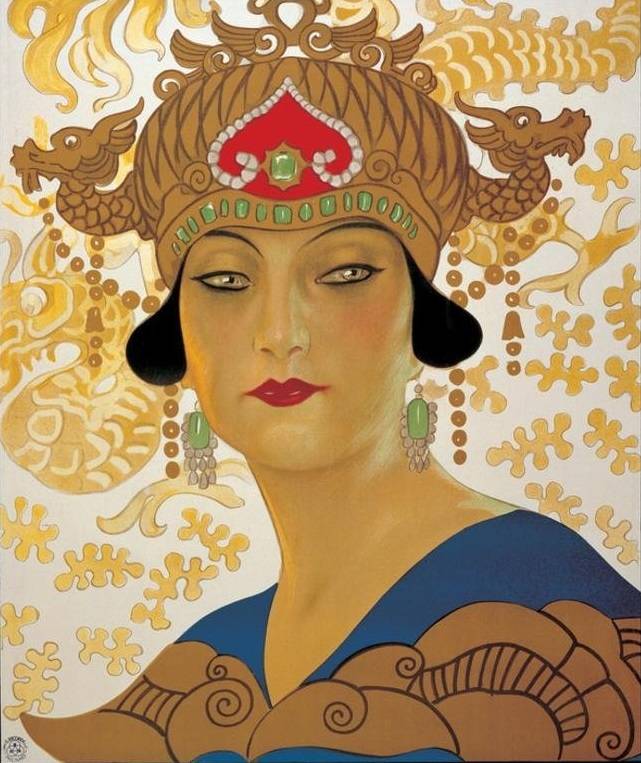
    • The story goes that a beautiful young maiden named Tamamo-no-Mae was part of a conspiracy to kill Emperor Toba who ruled over Japan from 1107 to 1123. This murderous plot was created by a feudal lord and he used Tamamo-no-Mae as a means to his end. When she died her dead body transformed into the Sessho-seki (killing stone).
    • But the legend goes deeper… It is believed that the maiden’s true self was the evil nine-tailed fox demon. Ninetails’ spirit is said to be trapped and encased in lava somewhere in the Tochigi prefecture near Tokyo. This area is famous for its hot springs and sulfur.
    • Many today still believe the stone is deadly and may even spew poisonous gas. So when it was recently discovered that the stone broke into 2 nearly equal parts it made headlines.
    • A lot of people online (mostly Twitter) are saying how this is just another messed up thing to add to the pile of horrible things to happen in the 2020s. But the stone most likely has been cracking for years now and things have just taken their natural course. Rain and wind slowly widened the cracks until the rock split.
    • Since the so-called demon rock has been a major tourist attraction in the area, there is talk about restoring it.
    • My question: are they going to get a Buddhist monk to seal the demon back inside before they seal it up with cement? Or are they going to use Elmer’s glue?

THANKS FOR LISTENING WHO’D A THUNKERS!

CREDIT

Categories
Uncategorized

Cats: Angels or Demons

The content below is from Episode 107 of the Who’d a Thunk It? Podcast

RECOMMENDATION SEGMENT

  • I recommend you watch the animated show called Stone Quackers.
    • Set in the fictional island city of Cheeseburger Island, the series revolves around the surreal misadventures of two ducks, Whit and Clay (respectively voiced by Whitmer Thomas and Clay Tatum), along with their friends Barf (voiced by Ben Jones) and Dottie (voiced by Heather Lawless), and the incompetent Officer Barry (voiced by John C. Reilly), and neighborhood kid Bug (voiced by Budd Diaz).
    • It is a gem of a show that only have like 12 episodes. I cracked up many times during the 3 days it took me to binge it on Hulu.
    • Among other things, John C Reilly as Officer Barry had me tearing up from laughter.

NOW FOR THE MAIN EVENT

  • I work from home and minus a few drawbacks, it is DEFINITELY much better than driving in to work every day. It saves me about 2 hours of time each day.
    • Another notable benefit to working from home is I get to spend my entire work day with my pets:
      • Rorschach a 7 year old, 18 pound, black Schipperke dog.
      • And Beerus, a 1 year old, chunky farm cat.
  • It is really nice to spend time with them and make sure they are getting attention all day. However, my cat only knows the meaning of personal space if it pertains to his own.
    • The little bugger jumps up on my work desk all day long and begs for attention. And when I’m working I can’t have a cat in between me and the keyboard.
    • But when I finally do brush Beerus off my desk I feel terrible.
  • Well it seems humans have been infatuated with cats for thousands of years. You’ve probably heard that cats were worshipped by the ancient Egyptians.
    • Well that’s what this week’s episode is about: Who worshipped cats, which cultures. How were cats worshipped. When and where were they worshipped. And what makes cats so damn special?
  • When and where were cats first domesticated?
    • An archeological dig in 1983 on the island of Cyprus (located in the Mediterranean Sea) revealed a jawbone of a cat dating back 8,000 years ago. Scientist concluded it was very likely it belonged to a domesticated cat, because who wants a demon hellspawn of a pissed off wild cat on your boat ride to the island?
    • Then in 2004 archeologist found a cat burried with a human. This made scientist reassess the date humans domesticated cats. They pushed the estimate back some 1,500 years, which brought the estimated year of domestication to 7,500 BCE.
    • But then in 2007 a study of the house cats genes was published stating all house cats today can trace their lineage back to the Middle Eastern wildcat, Felis sylvestris… get it? “Sylvestris”… like sylvester the cat from the Looney Tunes.
    • So now the current thought is that cats were first domesticated by humans some 12,000 years ago.
Sylvester, the American feline deity. Starting in 1930 Americans would sit in their homes and stare at a broadcasted image of Sylvester along with other animated deities, a tradition that is still practiced to this day.
  • That might sound like quite the jump in time estimation just based on a genetic study, but the theory makes sense. The researchers suggested that cats would have been domesticated around the same time humans began to cultivating crops.
    • Dogs were domesticated much earlier because dogs are great hunting companions. So the thought is that they were domesticated when humans were all hunting and gathering as nomads. But once we started to settle down and use agricutlure to feed ourselves, cats became useful.
    • Where there are large storage areas of grain and crop products there are rodents. Rodents are a main food source for cats.
    • The running thought now is that cats domesticated themselves. When we humans started storing our food from farming, the food stores attracted the mice, and the mice attracted the cats. Instead of getting rid of the cats, early humans kept them around because they kept the mice away.
    • Humans favored more docile and friendly cats and those were the ones that stuck around and evolved into the modern house cat.
      • as I wrote that last line, Beerus the cat jumped up on my desk, started purring and rubbing his face on my chin… yeah, I can see how we used to worship these little guys
Bastet
  • The most famouse culture to have worshipped cats was the Ancient Egyptians
    • Cats were thought to embody the Egyptian goddess of love Bastet and whenever Bastet is seen in Ancient Egyptians art she has the head of a cat.
      • Bastet was the daughter of the sun god Ra and moon goddess Isis. In earlier depictions Bastet is shows with the head of a fierce lion or lioness. Then later on she is shown with the head of a domestic cat. She starts to be portrayed as a mother with a bunch of god kittens. She is a protector of her family.
    • Cats were kept as companions to ward off pests in Ancient Egypt and historians believe this contributed to their portrayal of deities.
    • Many paintings found in Egyptians tombs show cats hunting birds, playing, or simply lounging under chairs.
      • A tomb was a continuation of ones life after death so naturally they had depictions of family members and their cats so they could take them with them after they died.
    • Other tomb paintings show cats holding daggers and fighting Apopis. Apopis was a snake deity that threatened Ra (the sun god) during night in the underworld.
    • But cats weren’t just the subject of paintings in tombs. Some cats were mummified and buried along with humans.
      • The thought was that the person could use the cats body as a vessel after death.
    • If you were charged and found guilty of killing a cat in Ancient Egypt it often meant you were subject to execution.
      • The one notable exception to this for mummification.
  • These next fun facts are from a website called Ranker.com. I’m not sure how reliable they are, just as a disclaimer.
    • When a beloved cat died, the family showed the amount of respect they would if a human member had died. They would even shave their eyebrows to show their loss and when their eyebrows grew back, they had finished mourning.
    • In 525 BCE during the Battle of Pelusium, Cambyses II of Persia was up against the military might of the Egyptians lead by Pharaoh Psametik III. Cambyses II wanted to eventually conquer Egypt.
      • Cambyses II used the unconventional tactic of ordering his men to capture as many cats as they could within the immediate area and release them upon the battlefield. When the Egyptian forces arrived at Pelusium they refused to fight for fear of hurting the sacred cats. The Egyptian forces surrendered to the Persians.
    • Archeologist recovered court records from the year 450 BCE that said it was illegal to export cats outside the empire. So instead of illegal drug smugglers you had illegal kitty smugglers. And apparently small bands of warriors were tasked with retreiving any stolen cats.
Cat in an Ancient Roman Mosaic
  • Ancient Rome had a positive view of cats
    • The Romans saw cats as a symbol of liberty. They didn’t hold any religious significance, but were revered all the same.
Li Shou
  • Many Ancient Asian cultures valued cats for their ability to protect scrolls from rodent damage.
    • The Chinese god Li Shou protected crops from being devoured by rodents. There is also a delightful story from Chinese myth about how cats (lead by Li Shou) were tasked by the creator gods to run the world. But they decided they’d rather nap in sunbeams and chase butterflies instead so they gave the job to humans lol.
      • It is adorable and I suggest you click the link I put on the blog and read it.
Ovinnik
  • The Polish people had their own feline deity.
    • Ovinnik was the name of a being from Slavic myth that protected farms. It was sometimes portrayed as a cat, protected crops and livestock, and burned down the crop stores of farms that committed evil.
    • The Ovinnik was also seen as a malevolent creature that demanded sacrifices of roosters.
  • But not all cultures valued cats
    • I’m sure there are plenty of cultures that did or still feel relatively indifferent to the little fuzzballs, but midieval Europe down-right hated them.
    • Where ancient Egyptians saw cats as vessels for the gods, Christian Europe saw them as vessels for satan or witchcraft.
    • Europeans killed cats by the thousands because they associated them with evil. The irony is that in their effort to ward off evil, they got rid of the main predator for rodents… which made the rodent population skyrocket, which brought upon the deadliest plague in human history.
    • It wasn’t until the 1600s that Europeans started to see cats in a more rational light.
Medieval cat, stealing family jewels. Rijksmuseum, 1555… I couldn’t NOT include this pic
  • And what about now?
    • According to Bloomberg’s The Magazine Trying to Bring the Web’s Cat Obsession Offline (which came out in 2015), cats drive almost 15 percent of all Web traffic.
    • We still love cats. They still are an integral part of our society. They still help humans by killing every small living thing in their vicinity.
      • They still keep farms free of rodents and they still make us feel less alone in this world with their smug and adorable demeanors.
    • And now I’m going to go snuggle my cat Beerus because his just so damn cute!

THANKS FOR LISTENING WHO’D A THUNKERS!

CREDIT:

Categories
Uncategorized

The Battle of Blair Mountain

The content below is from Episode 106 of the Who’d a Thunk It? Podcast

RECOMMENDATION SEGMENT

  • Recently I was scrolling through Netflix and saw a movie from the 90’s that I hadn’t seen in ages called Gattaca. And don’t worry, even though this movie came out in 1997, I won’t spoil anything for you.
    • Starring Ethan Hawke, Jude Law, Uma Thurman, and a bunch of other familiar faces, Gattaca is a movie I would see scattered scenes of while flipping through the HBO channels on my TV at home.
    • When I did get around to watching the entire movie I was shocked by how deep the experience was.
    • The level of detail that went in to making that movie feel like it was really in the future was astounding.
    • And my favorite part of the movie is how they took a what I thought was a mere subplot, and turned out to be the most important part of the movie.
    • I told Shannon that the one scene in this movie changed how I saw the world afterwards.
    • The movie was a box office flop, but critically acclaimed. It is a hidden gem of a movie and it is on Netflix right now.

NOW FOR THE MAIN EVENT

  • The largest uprising in the history of the United States of America is simply known as the American Civil War.
    • Since then there have been a few uprisings within the states. The largest uprising since the Civil War is known as The Battle of Blair Mountain.
  • This battle was the largest encounter of what came to be known as the Coal Wars.
    • The Battle of Blair Mountain occurred in Logan CountyWest Virginia, as part of the Coal Wars, a series of early-20th-century labor disputes in Appalachia. Up to 100 people were killed, and many more arrested. The labor union United Mine Workers  temporarily saw declines in membership, but the long-term publicity led to improvements in membership and working conditions in the mines.
    • As for the battle itself, it was five days from late August to early September 1921, some 10,000 armed coal miners confronted 3,000 lawmen and strikebreakers (called the Logan Defenders) who were backed by coal mine operators during the miners’ attempt to unionize the southwestern West Virginia coalfields when tensions rose between workers and mine management. The battle ended after approximately one million rounds were fired and the United States Army, represented by the West Virginia Army National Guard led by McDowell County native William Eubanks, intervened by presidential order.
  • PBS made a documentary on the subject titled The Coal Wars.
    • Their description of the documentary was written very well.
    • It reads: “At the dawn of the 20th century, coal was the fuel that powered the nation. Yet few Americans thought much about the men who blasted the black rock from underground and hauled it to the surface. The Mine Wars tells the overlooked story of the miners in the mountains of southern West Virginia — native mountaineers, African American migrants, and European immigrants — who came together in a protracted struggle for their rights. Decades of violence, strikes, assassinations and marches accompanied their attempts to form a union, culminating in the Battle of Blair Mountain in 1921, the largest armed insurrection since the Civil War. The West Virginia mine wars raised profound questions about what freedom and democracy meant to working people in an industrial society.”
  • This all started with the coal miners wanting better working conditions from the coal companies.
    • There were unions and big successful coal companies involved here.
      • Now, I am no expert on labor unions. In fact, I consider myself to be quite in the dark on the subject. But I’m aware the topic is quite polarizing and tends to turn into a political issue. I’m also aware that organized crime is heavily involved in the history surrounding labor unions. I won’t pretend to know if labor unions are good or bad.
      • But from what I’ve read about the Battle of Blair Mountain, I’m 100% on the union’s side.
  • These coal miners were subjected to some of the most blatantly immoral working conditions I have ever heard of before.
    • These coal companies owned EVERYTHING in the area. They build entire towns, homes, general stores, schools, etc. So their power and influence was all-incompassing.
    • They even had complete control over the economy by distributing their own currency known as company scrips.
  • The coal companies made it so their stores only accepted scrips. So the miners and townsfolk that lived there were financially bound to the town they lived and worked in…
    • Miners lived in company owned houses, shopped in company owned stores, only allowed to spend company money, and had their entire lives ruled by the company they worked for.
    • They weren’t even given the proper tools to use on the job. They had to lease the mining equipment they used.
    • If that level of influence wasn’t enough, the miners were forced to sign “Yellow-Dog” contracts. These contracts stricly forbid miners from joining a labor union or even associating with anyone in a union. Penalty for breaking these yellow-dog contracts was immediate termination from their job… in a town where you couldn’t find any other type of work.
      • Just imagine trying to find a job in an area where EVERYTHING is owned by the company that just fired you…
      • The miners that were caught joining a union or even caught being seen with someone in a union didn’t just lose their job. They were blacklisted from the company/entire town, and evicted.
      • This was the 20th century version of being banished. It was common for Yellow-dog contract breakers to be beaten by company security on their way out of town.
  • Despite all the companies’ efforts to discourage unionization, the WV coal miners did band together in the effort to improve working conditions.
    • But the coal companies had lots of wealth on their side. They hired men from the Baldwin-Felts Detective Agency to be their muscle. It was the Baldwin-Felts boys who kept the miners in line. But they weren’t official law enforcement and they didn’t abide by any official form of morality or code. They simply did as their employer told them.
    • At any sign of uprising or pushback against the coal companies, the Baldwin-Felts “detectives” would perform drive by shootings at miners’ homes. This didn’t only endanger the miners, but their families as well.
    • Women and children were being injured or killed over this dispute and that escalated things further.
  • Nine years before the Battle of Blair Mountain:
    • A group of miners were on strike. They wanted their union to be recognized by their employer. The striking miners were delt with by the Baldwin-Felts agency.
    • The agents forcibly evicted miner families at gunpoint. They threw all of their property out onto the street. When the miners and their families were evicted this way they resorted to living in tents and even creating tent colonies with other evicted miners.
    • The agents drove an armored train through one of these tent colonies and open fired on the evicted miners with machine guns. At least one person was killed.
    • A few years later the same agents were employed in Ludlow Colorado where they burned women and children alive in a mining camp cellar.
      • These were bad men.
  • In Spring of 1920, shots were fired between the Baldwin-Felts agency and a pro-union group of miners including a West Virginian Police Chief.
    • the result was 10 killed, including the town mayor.
    • Less than 1 year after the shootout, the Police Chief was acquitted of all charges related to the shootout. As he and his deputy left they were gunned down by Baldwin-Felts agents on the courthouse steps.
      • This shit played out like a movie and I haven’t the faintest idea why it hasn’t been made in to one yet.
    • The Police Chief’s name was Sid Hatfield. And he was a friend of the miners of Matewan, West Virginia. He took the role of public servant seriously. He did things like instead of arresting the miners when they got drunk and rowdy, he’d walk them home.
  • The Baldwin-Felts’s blatant disregard for the people’s court ruling was a step too far. I mean, they gunned down a freshly acquitted POLICE CHIEF on the steps of the courthouse.
    • If a coporate security force did that today and no government entity did anything about it, a mob would probably rip them to pieces.
      • Our society is a thing that we all subscibe to and recognizing the law is probably the most important part of that subscription. Individuals or groups disregard the law all the time and for that they are considered criminals. But when a well armed group of thousands assasinates a police chief… they are calling upon the full force of society to show them what it means to go against it… what it means to completey cast aside the law as if you are more powerful than society itself.
    • This was the spark that lit Blair Mountain ablaze with fury.
      • and I’ll admit it kind of got me fired up just reading it
  • A force of about 10,000 miners and unioners took up their hunting rifles prepared for an all-out war.
    • A lot of these men were veterans of the first World War and were prepared for a proper fight.
    • These miners were up against a force of about 3,000 men from the Baldwin-Felts agency, the coal companies, and eventually even the federal government intervened at the order of President Harding.
  • The Smithsonian Magazine summarized the battle as such:
    • The Battle of Blair Mountain saw 10,000 West Virginia coal miners march in protest of perilous work conditions, squalid housing and low wages, among other grievances. They set out from the small hamlet of Marmet, with the goal of advancing upon Mingo County, a few days’ travels away to meet the coal companies on their own turf and demand redress. They would not reach their goal; the marchers instead faced opposition from deputized townspeople and businesspeople who opposed their union organizing, and more importantly, from local and federal law enforcement that brutally shut down the burgeoning movement. The opposing sides clashed near Blair Mountain, a 2,000-foot peak in southwestern Logan County, giving the battle its name.
Miners surrendering their weapons after the battle.
  • What does thi all mean?
    • Well this was a power of the people moment. Those who took up arms knew they were up against those who had oppressed them for so long. And while the Baldwin-Felts agency had broken the law when they killed the Police Cheif Sid Hatfield, the miners were now the ones on the other side of the law. The 10,000 fighting force of the miners were up against society.
    • A historian by the name Chuck Keeney is a descendant of one of the labor union leaders Frank Keeney, and he has a wealth of knowledge on the Battle of Blair Mountain. He says the miners never gave up any leaders of their army due to a vow of secrecy. They wanted to avoid any pinpointed legal retaliation on any man who lead their cause.
    • Though these miners don’t have a name of a general that lead them in to battle written anywhere in the history books, they did consider themselves an army.
    • They had a large force and a uniting cause. They rebelled against the security system that kept them in line all those years, but they were also seeking vengeance for their friend Sid Hatfield. And just becuase they were full of secrets and were officially leadlerless doesn’t make them unorganized. Remember, a great deal of these men had faught in the Great War. They knew how to put up a fight.
    • The Battle included military-grade machine guns and even aircraft was used to bomb the rebels.
    • This was a class war, or at least the closest thing our country has ever seen to it.
      • Forget what you’ve been seeing on the news in the past few years with protests and looting. That all pales in comparison to a force of 10,000 blue collar workers taking up arms and marching across the Appalachian mountains to confront their employers and politicians. COULD YOU IMAGINE THE MEDIA COVERAGE TODAY?
    • After days of marching and taking fire from enemies across valleys and mountain tops, the fighting did end. It was September 2nd of 1921 when President Warren G. Harding agreed to the pleas of WV policitians. Mr. President sent federal troops (the United States ARMY) in to the conflict to break it up.
    • The veterans of the miner army were most likely seen as leaders in all this. So when they refused to take up arms against their own government which they had faught for so recently, it persuaded the entire force to do so as well. Their fight wasn’t against their beloved Uncle Sam. It was against the coal companies, the ones who had made their lives a living hell.
    • In the end men had died. Historians fight it difficult to find an exact number, but somewhere between 100 and 200 men had been killed. Also, 958 of the miners were brought up on charges for murder, conspiracy to commit murder, and treason against the state.
    • Some of these men were acquitted by juries of their sympathetic peers, but other spent years in prison. The last miner of Blair Mountain was paroled in 1924.
  • Another mentionable point in all this is the diversity of the miner army
    • Back in 1921 the civil rights had not happened yet. Most towns were segregated (WV coal towns being of no exception). Brown v. Board of Education (the landmark decision of the U.S. Supreme Court that ruled racial segregation in public schools are unconstitutional) wouldn’t come across the desks of the supreme court until 1952.
    • From the Smithsonianmag.org’s article:
      • “However, Wilma Steele, a board member of the West Virginia Mine Wars Museum, says Matewan was one of the only towns in the United States where Black and white children, most commonly Polish, Hungarian and Italian immigrants, went to school together. Other miners were white Appalachian hill folk. Most all were kept apart in order to prevent organization and unionization. It didn’t work. Keeney recalls one incident during the Mine Wars, Black and white miners held cafeteria workers at gunpoint until they were all served food in the same room, and refused to be separated for meals.
      • ‘We don’t want to exaggerate it and act like they were holding hands around the campfire, but at the same time they all understood that if they did not work together they couldn’t be effective,’ Keeney says. ‘The only way to shut down the mines was to make sure everybody participated.'”
  • After the Battle of Blair Mountain the Coal Miner unions saw a drastic drop in memberships, which hinted that the uprising had a negative affect on its cause.
    • But that didn’t last long. Soon memberships shot back up.
    • And even though the miners had lost the battle, they had made their plight known to the nation.
    • The years and decades following the Battle saw working conditions greatly improve in the mines.
  • What do I think about all this?
    • While reading about all-out warfare that occurred just 100 years ago within the USA I thought to myself “how have I never heard about this?”
    • I live within just a few hours drive to Mingo county and where this all went down. How am I just now hearing about it as I look up obscure topics for podcast episodes?
    • THIS WAS A BIG FREAKING DEAL
    • Then I put on my tin hat and thought that maybe, just maybe, it is the elites of the world that have made this topic seem less important than it is. The same organizations and governments that ban movies like the Battleship Potempkin.
      • A story about sailors on the Russian ship Potemkin that revolt against their harsh conditions. The sailors kill the officers of the ship to gain their freedom. The people of the nearby city Odessa honor the sailors as a symbol of revolution. Tsarist soldiers arrive and massacre the civilians to quell the uprising. A squadron of ships is sent to overthrow the Potemkin, but the ships side with the revolt and refuse to attack.
      • This film was banned in so many countries around the world for fear that it would call their citizens to revolt.
    • But who am I kidding? the elites didn’t bury the story of Blair Mountain. I mean, I was able to find it myself with a simple google search. Dozens of credible sources documented the battle with great detail. Perhaps it is us, the people who chose to forget.
      • One thing I do know, the miners of Blair Mountain took a stand and made a difference in this world. And for that I am grateful.

THANKS FOR LISTENING WHO’D A THUNKERS!

Until next week.

CREDIT:

2:50

Categories
Uncategorized

The Elephant’s Foot

The content below is from Episode 105 of the Who’d a Thunk It? Podcast

RECOMMENDATION SEGMENT

  • This week I strongly suggest you watch HBO’s mini-series Chernobyl. It is one of the greatest non-fiction miniseries I’ve ever seen.
    • I think I have recommended it before. But it directly ties in with this week’s episode. As I was looking in to this week’s episode I found myself picturing scenes from that show.
    • Aria Bendix from Business Insider wrote in regards to the show’s level of accuracy to the real-life events:
      • “For the most part, it’s hauntingly accurate — with the exception of a few artistic liberties.”
    • If you watcht he series I think it will give you a very good base of knowledge to go by whenever the topic of Chernobyl is brought up in your life…. like when you listen to a small podcast episode!

NOW FOR THE MAIN EVENT

  • And this week’s is about the Elaphant’s Foot
    • The Elephant’s Foot is the most dangerous radioactive waste in the world. It is a solid flow of corium that came from the nuclear meltdown at the Chernobyl nuclear power plant on April 26, 1986.
    • Now let me briefly summarize some topics surrounding the giant deadly blob of radioactive ooze before I explain further:
  • Nuclear Power
    • Nuclear Power Plants heat water to produce steam. The steam is used to spin large turbines that generate electricity. Nuclear power plants use the heat produced during nuclear fission to heat water.
    • In nuclear fission, atoms are split apart to form smaller atoms, releasing energy. Fission takes place inside the reactor of a nuclear power plant. At the center of the reactor is the core, which contains uranium fuel.
    • The uranium fuel is formed into ceramic pellets. Each ceramic pellet produces about the same amount of energy as 150 gallons of oil. These energy-rich pellets are stacked end-to-end in 12-foot metal fuel rods. A bundle of fuel rods, some with hundreds of rods, is called a fuel assembly. A reactor core contains many fuel assemblies.
    • The heat produced during nuclear fission in the reactor core is used to boil water into steam, which turns the blades of a steam turbine. As the turbine blades turn, they drive generators that make electricity. Nuclear plants cool the steam back into the water in a separate structure at the power plant called a cooling tower, or they use water from ponds, rivers, or the ocean. The cooled water is then reused to produce steam.
      • It is a pretty nifty power source for us humans, although the risks CAN BE pretty high… Those risks are the major topic of today’s episode.
  • Chernobyl
    • Chernobyl was the site of a nuclear power plant in Soviet Union Ukraine, but then there was an accident.
      • A tiny little whoopsy moment that had the potential to turn a huge part of the globe in to an uninhabitable waste land for thousands of years.
    • Early in the morning of April 26th of 1986 a reactor in unit 4 of the Chernobyl exploded during a routine test of the plant’s turbine generator system. This sent clouds of radioactive smoke in to the air above the Chernobyl plant.
    • Winds that day carried the toxic cloud for hundreds of miles.
      • Some 150,000 square kilometres in Belarus, Russia and Ukraine are contaminated and stretch northward of the plant site as far as 500 kilometres. An area spanning 30 kilometres around the plant is considered the “exclusion zone” and is essentially uninhabited.
    • This was a major public health catastrophe like the world had never seen before. Entire communities were being exposed to varying degrees of radiation.
    • The Chernobyl accident in 1986 happened because of a flawed reactor design and because the operators employed to run things were undertrained.
    • The resulting steam explosion and fires released at least 5% of the radioactive reactor core into the environment, with the deposition of radioactive materials in many parts of Europe.
    • Two Chernobyl plant workers died due to the explosion on the night of the accident, and a further 28 people died within a few weeks as a result of acute radiation syndrome.
    • The United Nations Scientific Committee on the Effects of Atomic Radiation has concluded that, apart from some 5000 thyroid cancers (resulting in 15 fatalities), “there is no evidence of a major public health impact attributable to radiation exposure 20 years after the accident.”
    • Some 350,000 people were evacuated as a result of the accident, but resettlement of areas from which people were relocated is ongoing.
      • Things were pretty bad at Chernobyl, but it could have been WAY worse.
  • The Elephant’s Foot, like I mentioned earlier, is a byproduct of the Chernobyl accident of 1986.
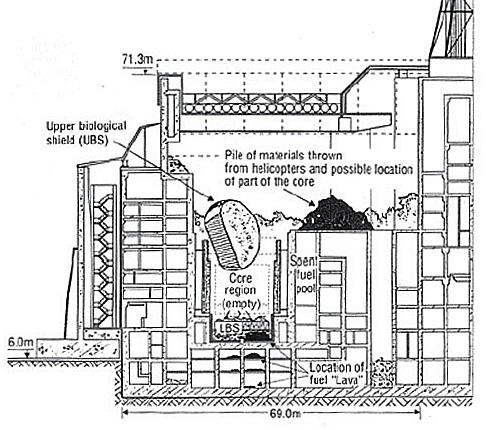
    • While the radioactive cloud was spreading to the surrounding areas, the fuel rods within the reactor had melted through their protective container.
      • This was bad. Very bad. It was basically lava, but SUPER radioactive.
    • The fuel rods melted at 4,091 degrees Fahrenheit (2,255 degrees Celsius) and remained above 3,022 degrees Fahrenheit (1,660 degrees Celsius) for over 4 days.
      • It was basically super hot lava. Most super-heated red and yellow lava that we see on the surface of the planet like in Hawaii is around 2,000 degrees Fahrenheit (1,093 degrees Celsius).
    • The melted fuel rods melted at such a high tempurature that they became a material known as corium.
  • Corium
    • Corium, also called fuel-containing material (FCM) or lava-like fuel-containing material (LFCM), is a material that is created in the core of a nuclear reactor during a meltdown accident. It resembles natural lava in its consistency.
    • It consists of a mixture of nuclear fuelfission productscontrol rods, structural materials from the affected parts of the reactor, products of their chemical reaction with air, water, and steam, and, in the event that the reactor vessel is breached, molten concrete from the floor of the reactor room.
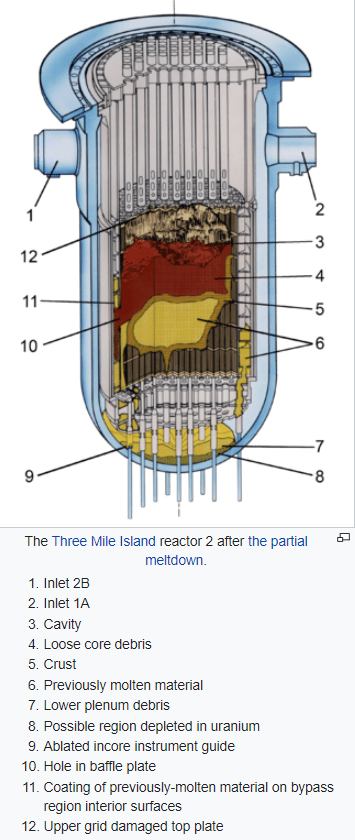
    • Corium has been created outside of a lab (or unintentionally) 5 times. Once at 3-mile-island in 1979, once at Chernobyl, and 3 times in the Fukishima Diiashi meltdown of 2011. The reason why the Elephant’s Foot is so special is because it is so large, and because it is the only instance where the corium ate through the reactor core and “escaped” to the environment.
  • So by this point in the Chernobyl accidentthere was the largest deposit of corium known to man oozing across the concrete floor of the reactor. It was eating everything in its path, including the concrete floor itself.
    • During the Chernobyl disaster rescue and containment crews were busy with trying to clean up the mess above ground to worry about any corium deposits so the Elephant’s foot was free to grow and spread for months before nuclear reactor inspectors.
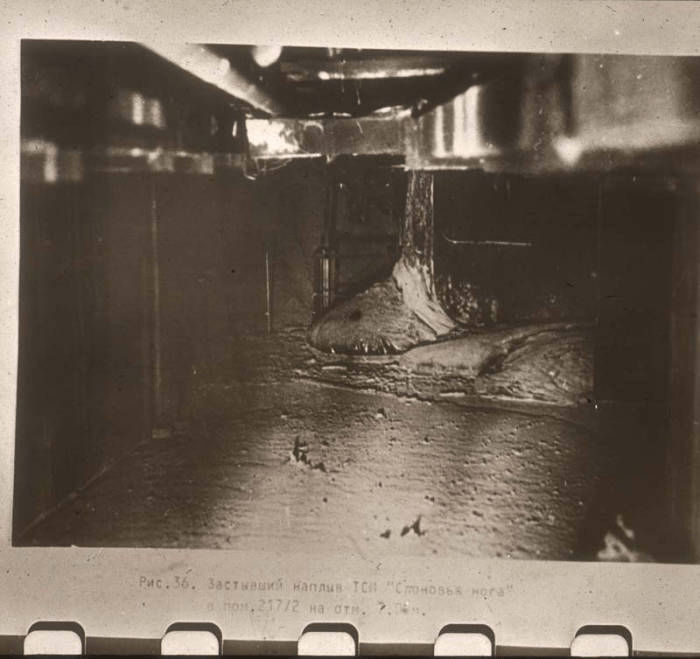
    • By the time it was discovered the Elephant’s Foot had grown so large in unit 4 that it had eaten through the concrete floor and fallen to a lower level. When the inspectors first laid eyes on the blob it had grown to a staggering 11 tons of deadly mass. It was nearly 10 feet (3 meters) in width.
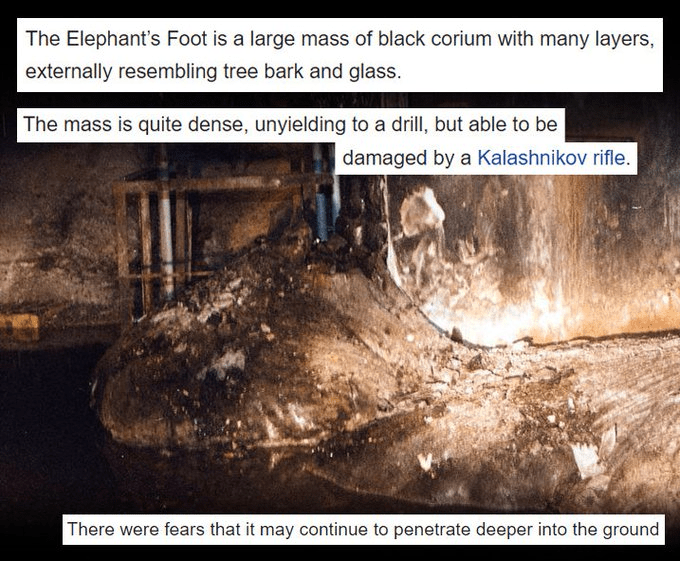
      • Wikipedia says: It is one small part of a much larger mass that lies beneath Reactor No. 4 of the Chernobyl Nuclear Power Plant. The Elephant’s Foot is located in Room 217/2, several dozen feet to the southeast of the ruined reactor and six meters above ground level. The material making up the Elephant’s Foot had burned through at least 2 m (6.6 ft) of reinforced concrete, then flowed through pipes and fissures and down a hallway to reach its current location.
      • The mass was quite dense and unyielding to a drill mounted on a remote-controlled trolley, but able to be damaged by a Kalashnikov rifle (AK-47) using armor piercing rounds. By June 1998, the outer layers had started turning to dust and the mass had started to crack. As of 2021, the mass has been described as having a consistency similar to sand
      • LOL I love how Russian that is… they couldn’t peirce it with a drill so they shot armor peircing rounds out of an AK47!
  • They named it the Elephant’s Foot because of the size and its outward appearance was gray and like tree bark, much like the skin of an elephant.
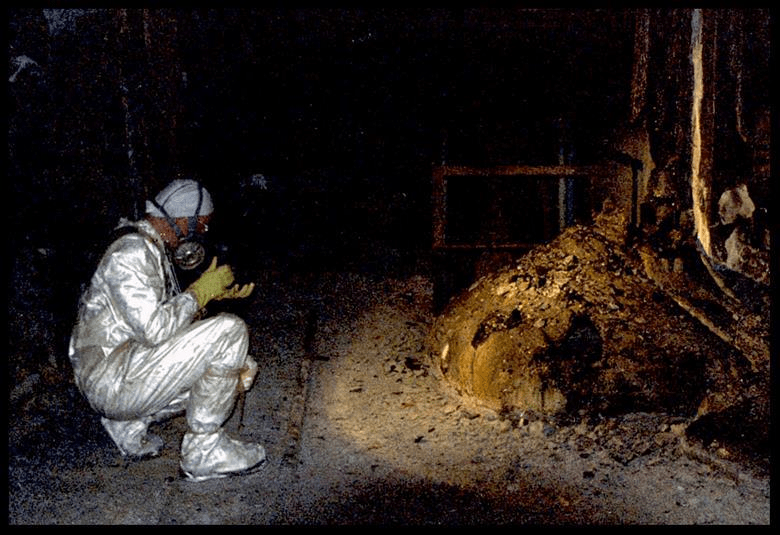
    • At the time of its discovery, about eight months after formation, radioactivity near the Elephant’s Foot was approximately 8,000 roentgens, or 80 grays per hour, delivering a 50/50 lethal dose of radiation (4.5 grays) within five minutes. Since that time the radiation intensity has declined enough that, in 1996, the Elephant’s Foot was visited by the Deputy Director of the New Confinement Project, Artur Korneyev, who took photographs using an automatic camera and a flashlight to illuminate the otherwise dark room.
    • Regardless of how much Wikipedia says the radiation has disipated since 1986, there is still a big Mr. Yuck sticker stapped on the side. That’s because the Elephant’s Foot is still very deadly.
  • Now this massive 11 ton blob of extra deadly lava is already mysterious because it is inherently off limits.
    • We want what we can’t have and this thing is so much in the “can’t have” category that people crave more information about it, even though it is just a big blob of rock in a basement.
    • If someone aske me if I wanted to go see a big blob rock in a basement I would probably say no. Exception being if I was a teenager because back then I didn’t care what I was doing as long as I was doing it with some friends.
      • But if you told me the blob was deadly I would become more interested.
    • But its connection to one of the biggest events of the 20th century and deadliness aren’t the only things contributing to the Elephant’s Foot popularity.
  • Back in 2013 a journalist was working on a piece about the Elephant’s Foot for a magazine. In an old archive of photographs from the Chernobyl accident he found the image that I used for this episode’s cover. It is very creepy.
    • The photo shows a man in a full-body cleaning suit and hard hat hunching over the Elephant’s Foot. But the man in the photo doesn’t look normal. His body is translucent like some sort of ghost and there seems to be a copy of himself standing directly behind him. There are also bright orange streaks of what appears to be lightning in the photo. It isn’t just creepy, it is haunting. Especially when you realize how deadly it is to be in this room.
    • It is peculiar that this photo emerged in 2013, so long after the Chernobyl accident. It is particularly mysterious when you consider the layers of secrecy that Russian and its allies placed upon the Chernobyl accident.
    • At first people thought the photo was taken soon after the Chernobyl accident and that surely the man in the photo and the photographer had died of radiation poisoning.
    • But then it was discovered by another journalist that the photo had a caption “Artur Korneev, Deputy Director of Shelter Object, viewing the ‘elephants foot’ lava flow, Chornobyl NPP. Photographer: Unknown. Fall 1996.”
    • Who is Artur Korneyev?
An article in the New York Times covered Artur’s story
Chernobyl: Capping a Catastrophe
By HENRY FOUNTAIN. Photographs by WILLIAM DANIELS
  • An article in the New York Times covered Artur’s story
    • The title: Chernobyl: Capping a Catastrophe
      • By HENRY FOUNTAIN. Photographs by WILLIAM DANIELS
    • Artur was about 40 years old in the photograph. He was a radiation specialist from Kazakhstan. He is an expert on the Chernobyl accident, especially the waste that was left like the Elephant’s Foot.
    • A lot of people were tasked with cleaning up the Chernobyl accident. It was Artur’s job to go in first, find the fuel that was left over, and document the level of radiation it was still giving off.
      • His safety was NOT garaunteed, so that those who followed after him might have a more safe working environment.
    • Artur went where the corium went. Through air ducts, drainage pipes, melted concrete floors, and so on. He said the corium looked as if it was water gushing from a flood, but stopped in time. Whenever he and his team encountered the much more radioactive solid fuel, it was there job to move it away, either with shovels or by kicking it with their boots.
      • Artur visited the Elephant’s foot many times. He is most likely the person to have seen the most in person.
      • It is believed that the famous photo that shows Artur Korneyev standing with the Elephant’s Foot was taken by a drone of some sort, and not a human photographer.
    • In 1995, Artur was one of the people to tell other countries in the west that the underground area under Unit 4 (or the sarcophagus as they called it) was not in safe. Because of his reports a group of 7 countries agreed to pay to have Unit 4 made as safe as possible. By 1995, Ukraine was an independent country and had decided to close the remaining reactors that were still operating. The last reactor was shut down in the year 2000.
    • The New York Times took a picture of Artur in his home back in 2014 at the age of 65. He has cataracts and other health issues that some beleive were brought on, not just by age, but his career of engaging with high levels of radiation.
      • I tried to see if he was still alive, but the best I found was an article from 2016 that wrote “he is probably still alive.” Just goes to show how little us westerners get to hear about Russia and the Eastern Block area lol.
    • Although Artur lived (or is still living) to an old age, experts say that being near the Elephant’s Foot for mere minutes could give someone radiation sickness, an hour would most likely be lethal.
    • While there have been many successful efforts above ground to contain the radiation at Chernobyl such as creating the sarcophagus and the giant concrete dome that was created just as recently as 2015, the Elephant’s Foot poses a threat in the opposite direction.
    • The fear is that the Elephant’s Foot could continue to eat through the concrete and sand beneath it and contaminate drinking water. This would be bad news for the population surrounding Chernobyl and all those within the same watershed.
    • However, this is an 11 ton blob of cooled radiation lava. It is sealed by the concrete sarcophagus and nestled within the labrynth of Unit 4’s concrete basement, each room, vent, and pipe also containing dangerous corium material. It ain’t going nowhere.
    • It will just sit there, potentially forever.

THANKS FOR LISTENING WHO’D A THUNKERS!

Tune in next week.

CREDIT

3:10

Categories
Uncategorized

Michael C Rockefeller

The content below is from Episode 104 of the Who’d a Thunk It? Podcast

RECOMMENDATION SEGMENT

  • Shannon recorded the recommendation segment this week. Tune in to the audio podcast to hear what recommends you check out.

NOW FOR THE MAIN EVENT

  • Micheal Clark Rockefeller was the youngest of 5 children raised by Mary Todhunter Rockefeller and Nelson Rockefeller.
    • He was born on May 18th of 1938.
    • Mike’s father Nelson was a New York Governor and former U.S. Vice President.
    • He was the grandson of American financer John D. Rockefeller Jr. and the great grandson of Standard Oil co-founder John D. Rockefeller
    • Basically Mike was American Royalty.
      • His story is one of those bios I read and can’t help but self reflect by saying to myself: “look at all the amazing crap this dude in his life by the age of like 25… what am I doing?”
      • But then I realize I wasn’t born in to one of the top 10 most wealthiest familes to have ever existed. Also, I realize I’m a happy person and that’s what matters most to me. … MOVING ON! lol
    • After attending The Buckley School in New York, and graduating from the Phillips Exeter Academy in New Hampshire, where he was a student senator and exceptional varsity wrestler, Rockefeller graduated cum laude from Harvard University with a A.B. in history and economics.
    • Though his father expected him to follow in his footsteps and help manage the family’s vast business empire, Michael was a quieter, more artistic spirit. When he graduated from Harvard in 1960, he wanted to do something more exciting than sit around in boardrooms and conduct meetings.
  • In 1960, he served for six months as a private in the U.S. Army and then went on an expedition for Harvard’s Peabody Museum of Archaeology and Ethnology to study the Dani tribe of western Netherlands New Guinea.
    • It was then known as western Netherlands or Dutch New Guinea. It is a massive island off the coast of Australia.
      • Today, New Guinea (the worlds 2nd largest island) doesn’t all fly the same flag.
      • New Guinea is administratively divided into two parts: its western half comprises the Indonesian provinces of Papua and West Papua (collectively, formerly called Irian Jaya); and its eastern half comprises the major part of Papua New Guinea, an independent country since 1975.
      • It is an island of immense cultural and biological diversity, it’s known for its beaches and coral reefs. Inland are active volcanoes, granite Mt. Wilhelm, dense rainforest and hiking routes like the Kokoda Trail. There are also traditional tribal villages, many with their own languages
  • Michael Rockefeller’s expedition filmed Dead Birds, an ethnographic documentary movie produced by Robert Gardner, and for which Rockefeller was the sound recordist.
    • “Michael said he wanted to do something that hadn’t been done before and to bring a major collection to New York” said Karl Heider, a graduate student of anthropology at Harvard who worked with Michael. By collection he was referring to a art or “primitive art” as they called it at the time.
    • Michael’s father Nelson Rockefeller was a prolific art collector. He had recently opened the Museum of Primitive Art, and its exhibits, including Nigerian, Aztec, and Mayan works. And this seemed to captivate young Michael.
  • Rockefeller and a friend briefly left the expedition to study the Asmat tribe of southern Netherlands New Guinea. After returning home from the Peabody expedition, Rockefeller returned to New Guinea to study the Asmat and collect Asmat art.
  • Michael’s upbringing had already given him ample experience with travel.
    • He had traveled extensively already, living in Japan and Venezuela for months at a time, and he craved something new: he wanted to embark on an anthropological expedition to a place few would ever see.
  • By the 1960s, Dutch colonial authorities and missionaries had already been on the island for almost a decade, but many Asmat people had never seen a white man.With severely limited contact with the outside world, the Asmat believed the land beyond their island to be inhabited by spirits, and when white people came from across the sea, they saw them as some kind of supernatural beings.
    • When Mike Rockefeller and the other white people with him wondered in to their territory they were an unwelcomed curiosity.
    • The locals put up with the team’s photography, but they didn’t allow the white researchers to purchase cultural artifacts, like bisj poles, intricately carved wooden pillars that serve as part of Asmat rituals and religious rites.
    • Michael was undeterred. In the Asmat people, he found what he felt was a fascinating violation of the norms of Western society — and he was more anxious than ever to bring their world back to his.
    • At the time, war between villages was common, and Michael learned that Asmat warriors often took the heads of their enemies and ate their flesh. In certain regions, Asmat men would engage in ritual homosexual sex, and in bonding rites, they would sometimes drink each other’s urine.
    • His journal read: “Now this is wild and somehow more remote country than what I have ever seen before.”
    • When the initial scouting mission concluded, Michael Rockefeller was energized. He wrote out his plans to create a detailed anthropological study of the Asmat and display a collection of their art in his father’s museum.

“It’s the desire to do something adventurous, at a time when frontiers, in the real sense of the word, are disappearing.”

Michael C Rockefeller

He spent his time in Netherlands New Guinea actively engaged with the culture and the art while recording ethnographic data. In one of his letters home he wrote:

“I am having a thoroughly exhausting but most exciting time here … The Asmat is like a huge puzzle with the variations in ceremony and art style forming the pieces. My trips are enabling me to comprehend (if only in a superficial, rudimentary manner) the nature of this puzzle…”

Michael C Rockefeller
  • Although adventure seems to fill those of us who crave it with a imense sense of purpose and thrill, it is also dangerous.
    • In fact, the danger is what makes it so damn fun.
    • While attributes such as experience, grit, strength, and intellect can partially negate the dangers of adventure; even the most battle-hardened adventurers are still mere humans and therefore can fall victim to these dangerous circumstances.
    • Mike was very intelligent, strong, and had all the resources imaginable at his disposal, and yet he did fall victim to the dangers of adventure.
  • On November 17, 1961, Rockefeller and Dutch anthropologist René Wassing were in a 40-foot (12-metre) dugout canoe about 3 nautical miles (6 kilometres; 3 miles) from shore when their double pontoon boat was swamped and overturned. Their two local guides swam for help, but it was slow in coming.
    • After drifting for some time, early on November 19, 1961, Rockefeller said to Wassing: “I think I can make it.” He then swam for shore. The boat was an estimated 12 nmi (22 km; 14 mi) from the shore when he made the attempt to swim to safety, supporting the theory that he died from exposure, exhaustion, or drowning.
    • Wassing was rescued the next day, but Rockefeller was never seen again, despite an intensive and lengthy search effort. At the time, Rockefeller’s disappearance was a major world news item. His body has never been found.
    • Rockefeller was declared legally dead in 1964.
  • Rich and politically connected, Michael’s family ensured that no expense was spared in the search for the young Rockefeller. Ships, airplanes, and helicopters scoured the region, searching for Michael or some sign of his fate. Even his parents flew to New Guinea to help in the search for their son.
    • The Dutch interior minister was quoted saying “There is no longer any hope of finding Michael Rockefeller alive,” just 9 days after he had gone missing.
    • His official cause of death was written down as drowning.
Asmat people today
  • While that is the official story, it is not the end of our story.
    • and could you imagine if it was?
      • Rick boy goes on an adventure and disappears, never to be seen again. The end. Thanks for coming. Good night… no. Now we delve into what most THINK happened to Michael C Rockefeller.
    • In 2014, Carl Hoffman, a reporter for National Geographic, revealed in his book Savage Harvest: A Tale of Cannibals, Colonialism and Michael Rockefeller’s Tragic Quest for Primitive Art that many of the Netherlands’ inquiries into the matter resulted in evidence that the Asmat killed Michael.
    • Apparently there were 2 dutch missionaries that had lived among the Asmat people for years. They spoke their language well and were told by Asmat people that they had killed a white man around that time. Based on the Missionaries’ description, the Asmat people beleived their own had killed Michael Rockefeller.
    • There was also a police officer by the name Wim van de Waal who also was convinced Michael had been killed by the Asmat people. He supposedly was given a skull by the Asmat that they claimed was Michael’s.
    • But the police report was classified and never shown to the Rockefeller family. They were told anything beyond his disapearance was mere rumor.
  • How Michael Rockefeller Died At The Hands Of Cannibals according to Carl Hoffman… over 50 years later.
    • Carl travelled to New Guinea, specifically to Otsjanep.
  • Apparently his guide overheard a couple of locals say something like “don’t talk about the white American that died here,” or something like that.
    • I find this a bit hard to beleive because who talks about something that happened 50 years ago? … but whatever, I wasn’t there.
    • Carl asked his interpreter to pry. The interpreter asked who the man was that the locals were talking about, and he was told it was Michael Rockefeller. He learned that it was common knowledge on the island that the Asmat people of Otsjanep killed a white man, but they shoulnd’t talk about it for fear of revenge or whatever.
  • But Carl and his interpreter also learned more about Michael’s supposed murder.
    • Just 3 years before Michael arrived on in Otsjanep there was war between the Asmat people. The Otsjanep people were having it out with the Omadesep and dozens of men from each side were killed.
    • The Dutch had just recently taken control of the island and wanted to keep their new land as colonizable as possible. So the Ducth colonial government tried to put an end to the violence… (because when foreigners try to put an end to age-old wars it always works out just fine lol).
    • The Dutch tried to disarm the Otsjanep tribe, but it didn’t go well. The two cultures were so different that communications were bound to break down. It ended witht he Dutch open firing on the Otsjanep people.
    • This was one of the Otsjanep people’s first time coming in to contact with white people and western cultures. It was definitely their first time with firearms. And what happened? The village watched as 4 of their jeus (war leaders) were shot and killed.
    • Try to imagine what their impression of white people was at the time. Just 3 years later and a young Michael Rockefeller was swimming ashore right up to these people…
  • Well according to one of those Dutch missionaries, the Otsjanep tribespeople who first saw Michael in the water thought he was a crocodile, but quickly realized he was a Dutch colonizer or a tuan as the locals called them.
    • These first people on the banks to see Michael were jeus themselves, but not just any jeus. They were the sons of the men who were gunned down just 3 years prior. They had a score to settle. “People of Otsjanep, your’ve always talking about headhuting tuans. Well, here is your chance,” cried one of the jeus.
    • At first the villagers were hesitant, probably for the consequences of their actions. But it wasn’t long before their spears were thrust in to the exhausted Michael who had just swam 12 miles.
    • Then it got pretty gruesome. Once he was dead they cut off Michael’s head, cracked open his skull and ate his brain like a coconut. They cooked his body on a spit over a fire and ate his flesh.
    • No part of his body went to waste. His thigh bones were used to make daggers and his tibias were sharpened to make fishing spear points.
    • His blood was drained. The Otsjanep tribesmen bathed in it while they performed ritual dances and sex acts.
      • This all sounds like some sick and evil act. And maybe it is in some objectionabley kind of judgement that we humans don’t have access to.
    • But in the minds of these tribesmen this was the right thing to do. It was their beliefe, their theology. The Otsjanep people believed in a balance of the world and that they should restore this balance. To them: the “white man tribe” had killed 4 of their highest ranking warriors. It was setting the balance of the world back to normal when they took Michael’s power. They consumed his body and absorbed his energy, the very same energy that had been taken from them.
      • Again, this is all according to Carl Hoffman in his book written in 2014 from a translator who was talking to Dutch missionaries.
      • That is quite a long line for this information to pass along (kind of like the telephone game). Also, 50 years is a long time for information to be distorted or fabricated all together. So who knows if this really happened.
      • Though many Asmat people told this story to Hoffman, no one who took part in the death would come forward; all simply said it was a story they had heard.
  • Aftermath
    • Of course the Otsjanep people didn’t just forget about it the next day. They couldn’t because it wasn’t long at all before the search for Michael came to their doorstep.
    • Remember, his mom and dad scoured the area with every ship, plane, and helicopter the Rockefeller fortune could buy. And for the Asmat people this must have seemed like the equivalent of a UFO army landing on the White House lawn. They had never seen these types of vessels before.
    • Not long after, cholera swept through the Otsjanep village and surrounding area. These villagers probably connected this sickness to the murder of the white man.
  • Then, one day when Hoffman was in the village, shortly before he returned to the U.S., he saw a man miming a killing as part of a story he was telling to another man. The tribesman pretended to spear someone, shoot an arrow, and chop off a head. Hearing words relating to murder, Hoffman began to film — but the story was already over.

Hoffman was, however, able to catch its epilogue on film:

“Don’t you tell this story to any other man or any other village, because this story is only for us. Don’t speak. Don’t speak and tell the story. I hope you remember it and you must keep this for us. I hope, I hope, this is for you and you only. Don’t talk to anyone, forever, to other people or another village. If people question you, don’t answer. Don’t talk to them, because this story is only for you. If you tell it to them, you’ll die. I am afraid you will die. You’ll be dead, your people will be dead, if you tell this story. You keep this story in your house, to yourself, I hope, forever. Forever…”

  • Does Carl Hoffman’s story read like complete mullarky? Yes. To me it does. It seems too sensational to be true. However, I wasn’t there. Sometimes sensational and horrible things happen.
  • Should I have saved this episode for Ocotober and make it part of the Who’d a Thunk It? FRIGHTFEST where I post only spooky stories all month? Perhaps, but I couldnt’ help myself. This story surprised me.
    • I couldn’t believe I had never heard it before. Michael C Rockefeller was practically American Royalty and a lot of people believed he was eaten by cannibals?!
  • Anyway, THANKS FOR LISTENING WHO’D A THUNKERS!
    • until next week

CREDIT

Categories
Uncategorized

The Jaws of Life

The content below is from Episode 103 of the Who’d a Thunk It? Podcast

RECOMMENDATION SEGMENT

  • This week I recommend you check out the Hulu original series Pam and Tommy
    • The show is about the real-life story of Pamela Anderson and Tommy Lee’s honeymoon sex tape that was stolen and leaked to the public.
    • I was born in 1993 so I don’t remember much at all about this scandal as it was happening. But I do know it was the first viral video. The tape was spread all over the place and just about everyone around at the time saw it. I also know of Pamela Anderson because I was a teenage boy once and she was on Playboy lol.
    • But what makes this show so interesting is how it shows each person involved as actual people.
    • Pamela Anderson wasn’t just a bimbo as many might have thought.
      • She was a small town canadian girl with dreams of becoming a mom.
    • Tommy Lee wasn’t just a rockstar.
      • While the show did portray him as a straight up asshole to his contractors, they also portrayed him as a loving husband and mournful father.
    • The subject material is obviously full of raunchy comedy stuff, but I think the overall message of the show is to highlight what the internet has done to our society as a whole. Whether for better or worse, the internet has connected us all. It is a great power that can be a great help to people, or it could ruin people’s lives.
      • Pam and Tommy’s sex tape is one of the first examples of that.

NOW FOR THE MAIN EVENT

  • Back in 1958 the Hurst Performance Inc. was founded by Bill Campbell and George Hurst in Warminster Township Pennsylvania. The company manufactured and marketed products for enhancing the performance of automobiles, most notably muscle cars.
    • George Hurst built a thriving business around motor racing, building floor-mounted gear shifts for race cars.
      • By the early 1960s, Hurst transmission shifters and other products had become legendary in auto racing, particularly in drag racing, and among custom car makers. Many automobile enthusiasts replaced flimsy factory shifters (and steering column shifters, as well) with Hurst floor shifters to obtain better control of gear selection, particularly for competitive driving. As automotive historian Mike Mueller noted, “If you didn’t have a Hurst shifter in your supercar, you were a mild-mannered loser.”
    • His company’s hand in enhancing the performance of some of American’s most beloved cars brought George Hurst to Indianapolis Motor Speedway in 1961.
    • While at the races back in 61′ he witnessed a crash and watched as the rescue crews took over an hour just to extract the driver from the wreckage.
    • An idea came to him in that grimm moment: “there has to be a better way.” This idea occurs to many people, but it takes that entrepreneurial spirit to get things done.
  • Hurst got to work. He had to come up a process or tool to make wreckage extraction more efficient.
    • He started by examining the current tools used: circular saws.
      • Besides taking much too long to cut in to the frame of a car, these saws were extremely loud (which distresses those who are trapped), and they create sparks which greatly increase the chance of an explosion (considering car wrecks typically have fuel spilled everywhere).
      • Other attempts to free trapped victims were done with a crowbar or halligan bar, but in doing so, rescue crews often made vehicles unstable. Prying open car doors giant metal bars works, but isn’t a quick job. It takes a lot of time and man power. Plus, all that jostling around shifts the car and could endanger the trapped victim further.
    • So Hurst came up with a different tool: the Hurst Power Tool
      • The first prototype was a patented hydraulic rescue tool that weighed 350 pounds. This of course was far too heavy for rescue crews to weild properly, but it was a start.
  • Within a decade, the Hurst Power Tool was cut down to about 65 pounds, making it MUCH more useful and marketable.
    • In 1971, they took the Hurst Power Tool to the SEMA trade show  for specialty equipment marketers in California. The spotlight propelled their device into stardom, and soon, fire departments were carrying it on their firetrucks.
    • The world of rescue soon realized hydraulic spreader-cutters are quieter, faster, stronger, and more versatile: they can cut, open, and even lift a vehicle.
    • Another little cool detail about the Jaws of Life is about the hydraulic fluid used:
      • Oil is the most commonly used incompressible fluid for hydraulic machines. However, the Jaws of Life equipment uses a phosphate-ester fluid, which is fire resistant and electrically non-conductive. At a crash scene, this type of synthetic fluid is favored over conventional oil.
      • The little details like that are what make this piece of equipment so cool. It was created by a company that developed badass car parts that are known for being dangerous, but their rescue equipment is made for safety. Down to the type of hydraulic fluid used.
    • When an occupant is trapped the tool is used to pry or cut the car to remove the occupant. It takes about two minutes to take the roof off a car. 
    • What used to take an hour, now only took rescue crews about 3 minutes.
      • As the Hurst website notes, “In three minutes, the average person can listen to a song, make their bed or brush their teeth. In three minutes, first responders can save a life with HURST Jaws of Life tools.”
    • Firefighters can elect to carry a combination tool that is the Swiss Army knife of the Jaws of Life, with cutting and spreading functions that increase the speed of extrication. Some departments also carry individual-function Jaws of Life machines that spread, cut, and ram. The StrongArm was adapted to meet the standards of law enforcement and military communities, adding a capable tool to their breaching arsenals. 
      • From what I can tell, it seems 5,000 pounds per square inch is the standard amount of forced used with these tools. I’m sure they can go higher, but that is the standard.
      • For comparison: the strongest bite ever recorded was a saltwater crocodile with 3,700 psi and we humans bite in to a steak with about 150 to 200 psi.
Spreader
Cutter
Ram in action
Ram
  • The Hurst Power Tool adopted the nickname the “Jaws of Life” for its role in snatching victims from the “jaws of death.”
    • Mike Brick (the man Hurst hired to market his invention) coined the phrase “Jaws of Life” after he observed people saying that their new device “snatched people from the jaws of death”, then used as a registered brand name for Hurst products. The name “jaws of life” is, however, used colloquially to describe other hydraulic rescue tools.
    • In the marketing and public relations field, this name is regarded as an amazing idea. The Jaws of Life sounds badass and it represents an invention that is super cool… that also happens to save lives on a regular basis.
    • Jaws of Life is still a trademarked brand name. But could be in danger to losing their rights to the name to genericization of the trademark.
      • A generic trademark, also known as a genericized trademark or proprietary eponym, is a trademark or brand name that, because of its popularity or significance, has become the generic term for, or synonymous with, a general class of products or services, usually against the intentions of the trademark’s owner.
      • Back in episode 12 “Trademark, Patent, or Copyright?” of the Who’d a Thunk It? Podcast I talked more about this.
      • Trademarks such as Band-Aid, Escalator, Laundromat, and Popsicle were once owned by companies as official brand names, but now lost their exclusive rights to the names. Once their product names became common use words that weren’t brand-specific they became entries in the dictionary and not specific names owned by companies.
      • The name “jaws of life” is such a badass name that it is used colloquially to describe other hydraulic rescue tools. This puts the trademark as risk.
    • I know I went on a tangent there, but I studied communication law in college and it fascinates me.
  • Another great Public Relations campaign conducted by Hurst is the Green Cross Award
    • Straight from JawsofLife.com:
      • The Green Cross is the symbol of recognition for those who have used HURST Jaws of Life® products to save lives. It’s our way of celebrating the bravery shown by rescue teams worldwide. Since the program’s inception, we’ve acknowledged tens of thousands of men and women around the globe with this prestigious honor.
  • I have a lot of respect for this company and their Public Relations tactics. It comes off as a nice story:
    • Founder of Hurst built his fortune by making muscle cars more efficient and drive faster. – One day he sees the other side of his industry when he whitnesses a crash. The danger associated with his work shocked him and he felt compelled to do something. So he invents life-saving tool that cuts the time of a rescue (situations where every second counts) down by over 55 minutes. With this invention he completely changes how fire and rescue operations are conducted all over the world.
      • It kind of reads like the Iron Man story. I love it.
      • And it just so happens his invention (along with having one of the coolest names for any piece of equipment ever) also looks like a badass piece of equipment. Similar to how little boys look upon modern constructions equipment like dump trucks and backhoes with admiration, I found myself googling what it would cost to buy my very own Jaws of Life… it is like $13,000 LMAO
  • The Hurst Performance company was bought out in 1970 by Sunbeam Products.
    • George Hurst was promised an executive position and seat on the board of directors as part of the buyout, but Sunbeam did not follow through. (According to one variation of this account, Sunbeam specifically informed Mr. Hurst that he would no longer be affiliated with the company.)
    • In 1987, the Hurst operations were sold by Sunbeam and became part of the Mr. Gasket Company. In 2007, B&M Racing and Performance Products bought the Hurst brand.
  • George Hurst died in 1986 at the age of 59. His invention, without a doubt, is one of the most instrumental tools used to save lives of the 20th century and it is still in use today all across the world.

CREDIT:

Categories
Uncategorized

The Michelin Star Story

The content below is from Episode 102 of the Who’d a Thunk It? Podcast

RECOMMENDATION SEGMENT

  • This week’s recommendation is a movie: Midnight in Paris.
    • This hollywood film takes a page out of the European film playbook. I felt like I was watching a French film with hollywood actors and budget.
    • Owen Wilson plays a writer who is in love with the past and the city of Paris. While on vacation with his unloving wife and his dreaded in-laws he gets a little wine drunk. Stumbling through the streets of Paris at night he is transported to 1920’s Paris where he meets all of his writer and artist idols.

NOW FOR THE MAIN EVENT

  • This week’s episode is about the Michelin Star rating system for restaurants and why the most prestigous rating system for food is operated by a tire company.
  • First, what is a Michelin Star?
    • Well Michelin employs people they call inspectors to critique food in restaurants all across the world. If they are sufficiently impressed they award stars known as Michelin Stars to the restaurant. They either award 1 star, 2 stars, 3 stars, or no stars.
    • Restaurants that receive a Michelin Star for the first time can expect a flood of food tourists while losing a Michelin Star devastates chefs. Gordon Ramsay, the celebrity chef who makes young chefs weep on his show Hell’s Kitchen, cried when he lost two Michelin Stars in 2013. 
    • And this is all a bit odd, because Michelin is a tire company whose annual reports highlight the cost of rubber and growth in the passenger car market. 
    • While there is a 3 star system with 3 stars being better than 2 and 2 stars better than 1, it is incredible to get just 1 star. Only the tippy top restaurants in the world qualify for any stars at all.
      • Getting 1 star is like a life-time goal for most chefs.
    • Here is the super subjective qualifying criteria:
      • To earn one Michelin star, a restaurant needs to be “a very good restaurant in this category”.
      • For two stars, it needs to be “excellent cooking, worth a detour”.
      • For three stars, a restaurant must serve “exceptional cuisine, worth a special journey.” 

THE GIST

  • This all started in 1895 when there less than 1,000 cars driving around Franch. Those few cars were rarely driven because maintenance for a car was very inconvenient and expensive. Like fine dining, driving a car was a luxury.
    • This was an issue for the Michelin brothers Edouard and Andre. They had just developed a new kind of tire, one that was air-filled and easy to replace as opposed to the standard tire of the time which needed to be glued on (if you can believe it). The Michelin brothers wanted to drive up the number of cars and the amount of miles being driven. More cars and more miles meant tires needed to be replaced more often.
    • In order to get more cars on the road and sell more tires they had a 400 page guide printed up. This guide was full of helpful and fun information for those who liked to tour France. It highlighted towns and cities that were accessible by car and also included where people could get their vehicles serviced or fill up with gas.
      • Service and gas stations were few and far between. Only certain pharmacies has gasoline at the time.
      • Most relevant to our topic, the guide included restaurants and hotels that Michelin thought were worth visiting.
    • The response from the public was that the guide was a smash hit. The loved it. The more restaurants they rated, the further people drove to check them out and the sooner their tires needed replacing.
      • It is considered one of the best Public Relations tactics to date.
    • The Red Guide book started to come out in the early 1900’s. The goal was to give the public a reason to drive more and it worked.
      • Two brothers who designed and made tires created a cultural boom for their country’s tourism.

“From an image standpoint, it certainly has helped as a halo for a tire brand. Because tires, of course, aren’t the sexiest product,” Tony Fouladpour, Michelin North America’s director of corporate public relations, told Business Insider.

From the Facebook account History Cool Kids:

The original Michelin Man from 1894.⁣

The Michelin Man is white because rubber tires are naturally white. It was not until 1912, that carbon chemicals were mixed into the white tires, which turned them black. The change was structural, not aesthetic. By adding carbon, tires became more durable.⁣

The star system that Michelin uses goes up to three and is broken down by whether or not it’s worth driving to the restaurant.

One star: “A very good restaurant in its category” (Une très bonne table dans sa catégorie)⁣

Two star: “Excellent cooking, worth a detour” (Table excellente, mérite un détour)⁣

Three star: “Exceptional cuisine, worth a special journey” (Une des meilleures tables, vaut le voyage).⁣

  • As the tire company grew, so did their guide. They launched country-specific editions throughout Europe that became popular enough to compel the brothers to start charging for the booklets in 1920.
    • In 1926, the guide expanded to the industry that made it famous — fine dining. Five years later, the three-star system was introduced.
    • As of September of 2021, there were 2,817 Michelin stars spread out across the entire globe according to Luxe.Digital
  • Today, Michelin continues to authoritatively judge restaurants in order to promote the company name. It’s a bit like if the Coca-Cola Company ran the Oscars, having created the ceremony in the 1920s so that people would go to the movies and drink more soda. It’s debatable whether the guide still helps Michelin sell tires, but Michelin’s ownership has been instrumental to the renown and authority of its restaurant guides. 

HOW they InSPECT:

  • I don’t know about you, but to me it sounds like one hell of a job to travel around trying delicious food anonymously and writing about it in the most respected food critic guide in the world.
    • But apparently it isn’t all it is cracked up to be. Some Frenchy apparently said it is a sucky job… but compared to what? Working in an office all day? … I have my doubts.
  • But here is how the inspector job works:
    • Each region of the world is assigned an inspector who takes responsibility for finding the most pleasurable places to dine in their region.
    • Like I said, these inspectors are anonymous. They are forbidden to speak with the press or any major outlets outside of their families.
    • They all have a ton of experience in the restaurant business or culinary field. Most are retired chefs actually. And every one of them has to pass an official Michelin Guide training course only held in France.
  • These days the inspectors have the luxury of checking their phones for the hottest spots around, but back when the guide started it was much more adventurous… and tedious lol.
    • Inspectors only found restaurants by driving all the back streets of France or getting a tip via word-of-mouth about a nice restaurant.
  • Now these undercover Michelin inspectors are a bit different from your typical food critics.
    • They don’t take notes. They simply soak up the experience. Also, they don’t just visit once before passing judgement. They visit a restaurant multiple times to get a good sense of the place.
  • Some say this gig isn’t all that it is cracked up to be. Pascal Rémy, a former French inspector for Michelin, released a book called “L’Inspecteur se Met à Table” (“The Inspector Sits at the Table”) back in 2004.
    • In this book Rémy says how the job is terribly lonely. On top of that he says inspectors don’t get paid nearly what they are owed and the standards of the Michelin star system have loosened up in recent decades. They have become lax.
    • In response, Michelin has denied most allegations made in the book, but do admit the job of a Michelin inspector isn’t as magnificent at one might imagine.

The BRAND

The Michelin Guide represents a minute fraction of a massive company and rather than being profitable, it is mostly a brand-building tool and a way to build on a tradition rooted in the company’s founders.

Michelin is aware that even though the guide is gaining recognition in the US, many do not make the connection between it and the tire company.

  • I personally had never even heard of the Michelin star rating system until I saw a movie about French cooking on Netflix just a year or two ago. It wasn’t until looking in to this podcast that I realized it was run by the same tire company.
    • When I first heard about the rating system I thought “Michelin? like the tire company? Nah, couldn’t be. That would be absurd.”
    • But it turns out they are one in the same.
  • The Michelin Star rating system that the world’s top chefs dream of was first created to get people to drive more so that more tires could be sold.
    • Now it has been wrapped in so much prestigue and elitism that it doesn’t matter that it doesn’t help sell tires anymore. The star rating has become it’s own thing now.

“We can’t spend millions on a campaign telling people, ‘Hey, we’re the same company!'” Tony Fouladpour says, laughing. “But it’s nice when people make the connection. It’s only been 10 years [in America]. Let’s see what happens after 10 more.”

THANKS for listening (and reading) Who’d a Thunkers! Tune in next week.

CREDIT:

Categories
Uncategorized

Beer

The content below is from Episode 101 of the Who’d a Thunk It? Podcast

RECOMMENDATION SEGMENT

  • This week I recommend you check out the HBO Max series Peacemaker.
    • From creator James Gunn, Peacemaker is weird, fun, and explicit… just like all of James Gunn’s work.
      • It follows the story of a comic book character known as Peacemaker
      • Peacemaker is the name of a series of fictional characters originally owned by Charlton Comics and later acquired by DC Comics. The original Peacemaker first appeared in Fightin’ 5 #40 and was created by writer Joe Gill and artist Pat Boyette back in 1966.
    • Is Peacemaker a hero or villain? Hard to say what the world would call him, but he calls himself a hero.
    • James Gunn’s version of Peacemaker is played by John Cena.
      • Cena does a wonderful job portraying this damaged psychopath as he tries to safe the world from the alien race known as Butterflies.
      • He likes 1980s rock ballads, his best friend Eagley (who is an intelligent bald eagle), and creating peace at any cost.
    • Also, this show has one of the best intro sequences I have ever seen.
      • At first I thought it was weird and corny (and it is), but then it grew on me. Watch the intro for yourself:

NOW FOR THE MAIN EVENT

  • I love beer. Probably too much.
    • But I ain’t the only one: Around the world, humans consume over 50 billion gallons of beer every year and it is the most widley consumed alcoholic drink on the plant.
    • So for this episode I wanted to go in to the history of beer and how it shaped our world today.
    • There a few questions I have always had surrounding beer and I thought I would share the answers I found here!
Jacob Jordaens – The Feast of the Bean King
  • First let us start with the History of Beer
    • Beer is old, very old. People have been making and drinking beer for so long that dating the origin of beer is rounded to the nearest thousand-year mark.
      • The first beer in the world was thought to be brewed by the ancient Chinese around the year 7000 BCE (known as kui). In the west, however, the process now recognized as beer brewing began in Mesopotamia at the Godin Tepe settlement now in modern-day Iran between 3500 – 3100 BCE.
      • But sources differ on this. Martin Zarnkow, a brewing historian in the Center of Life and Food Sciences at the Munich Technical University said “(ancient) Sumerians didn’t discover beer, nor did the Egyptians, as some people believe. Theories point to beer being produced in the Neolithic Revolution more than 11,000 years ago.”
      • What I take away from all these different sources giving different dates is that beer has been around for so long that we aren’t exactly sure how old it is.
      • As almost any cereal containing certain sugars can undergo spontaneous fermentation due to wild yeasts in the air, it is possible that beer-like drinks were independently developed throughout the world soon after a tribe or culture had domesticated cereal. Chemical tests of ancient pottery jars reveal that beer was produced as far back as about 7,000 years ago in what is today Iran. This discovery reveals one of the earliest known uses of fermentation and is the earliest evidence of brewing to date.
    • What we know is what it would take to create beer, and that does give us some clues.
      • Beer is made with grain. So it stands to reason a civilization would need more grain than what was needed to feed their population.
        • Because if you are starving, you will probably eat the grain before brewing up a 6 pack.
      • In addition to grain you also need a water source and storage so the brew can sit. This storage space and time allows the brew to go through the fermentation process.
        • Fermentation being yeast eating sugars to create alcohol.
      • So for the first people to make beer they needed a lot of grain, probably in the form of a farmed feild.
      • The first beer makers were almost certainly not nomadic in nature because it isn’t easy to haul big jugs of water and beer around as you wait for it to ferment.
      • Some historians theorized that beer was a big part of why humans started to give up their nomadic ways and start to settle in specific places. But the same argument can be made that argriculture as a whole was the reason.
        • Still is a fun thought that beer was the thing that tamed humanity from roaming all over.
      • So even though historians can’t agree on when beer brewing started, it is a safe bet that it didn’t start before agricutlure.
  • Beer even infiltrated ancient mythologies
    • Back in 1800BC, a poem was written down on a clay tablet that gave instructions on how to brew beer. It is known as the Hymn to Ninkasi.
    • Ninkasi is the tutelary goddess of beer in ancient Sumerian religious mythology.
    • The Hymn to Ninkasi is at once a song of praise to Ninkasi, the Sumerian goddess of beer, and an ancient recipe for brewing. Written down around 1800 BCE, the hymn is no doubt much older as evidenced by the techniques it details which scholars have determined were actually in use long before the hymn was written.
    • The Hymn to Ninkasi is the oldest record of a direct correlation between the importance of brewing, and the responsibility that women had with regard to supplying both bread and beer to the household. Ninkasi is female, and the fact that a female deity was invoked in prayer with regards to the production of brewed beverages illustrated the relationship between brewing and women as a domestic right and duty.
    • The repetitive nature of the poem suggests that it was used as a tool in order to pass down information from generation to generation as a way of learning.
  • In the Christian religion there is Saint Brigid of Kildare or Brigid of Ireland
    • Saint Brigid of Kildare or Brigid of Ireland ( 451 – 525) is the patroness saint (or ‘mother saint’) of Ireland, and one of its three national saints along with Patrick and Columba. According to medieval Irish hagiographies (which are biographies of saints), she was an abbess (or head nun) who founded several convents of nuns, most notably that of Kildare, which was one of the most important in Ireland.
    • There are few historical facts about her, and early hagiographies are mainly anecdotes and miracle tales, some of which are rooted in pagan folklore.
      • St. Brigid is one of the appropriated saints meaning the Christians made her a saint to appeal to the local’s religious beliefs in hope that they would convert to Christianity.
    •  Saint Brigid shares her name with a Celtic goddess. She is patroness of many things, including poetry, learning, healing, protection, blacksmithing, livestock and dairy production… and of course beer. 
      • Brigid pre-dates Christianity and is said to have created an entire lake of beer in order to help a leper colony.
  • Here is St. Brigid and/or Celtic Goddess Brigid’s prayer about beer in heaven:

I would like a great lake of beer for the King of Kings.

I would like to be watching Heaven’s family drinking it through all eternity.

I’d like to give a lake of beer to God.

I’d love the Heavenly Host to be tippling there For all eternity.

I’d love the men of Heaven to live with me, To dance and sing.

If they wanted, I’d put at their disposal Vats of suffering.

White cups of love I’d give them, With a heart and a half; Sweet pitchers of mercy I’d offer To every man.

I’d make Heaven a cheerful spot, Because the happy heart is true.

I’d make the men contented for their own sake I’d like Jesus to love me too.

I’d like the people of heaven to gather From all the parishes around, I’d give a special welcome to the women, The three Marys of great renown.

I’d sit with the men, the women of God There by the lake of beer We’d be drinking good health forever And every drop would be a prayer.

  • There is a theory that whenever the Bible is talking about wine, it was most likely beer.
    • The area in which the Bible takes place in an area of the world that wasn’t very condusive to growing red wine grapes. Instead, Jeruselem and other parts of the middle east would have had much more grain and honey at their disposal than grapes.
    • The reason why the modern version of the bible assumes it was wine is because the scholars that interpretted it were from Italy and France where the common alcoholic drink is wine.
    • But in reality, it is MUCH more likely the alcohol that the characters of the bible were drinking was Beer, Mead, or some combination of the two.
  • Speaking of Christianity and Beer, where did the association of monks and beer come from?
    • The short answer is charity. Before the industrial revolution, beer wasn’t just a party beverage, it was a food source.
    • Monastaries would brew beer as a liquid alternative to bread and provide it to the poor and starving.
    • Before the discovery of yeast and how it played a major role in the creation of alcohol, it was thought that alcohol only came to be due to a divine blessing.
  • America’s History of Beer
    • Prior to Prohibition, there were thousands of breweries in the United States, mostly brewing heavier beers than modern US beer drinkers are used to.
    • Beginning in 1920, most of these breweries went out of business from prohibition and the depression, although some converted to soft drinks and other businesses.
    • Bootlegged beer was often watered down to increase profits, beginning a trend, still on-going today, of the American markets heavily advertising the weaker beers and keeping them popular.
      • I find that fascinating. Because of the stock market crash and the outlawing of alcohol in America, beer started to be sold illegally and unregulated. Because it wasn’t regulated, distributors began watering down their brews to maximize profits. That is when the American public got a taste for really light beers and that is why we still love them today.
        • THIS IS WHY I FIND HISTORY TO BE SO AMAZING
        • It is like connecting the dots and seeing the entire picture.
    • Consolidation of breweries and the application of industrial quality control standards have led to the mass-production and the mass-marketing of huge quantities of light lagers. Advertising became supreme, and bigger companies fared better in that market.
    • The decades after World War II saw a huge consolidation of the American brewing industry: brewing companies would buy their rivals solely for their customers and distribution systems, shutting down their brewing operations.
    • In the last 150 years there as been a trend in the American Brewery scene:
      • Despite the record increases in production between 1870 and 1895, the number of firms fell by 46%. Average brewery output rose significantly, driven partly by a rapid increase in output by the largest breweries.
      • As late as 1877, only four breweries topped 100,000 barrels annually. By 1895, the largest sixteen firms had greatly increased their productive capacity and were all brewing over 250,000 barrels annually; and imports have become more abundant since the mid-1980s. The number of breweries has been claimed as being either over 1,500 in 2007 or over 1,400 in 2010, depending on the source. As of June 2013, The Brewers Association reports the total number of currently operating US breweries to be 2,538, with only 55 of those being non-craft breweries.
https://eh.net/encyclopedia/a-concise-history-of-americas-brewing-industry/
  • I’ve always wondered about the different kinds of beers
  • Lager
    • Lagers are a typical entry point into beer for new drinkers. Made with bottom fermenting yeast that has a lower tolerance to alcohol, lagers can taste light and a little malty. Classic lagers in America include Miller High Life, Coors, Budweiser and Yuengling. Lagers are a great launching pad for newcomers to beer.
      • Yuengling is America’s oldest brewery. One of their sayings is “We aren’t the best because we are the oldest. We are the oldest because we are the best.” The Yuengling Company started in 1829 in Pottsville Pennsylvania. They are legendary here in my home state. We Pennsylvanians are mighty proud of Yuenglings.
  • IPA
    • India Pale Ales (IPAs), which encompass numerous styles of beer, get their characteristics largely from hops and herbal, citrus or fruity flavors. They can be bitter and contain high alcohol levels, though the final product depends on the variety of hops used. Some IPAs can taste like pure citrus, while others are strong and bitter. Prominent IPA styles include West Coast IPA, British IPA and New England Style IPA.
    • Fun little origin story behind the name of an Indian Pale Ale: The IPA was invented in Britain. Here’s the abridged version: British sailors, while sailing to India, loaded up barrels of beer with hops, because hops were a preservative. The hops hung around in the beer for so long that they lost their fruity flavor and left a bitter tasting beer. 
  • Pale Ale
    • Pale ales are usually hoppy but carry a lower alcohol content than IPAs. Most types of pale ale, which can include American amber ale, American pale ale, blonde ale and English pale ale, are malty, medium-bodied and easy to drink.
  • Pilsner
    • Pilsner is a type of pale lager. It takes its name from the Bohemian city of Plzeň, where it was first produced in 1842 by Bavarian brewer Josef Groll. The world’s first pale lager, the original Pilsner Urquell, is still produced there today
  • Stout
    • A dark beer, the flavor of stouts depend on where they come from. Sweet stouts largely originate from Ireland and England and are known for their low bitterness. In fact, Ireland’s Guinness brand produces some of the world’s most recognizable stout beer.
    • According to the Beer Judge Certification Program (BJCP), which ranks and evaluates all styles of beer, stouts are a “sweet, full-bodied, slightly roasty ale that can suggest coffee-and-cream, or sweetened espresso.” While the darker color of the beer gives the impression it’s tough to drink, these stouts carry sweetness from unfermented sugars that offset any bitterness.
    • Stouts produced in the U.S. combine the typical dark body and creamy notes with the hoppy bitter flavors characterized by American beers. American stouts are strong, highly roasted, bitter and hoppy, with high malt flavors that give them the taste of coffee or dark chocolate, according to the BJCP.
  • Porters
    • Porter is a style of beer that was developed in London, England, in the early 18th century. It was well-hopped and dark in appearance owing to the use of brown malt. The name originated from its popularity with street and river porters.
    • Porter is actually the great-grandpa of today’s stout. It was, and still is, made with dark malted barley, a good amount of hops, and top-fermenting ale yeasts. The end result is usually a dark medium-bodied beer with a nice balance of malty sweetness and bitter hoppiness.
    • According to the Beer Judge Certification Program a Stout is defined as “a very dark, roasty, bitter, creamy ale,” while a Porter is described as “a substantial, malty dark ale with a complex and flavourful character.” … Basically a Stout has roasted malts and associated flavours, whereas a Porter does not.”
  • Belgian Beer
    • Belgium’s rich beer culture has poured into the U.S. over the years, giving enthusiasts on this side of the Atlantic a deep appreciation for the wide variety of Belgian-style flavors. Belgian beers span pale ales, dark ales, fruity beers and sour ales. WebstaruantStore, which provides equipment and information for restaurants, bars and other establishments, generally defines Belgian-style beers as carrying fruity, spicy and sweet flavors with a high alcohol content and low bitterness.
  • Wheat Beers
    • Then we have wheat beers which are typically disgusting and are the only type of beer I really don’t care for lol
    • Wheat beers rely on wheat for the malt ingredient, which gives the beverage a light color and alcohol level that makes it perfect for kicking back with during the summer and for combining it with fruit, like a slice of lemon or orange. Some wheat beers, with their funky and tangy flavors, fall under Belgian-style brews while the ones made in the U.S. have a light flavor that recalls bread.
  • Sour Beer
    • Sour beer has shot up in popularity in the U.S. over the last few years, becoming an enticing beverage to people looking to branch out their beer palates or to those wanting to try something new. Highly tart, sour beers can take on many forms, including Belgian-style Lambic beer, fruity Flanders ale and lemony Berliner Weisse beer. With the addition of fruits like cherry, raspberry or peach, sour beers marry sweet and sour to make beer flavors completely unlike the lagers and IPAs of yore.

CREDIT:

Categories
Uncategorized

Khutulun: Warrior Princess of the Moon

The content below is from Episode 100 of the Who’d a Thunk It? Podcast

ANNOUNCEMENT!

  • This is my 100th episode of Who’d a Thunk It! To celebrate this milestone I will be releasing a video recording of me reading this week’s episode. Be sure to check it out!

RECOMMENDATION SEGMENT

  • This week I recommend you play a board game called Settlers of Catan!
    • I’ve been playing Catan for years now and it is one of the most engaging board games I’ve ever played.
    • There is a fine line between too simple where you lose interest in a game and too complex that you give up trying to figure it out. Catan walks that line well.
    • You can say it is like monopoly, but that usually confuses people because it looks nothing like monopoly. However, the games are similar in that you collect resources and try to conquer the entire board.
    • The great thing about Catan is the trading aspect where you negotiate with other players even though they are your competition. You can even form temporary alliances.
      • But don’t worry, the game is simple enough that you can hold casual conversations and maybe even have a few beers while you play without being lost.

NOW FOR THE MAIN EVENT

This week’s episode is about a warrior princess named Khutulun.

  • In order to tell Khutulun’s story we must first start with Ghengis Khan.
  • Now that is enough about Ghengis Khan. The man deserves his own Thunk It episode. I had to mention him because he is the ancestor to who I’m really going to be talking about: Khutulun Warrior Princess.
  • The way Ghengis raised his children and the culture/empire he created directly affected how Khutulun became her own person.
    • After Ghengis died in 1227AD, his empire continued to expand and conquer, but that didn’t last forever.
    • Similar to Alexander the Great and Atilla the Hun’s empire, Ghengis’s Mongol empire burned bright, but not for long.
      • All those testosterone fuled alpha male characters started chomping at each other to grab their own slice of grandDaddy’s empire.
  • Khutulun is known by several names: Khutulun, Aiyurug, or Aijaruc, all referring to moonlight.
    • Khutulun, Warrior Princess or Princess of Ten Thousand Horses, was Ghengis’s great-great-granddaughter. But have no fear, this badass b-word has a compelling story all her own.
      • What we know about Khutulun today is mainly because of 2 historians: Marco Polo carried her story to Europe and Rashid al-Din Hamadani spread her story in Persia.
Rashid al-Din Hamadani - Wikipedia
  • By the time Khutulun was born in 1260, her great-great-grandfather’s empire was already on shaky ground. The writing was on the wall that civil war was coming.
    • To summarize the inner fighting of the Mongol empire at the time:
      • : some of the Khans like Khutulun’s father Kaidu liked to do things the old-school mongol way like bashing skulls, raping, pillaging, riding horses, wrestling, and the usual nomad life of a G.
      • However, there was an older wiser Khan named Kublai Khan who was more interested in ruling in the long term. He wanted to use politics and establishing a successful empire within.
      • Most sources say Kublai was Kaidu’s cousin, but some say Kublai was Kaidu’s Uncle. Regardless.. they were related, yet rivals.
    • Kaidu and the Old-School Khans started a 30-year-long war with Kublai and his people.
      • During this war Kaidu had an ace of a warrior that he kept in his backpocket for the toughest battles. It wasn’t any of this 14 sons, it was his ultra-badass daughter Khutulun
    • Khutulun was like Kaidu’s heat seeking missile on the battlefield. Here is how Marco Polo described Khutulun’s most notable skill:

“Sometimes she would quit her father’s side, and make a dash at the host of the enemy, and seize some man thereout, as deftly as a hawk pounces on a bird, and carry him to her father; and this she did many a time.”

Marco Polo
  • She would just leave the protection of the Khan’s side, charge right in to battle, and capture a high priority target on the enemy side and bring him back to her own side to interrogate or whatever.
    • The greatest strategic benefit this had on the battlefield was to boost morale of her allies and terrify her enemies. It also cemented her formidable reputation.
    • To get a better idea of Mongolian culture it is import to point out that Khutulun’s abilities was unusual, but not unique.
      • Mongol women rode horses as skillfully as men, often carried a bow and wore a quiver, and they repeatedly appeared in early reports as fighting alongside men. The ability of women to fight successfully in steppe society when they failed to do so in most of the other sedentary civilizations came from the difference in how Mongols used horses with the bow and arrow.
      • In armies that relied on infantry and heavy weapons such as swords, lances, pikes, or clubs, men enjoyed major physical advantages over women.
      • But the Mongol army was all about being on horseback, being mobile and in that, women were more than qualified. While they typically had less strength than their male counterparts, they were able to ride faster and shoot a bow&arrow just as well.
    • Jack Weatherford at LaphamsQuarterly.org describes it well:
      • “Mounted on a horse and armed with a bow and arrows, a trained woman could hold her own against men in battle. Women fared better in combat based on firepower than in hand-to-hand combat. Although archery requires strength, muscular training and discipline prove to be more important than brute force. An archer, no matter how strong, can never substitute mere might for skill in shooting. By contrast, good swordsmanship requires training and practice, but a sufficiently strong person wielding a sword can inflict lethal damage without prior experience. Mongols, like their relatives the Huns and Turks, relied almost exclusively on the bow and arrow in warfare.”
    • Our warrior princess assisted her father in many battles, particularly against the Yuan Dynasty of her cousin the Great Khan – Kublai (r. 1260–1294).
  • Khutulun’s ability on the battlefield impressed more than just Marco Polo.  Her father was “most pleased by her abilities” (not a man of words that Kaidu). But perhaps even more impressive than her ability in battle was her physical ability to wrestle.
    • Among the Mongols, athletic victory carried a strongly sacred essence, and the champion was considered to be blessed by the spirits. So Khutulun’s athletic triumphs made her the ideal companion for her father in battle. Her presence, mounted next to him on the battlefield, extended her reputation for past athletic victories into an implied guarantee of dominance on the battlefield. Throughout their lives the two constantly defied the efforts of Khubilai Khan to rule over the tribes of the steppes of western Mongolia and Kazakhstan and over the mountainous regions of western China and Kyrgyzstan. They resisted every army sent against them and kept their homeland permanent free of rule by his Yuan Dynasty.
    • Mongols loved to wrestle each other, place bets on the outcome, and get loaded on alcohol while they did so. Wrestling was a major part of their culture and celebrations.
  • Unlike the emperor Kublai Khan who enjoyed the luxury of the Chinese court, Khutulun rejected the temptations of sedentary civilization and sought to maintain the hardy Mongol way of life.
    • She was a large and powerfully built woman, and she used her size and strength in the three Mongol sports of horsemanship, archery, and wrestling, as well as in the primary Mongol vocation of warfare.
    • In this time period and in this culture, there were no weight classes or any kind of division of gender. Anyone could wrestle anyone.
      • On top of that there was no boundary or fight clock. The match went where it went and lasted as long as it took.
      •  The two opponents grabbed the other’s arms or waist until one forced the other to the ground. If any part of the body touched the ground, no matter how briefly, that contestant lost. Smaller or less skilled wrestlers might be thrown in a few seconds, but evenly matched wrestlers sometimes locked their arms around each other and pushed other back and forth like two bull elephants for as long as necessary until one competitor dropped.
    • This is the environment Khutulun was competing in. She went up against warriors from the largest empire at the time, known for their brutality. The opponents she faced were of all shapes and sizes… and she was undefeated.
The Undefeated Khutulun – Travel Through Time
  • “Now, okay, back up. How can we be sure of that? Well, according to Marco Polo (and this is corroborated by other historians of the time, including Rashid al-Din), papa Kaidu desperately wanted to see his daughter Khutulun married, but she refused to do so unless her potential suitor was able to beat her in wrestling. So she set up a standing offer, available to all comers: beat her and she’d marry you. Lose, and you give her 100 horses. – She ended up with 10,000 horses and no husband.”
    • From author Jason Porath over at one of my favorite blogs RejectedPrincess.com
  • Jason also pointed out that 10,000 wasn’t exactly 10,000. Back then it was a good number to say when you wanted to hyperbolize a point. So instead of 10,000 we might say “like a million” today. When the number 10,000 is said here it is meant as “so many I couldn’t count.”
    • But apparently the amount of horses she had was comparable to the herds of the emporers. So it was a butt-load of horses.
  • There was an occasion where a dude wanted to marry Khutulun so bad that he bet 1,000 horses instead of the required 100.
    • An excited crowd gathered for the match. In the desire to please her parents Khutulun agreed to let the prince win. In the rush of competitive excitement as she stepped forward to face her rival, however, her filial resolve to please her parents melted. She grabbed her opponent by the arms, and found him to be more formidable than her usual challengers. He struggled against her, and they pushed this way and that, but she could not submit and allow herself to be thrown. The match continued for an agonizing long time with neither able to dominate. Finally, in a great surge of energy Khutlun threw him to the ground. She not only defeated but humiliated him, and he disappeared, leaving behind the additional thousand horses for her herd but having shattered her parents’ hopes of marrying her to a worthy suitor.
  • It wasn’t until her un-marrying ways started to bring rumors and shame upon her family that she agreed to get hitched.
    • Khutulun’s not-so-typical public life without a husband stirred up a lot of gossip not only in her father’s kingdom, but also among the neighboring Muslim territories. Her political and military enemies who had not been able to defeat her on the battlefield spread a rumor that she maintained an incestuous relationship with her father and that was why she wouldn’t take any other man while he lived. 
    • Khutulun agreed to get married to stop the rumors and the negative affect they had on her father’s reputation. Who she married is lost to history.
    • Sources vary about her husband’s identity. Some chronicles say her husband was a handsome man who failed to assassinate her father and was taken prisoner; others refer to him as Kaidu’s companion from the Choros clan. Rashid al-Din wrote that Khutulun fell in love with Ghazan, Mongol ruler in Persia.
    • We do know that she never lost to him in a wrestling match lol.
Khutulun: Descendant Of Genghis Khan & Asia's Fiercest Female Badass
  • Khutulun’s dad Kaidu had known for some time that he wanted to choose his daughter to be his successor, but that didn’t happen.
    • Of all Kaidu’s children, Khutulun was the favorite, and the one from whom he most sought advice and political support.
    • A lot of other mongols wouldn’t accept Khutulun as their leader.
      • Unclear if this is because she was a woman or not.
    • But the main reason Khutulun didn’t get to become Khan was her 14 brothers. They, just like their fathers and grandfathers, had realized they claim some of their father’s power for themselves and got greedy.
      • This is really sad considering it goes against one of the things that made Ghengis’s empire so great and powerful. When Ghengis Khan was alive he made sure promotion within his military ranks and other facets of this empire was NOT based on nepotism. He rewarded his subjects with power and prestige SOLELY based on merit. Then his descendants mucked everything up with their petty claims to power based on birthright.
    • In the end, none of Kaidu’s sons became Khan. The title of Great Khan was given to a member of a rival clan named Duwa.
  • Unfotunately this is where Khutulun’s story slides in to the dark pit of historical obscurity.
    • We know she died 5 years after her father Kaidu Khan at the age of 46.
    • When Kaidu died in 1301, Khutulun guarded his tomb with the assistance of her brother Orus. She was challenged by her other brothers including Chapar and relative Duwa because she resisted their succession. The year of her death was 1306
    • How she died is unkown.
    • It wasn’t long after that the nomadic clans of the mongol empire begane to separate and lose all semblance of a cohesive power.
A cool woman more people should know about: Khutulun. (Context below,  illustration by me) : r/TwoXChromosomes
  • When Khutulun died and the great empire she once belonged to started to whither, history nearly forgot about her all together.
    • But the power of storytelling kept her legend alive.
    • In 1710 a French orientalist by the name Francois Petis de La Croix wrote a story titled Turandot (“Turkish Daughter”). It was loosely based on Khutulun’s life, but details were changed to fit what a European man’s image of a strong woman might be.
    • Instead of challenging suitors to wrestling matches, Turandot gave them riddles and if they failed to solve her riddles they were executed.
      • Sounds like a cool story, but you see how Turandot was very different from Khutulun.
    • Then in the 20th century Francois Petis de La Croix’x story was adapted into an Italian opera. However, this opera was warped even farther from Khutulun’s actual history. In the opera Turandot was a no-nonsense kind of princess who finally gave in to love and things ended happily ever after…
  • But while the West may have totally rewritten history with its recasting of Khutulun into Turandot, Mongolia continues to honor Khutulun’s actual story to this day.
    • When Mongolian men wrestle in the Naadam games held annually since Genghis Khan founded the nation in 1206, they wear a particular vest with long sleeves but no shoulder covering and a completely open front exposing the whole of the chest, thereby allowing each wrestler to be certain that his opponent is male.
    • At the end of each match, the winner stretches out his arms to display his chest again, and he slowly waves his arms in the air like a bird, turning for all to see. For the winner it is a victory dance, but it is also a tribute to the greatest female athlete in Mongolian history, a wrestling princess whom no man ever defeated. Ever since she reigned as the wrestling champion of the Mongols in the thirteenth century, however, male wrestlers have only wrestled men.
    • That last detail seems a bit sad at first. But then I chose to see it as: Khutulun whooped so much ass that mongolian men refuse to go up against women anymore lol.
  • Cheers to you Khutulun! In a time when women REALLY had it rough you forged a reputation that has spanned the better part of a millenia.

THANKS FOR LISTENING WHO’D A THUNKERS!

CREDIT:

Categories
Uncategorized

The Coca-Cola Secret

The content below is from Episode 99 of the Who’d a Thunk It? Podcast

RECOMMENDATION SEGMENT

How to play Street Fighter: a fighting game primer for everyone - Polygon
  • Fighting Games
  • Last week’s episode was about Capoeira, a unique martial art that came from African slave communities that formed in Brazil.
    • The only reason I knew that this form of martial art existed was because of a video game franchise called Tekken that I had played when I was a just a boy.
      • There is a character in that franchise named Eddy Gordo who is a capoeira master and that is how his character fights in the game.
    • Well, a few days after publishing that episode I was cruising through the PlayStation store on my PS4 and saw that Tekken 7 was on there. It wasn’t on sale or anything and so it was listed for like $50 even though the game is like 5 years old.
      • I almost didn’t buy it, but my lovely fiancee Shannon pointed out that it costs about $50 to get her nails done and that I should get it if I really wanted it.
    • I bought Tekken 7 and have been having a ball reliving the fighting game mechanics I loved so much as a kid.
  • So my recommendation to you dear Who’d a Thunker is to get a fighting game of your choice, whichever holds the most nostalgia, and play for an hour or so.
    • Whether you prefer Mortal Kombat, Tekken, Street Fighter, or any other fighting game, I promise it will be fun. Try to convince your significant other or friend to play with you on a split screen match.
    • One of the best parts about a fighting game is that you can no idea how to play a video game and still have fun. It is called button mashing and as long as you just randomly press the punch and kick button, you still have a chance to kick some virtual ass!

NOW FOR THE MAIN EVENT

  • Coca-Cola never patented their secret formula because otherwise they would be required to disclose it to the public.
    • And because of that they have gone through quite a lot of trouble to keep it a secret.
  • In 1886 a Confederate Colonel in the American Civil War by the name John Pemberton was wounded in battle and subsequently became addicted to morphine. Which isn’t surprising as morphine is an opioid and they gave it out like candy in those days.
    • To battle his addiction he came up with a drink that would help him fight the cravings for morphine. That drink was Coca-Cola. He then tried to sell his invented drink at market with moderate success. The secret recipe was passed by word of mouth for decades, never being written down for fear of someone stealing it.
    • It wasn’t until 1919 that the Coca-Cola recipe was written down.
  • A man named Ernest Woodruff was the head of a group of investors who wanted to springboard Coca-Cola’s success.
    • The investors took out a loan to buy the Coca-Cola company in 1919 and used the first known written record of the Coca-cola secret formula as collateral.
  • With the written copy of the recipe (or formula) as collateral, the deal went through. The investing group bought Coca-Cola for $25 million.
    • They offered half a million shares to the public at $40 a share.
  • The Trust Company was the underwriter for the 1919 acquisition and public offering deal.
    • Then the Trust company merged with another financial entity and became the SunTrust Bank.
      • Vocab word I looked up: Underwriting services are provided by some large financial institutions, such as banks, insurance companies and investment houses, whereby they guarantee payment in case of damage or financial loss and accept the financial risk for liability arising from such guarantee.
        • On the lower end of the salary range, people can make around $46,000, usually those in entry-level positions.
    • For 86 long years the formula was held in the main vault at Atlanta Georgia’s SunTrust Bank.
    • Then in 2011 the original secret formula was transported from the SunTrust vault to a new vault that Coca-Cola uses as an attraction for their World of Coca-Cola museum… yes that is a real thing.
      • My tin hat side says that the vault they keep on display doesn’t actually hold the secret formula, but that is just a sneaking suspicion of mine.
World of Coca-Cola
  • Now here is where we get into some weird secret agent type stuff.
    • The Coca-Cola company says they have 2 higher up senior exec types that know the secret formula at any given time.
    • However, they never have given names or official positions for those 2 execs. We do know that all senior executives cannot travel on the same plane.
    • And although I couldn’t find anything to back this up, I’m certain I once watched a video describing how even these two men don’t know the entire recipe as individuals. Each of them have half the recipe, but not the whole recipe.
  • The vault, like one straight from a film, has a palm scanner, a numerical code pad and massive steel door.
    • Inside its walls, there’s another safe box with more security features. And inside that, a metal case containing what its owners call “the most guarded trade secret in the world.” A piece of paper with, according to Coca-Cola, a recipe inside.
  • Facts about Coca-Cola
    • In 2011, This American Life published what it believed to be the recipe, found in a 130-year-old notebook belonging to the inventor’s best friend. The drink’s 15 ingredients include cinnamon, neroli, coriander and nutmeg oil. Coca-Cola insisted, if anything, this was an old recipe.
    • Despite being invented by John Pemberton, it was actually a businessman called Asa Griggs Candler who brought Coca-Cola to the masses. Having bought Coca-Cola from Pemberton in 1888 for $550 (£421), he marketed it aggressively, making millions in return.
    • During World War II, one of the Coca-Cola leaders Robert Woodruff declared servicemen and women should be able to get a bottle of Coca-Cola for 5 cents wherever they were in the world, no matter what it cost the company. More than 5 billion bottles of Coke were distributed to US troops. Portable soda fountains were even flown into remote areas in the South Pacific.
This was made in 1931 by artist Haddon Sundblom
  • Facts about coco-cola continued:
    • It’s a common myth Coca-Cola invented the image of Santa Claus as we know it today. Santa had been portrayed as a man dressed in red as early as 1870. However, there were some ads that boosted the red suit image.
    • Invented by pharmacist John Pemberton in 1886, Coca-Cola was originally advertised as a brain tonic to relieve headaches and exhaustion. It contained ingredients from the kola nut, including caffeine, and also cocaine – but not as much as people think. There was only 9 milligrams per glass and it was removed in 1903.
    • Pemberton’s inspiration for the drink was a popular concoction called Vin Mariani, invented in France. It was a mixture of Bordeaux red wine and cocaine. However, the US, especially the Deep South, was in the midst of an anti-alcohol movement. This gave Pemberton the idea of creating a drink for those who were abstinent.
  • I think the Coca-Cola company is a great representation of America.
    • It was born out of an opioid addiction from the Civil War.
    • It was passed down from generation to generation until business men were able to integrate it into the American economy.
    • Coca-Cola has had one of the most successful advertising runs of all time and is one of the most recognizable names around the globe.
    • And now they use secrecy to keep their success.

CREDIT