

The content below is from episode #153 of the Who’d a Thunk It? Podcast
RECOMMENDATION SEGMENT

- This week I recommend you check out a YouTube channel called Pitch Meeting
- It is a very simple concept. One dude Ryan George
- Ryan George was born on 21 June 1989 in Montreal, Quebec, Canada. He is an actor and writer, known for Screen Rant Pitch Meetings (2017), Oddballs (2022) and Campus Law (2017).
- Plays two characters: One is a studio exec who listens to the movie pitches of a writer (the other character he plays). Both characters make exaggerated faces and weirdly reacts to what the other character says.
- But in the guise of this fake pitch meeting are what I consider to be great movie critiques. The fake pitch meetings are of movies that have already come out. So for example, they might do a Pitch Meeting video for the latest Batman movie and make fun of how incredibly dark it is, both the content and lighting.
- I recommend this YouTube channel because by all means, I should hate it. All videos are almost completely the same, yet I can’t stop watching. It is funny and makes very good points about movies.
- It is a very simple concept. One dude Ryan George
https://www.youtube.com/@PitchMeetings

The Studio Exec version of Ryan

The writer version of Ryan
NOW FOR THE MAIN EVENT
- Today’s episode is about a true historical badass that I’ve wanted to do an episode on for awhile now, ever since I saw a meme on the subReddit r/HistoryMemes.
- Today we talk about the Father of the US Navy: John. Paul. Jones.

- Here’s his Wikipedia summation:
- John Paul Jones (born John Paul; July 6, 1747 – July 18, 1792) was a Scottish-American naval captain who was the United States’ first well-known naval commander in the American Revolutionary War. He was a Freemason, and made many friends among U.S political elites (including John Hancock and Benjamin Franklin) as well as enemies (who accused him of piracy), and his actions in British waters during the Revolution earned him an international reputation that persists to this day. As such, he is sometimes referred to as the “Father of the American Navy”
- Jones was born and raised in Scotland, became a sailor at the age of thirteen, and served as commander of several merchantmen. After having killed one of his mutinous crew members with a sword, he fled to the Colony of Virginia and around 1775 joined the newly founded Continental Navy in their fight against the Kingdom of Great Britain in the American Revolutionary War. He commanded U.S. Navy ships stationed in France, led one failed assault on Britain, and several attacks on British merchant ships. Left without a command in 1787, he joined the Imperial Russian Navy and obtained the rank of rear admiral.

- He started his life in Scotland on the Solway Coast, the son of a modest gardener. By the time he was a pre-teen he was a sailor.
- He began his seafaring life as ship’s boy on the brig ‘Friendship’, sailing out of Whitehaven, across the Solway, and plying its trade to the West Indies and Virginia. Aged 17, he became the third mate on the on the ‘King George’ of Whitehaven.
- Two years later, in 1766, he transferred as first mate to another slave ship.
- At first he was on merchant ships and was making quite a lot of booty on the Atlantic slave trade. But he hated the life of a slave trader calling it an ‘abominable trade’.
- While one of the slave ships he was working on was put to port in Jamaica he resigned his post.
- It should be noted, he gave up the life of a slaver AFTER he made a fortune selling human lives.
- The following years saw his career mired in controversy, with accusations of abuse and murder.
- He worked on a brig known as “John” and took command of the vessel when the captain and first mate mysteriously died.
- Whether gained through suspicious means or not, John Paul Jones’s was a natural seaman. His skills as a navigator impressed the owner of the brig John so much that he was appointed Ship Master.

- JPJ was living life to the fullest as Ship Master until one day…
- He swung into the port at Tobago in 1773. His crewmate was acting unruly and mutinous so, naturally, JPJ had him tied to the mast of the ship and flogged violently. He believed a show of force was necessary to command the power of a ship.
- Unfortunately, JPJ flogged too violently and the punished crewmate died from his injuries.
- JPJ’s reputation was shot to pieces and he was wanted for cruelty and murder.
- Other versions say the crewmate didn’t die that day. He charged JPJ with acts of cruelty against him. JPJ won in court and wasn’t charged… but the crewmate mysteriously died a few days later and the authorities were certain JPJ murdered the guy out of retaliation.
- Either way, the important part was that JPJ had anger issues that cost a man his life and what did he do?
- Well he did what most Europeans did back then when they were wanted criminals… he fled to the American Colonies.
- JPJ set sail for Fredericksburg Virginia (boy home of George Washington is in Fredericksburg and so is my old college buddy Panda)
- Panda, if you are listening, sup buddy! Hope you are enjoying life in Fredericksburg. Thanks for having us as your guests last month.
- In Fredericksburg JPJ’s brother had a big rich estate where he could crash. It the sweet life and JPJ was comfortable there… but not for long. JPJ is a wild-ass SOB and living the comfortable life isn’t sustainable for men like him.
- Luckily JPJ didn’t have to live the quiet life for too long. A little thing called the Revolutionary war was about to kick off.
- In 1775, with events working up to the American Revolution, Jones returned to Virginia and joined the fledgling ‘Continental Navy’ – the navy of the United States during the American Revolutionary War.
- The colonies decided they wanted to go up against the British, but the British had the undisputed largest Navy in the world while the colonies had the equivalent of a few fishing boats.
- Desperate for the closest thing to a fighting Navy they could scrounge up, the Colonists called upon men like JPJ to get ships and good naval commanders on their side.
- They didn’t care too much about the criminal history of these men because most colonists had sketchy pasts and they were desperate.
- When JPJ joined the Continental Navy he was given the rank of Senior First Lieutenant.
- He was the first man to hoist a United States Naval Ensign over a US vessel, the 30-Gun Alfred, on which he served as second-in-command.
- JPJ’s first couple months aboard the Alfred were full of sailing along the East coast laying waste to any British ship he could find. He and the continental navy sacked merchant ships and slow the supply line from Britain to their troops in America. It was pissing off the British royalty.
- He ran successful campaigns enough times to get himself the command of his own ship the 12-Gun Sloop named Providence.
- He captured 16 British ships in just 6 weeks.
- It was November 2nd of 1776 when he went up against the British Coal Fleet at Isle Royale. He destroyed most of the fleet, rescued American POW’s, and stole a bunch of winter gear from the British that was supposed to go to British troops stationed in New York and Canada.


- Then JPJ got an upgrade to the 18-Gun Frigate named the Ranger.
- If you ask me, the Ranger sounds way cooler than the Providence.
- JPJ was sent to France to garner support for the Americans. We went straight to Paris and met up with his friend Ben Franklin. The two networked around trying to get the French Navy on the side of the Colonists. While doing so they apparently partied it up hitting up local pubs and cavorted around with French ladies.
- JPJ and Ben Franklin were successful in getting the French on their side and when that became official JPJ high tailed it to Jolly Old England. As he left, the Ranger got an official military solute from the French Fleet. This was the very first time an American ship was officially saluted by a foreign vessel of war.
- When he reached England he went for the town of Whitehaven and began an assault in the dark of night. He and 16 of his crew rowed ashore and set ablaze to the fleet stationed there. He and his crew aboard the Ranger did the same to the estate of the Earl of Selkirk.
- The objective was to capture the Earl of Selkirk and hold him for ransom, but the Earl wasn’t in that night.

- The Ranger ravaged the British coast and Isles until his had to head back to France for resupply.
- On the way back to France she encountered the British 20-Gun Sloop-o-War HMS Drake. A naval battle ensued, that which lasted 1 hour. The Ranger was vitorious killing 40 enemy sailors including the captain. JPJ captured the HMS Drake and subsequently boosted American morale back home. This was the first American naval victory over the Brits.

- His reputation had slowly grown up until this point, but with the Ranger’s victory over the HMS Drake, JPJ was now reaching naval supernova status.
- He returned to France and was put in charge of a squadron of US Warships and captain of the USS Bonhomme Richard (a 42-Gun Frigate refitted from a French Merchant vessel).
- In September of 1779 the Bonhomme Richard encountered a massive fleet of 40 British merchant ships. This Fleet was guarded by the 44-Gun Frigate Serapis and the 28-Gun Countess of Scarborough.
- Ben Thompson from one of my favorite blogs BadassOfTheWeek.com writes:
” Jones ordered his ships on the attack, and the Bonhomme Richard and the Serapis closed and became involved in a brutal Frazier-and-Ali style old-school life-or-death face-smashing brawl. Devastating broadsides from Serapis blew apart theBonhomme Richard‘s sides, knocking out several of her main deck cannons and crippling the ship. Jones fired back with broadsides of his own, but continued fire from the larger and more heavily-armed Serapis raked his ship, driving in his counters and quarters, forcing him to abandon all of his lower-deck guns, and catching Bonhomme Richard on fire in several places. At one point in the battle, a volley from Serapis blew a large portion of the Bonhomme Richard‘s mast off, causing Captain Pearson of Serapis to ask whether Jones had struck his colors in surrender. Jones took a look at the burning wreckage of his crippled warship, which taking on water and littered with dead bodies, set his jaw, and declared:
‘Surrender?! I have not yet begun to fight!‘

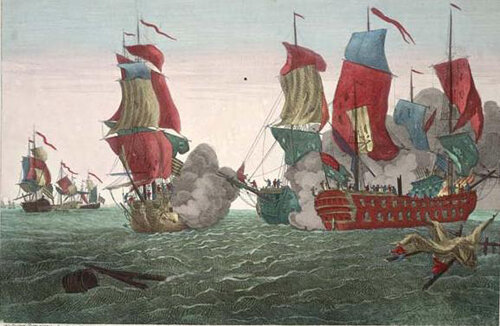
Jones then rammed Serapis with Bonhomme Richard, fouling both ships together. Serapis attemped to pull away from the Bonhomme Richard so she could bring the full might of her artillery to bear on the almost-defenseless American ship, but Jones threw hooks over the side and lashed the two ships together. His desperate men poured musket fire and hurled hand grenades at the Serapis‘ deck, setting fire to the ship and inflicting heavy casualties. A large contingent of British marines forward in an attempt to board the American vessel, but Jones was able to repulse the boarding party before leading a group of his own men over to Serapis, where he was able to capture the vessel and effect her surrender.
By the time the sun set that night, both ships were crippled, had lost over half of their men and were on fire in numerous places. Bonhomme Richard had to be abandoned the following morning when attempts to bail several feet of water out of her hold proved fruitless.”
- JPJ won. He was knighted by the King of France, Kin Louis. He was given the order Military Merit from the French and the Medal of Valor from the US Continental Congress in 1787. The British Government hated him.
- When JPJ captured the Serapis he sailed it into a Dutch Port and there was some political tension that arose from this the details of which are messy and complicated. But what came out of it was that JPJ flew his own flag over the Serapis, thought to be designed by Benjamin Franklin (ambassador to Paris at the time).

This SOB flew his own made up flag lol.

- Now after the American Revolution JPJ found himself home in the US with no wars to fight.
- The war hound was restless. So he set sail for Russia and enlisted his services for Empress Catherine II in the Russian navy.
- Jones served as a Rear Admiral for a Black Sea Russian Fleet under the appointment of Catherine the Great. He went by the name Pavel Dzhones.
- He became Vice Admiral and commanded the Vladimir, an 24-Gun flagship of the Imperial Navy.
- Under the Russian flag he defended the Liman Region of the Black Sea from the Ottoman Turks. He was awareded the Order of Saint Anne from the Russian Monarchy.
- The war hound was restless. So he set sail for Russia and enlisted his services for Empress Catherine II in the Russian navy.
- He retired to Paris in 1790.
- Two years later in 1792 he died. His remains were barried in Saint Louis Cemetary.
I can take no delight in the effusion of human Blood;
but, if this War should continue,
I wish to have the most active part in it.”
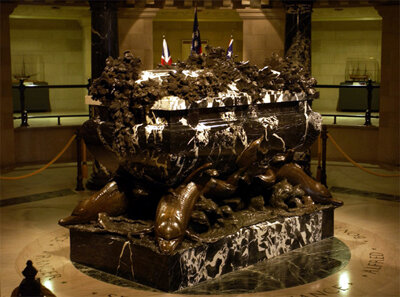
- The French, anticipating the US government would one day wish to return Jones’s remains to America, buried him in an expensive lead casket that was filled with rum for preservation.
- In 1905, after an extensive four-year search funded by the US Ambassador Horace Porter, Jones’s body was rediscovered.
- JPJ’s body was exumed and returned to the US Military escorted by many battleships. He was burried with full military honors at the US Naval Academy chapel in a sarcophagus.
- President Theodore Roosevelt would have Captain John Paul Jones reinterred at a specially built chapel at the US Naval Academy in Annapolis, Maryland. Renewed interest in John Paul Jones led to Congress allocating $50,000 in June 1909 for a memorial to be built for him on the National Mall.
- The memorial includes a bronze statue of Jones, 10 feet high, sculpted by Charles Henry Niehaus of New York City. It shows Jones standing with his left hand on the hilt of his sword. The rest of the memorial has a 15-foot marble pylon behind him, with two bronze dolphins on either side shooting water. This part was designed by the firm of Carrere & Hasting also of New York City.
- The john Paul Jones Memorial was dedicated on April 17, 1912 which, by happenstance, was just two days after the British steamship Titanic sank. The memorial was dedicated by President William Howard Taft. The statue was unveiled by Spanish American War hero Admiral George Dewey.
- Jones is also remembered by his adversaries. The quaint Scottish cottage on the estate of Arbigland, where the gardener’s son, the future John Paul Jones, grew up has been preserved as a museum.
- Furthermore, the British Port of Whitehaven, raided by Captain Jones during the American Revolution, decided to pardon him in 1999.

CREDIT:
- https://www.badassoftheweek.com/jones
- https://blog.historicenvironment.scot/2018/09/john-paul-jones/#:~:text=A%20year%20later%2C%20Jones%20quit,it%20an%20%27abominable%20trade%27.
- https://en.wikipedia.org/wiki/John_Paul_Jones
- https://www.nps.gov/nama/planyourvisit/jones.htm#:~:text=Furthermore%2C%20the%20British%20Port%20of,to%20pardon%20him%20in%201999.
 The Journal of A_C_Unit