

The content below is from Episode 157 of the Who’d a Thunk It? Podcast
RECOMMENDATION SEGMENT

- This week I recommend you open Netflix and watch Altered Carbon
- I will admit I didn’t finish season 2 of the show as I thought it felt like a completely different show from season 1.
- But season 1 is still worth the watch
- I got Shannon into it and she seems to enjoy this futuristic sci-fi private I concept.
- Plus, I am currently listening to the audiobook and that of course has more detail.
- The world of Altered Carbon is a rich one with all sorts of different sci-fi concepts you’ve probably never considered a possibility (even with imagination) before.
- Here’s the summary:
- More than 300 years in the future, society has been transformed by new technology, leading to human bodies being interchangeable and death no longer being permanent. Takeshi Kovacs is the only surviving soldier of a group of elite interstellar warriors who were defeated in an uprising against the new world order. His mind was imprisoned for centuries until impossibly wealthy businessman Laurens Bancroft offers him the chance to live again. Kovacs will have to do something for Bancroft, though, if he wants to be resurrected. Bancroft’s request of Kovacs is to solve a murder — Bancroft’s. “Altered Carbon” is based on Richard K. Morgan’s cyberpunk noir novel of the same name.
- Joel Kinnaman plays Takashi Kovacs in season 1 and I’ve always thought Kinnaman brings a captivating grittiness to the roles he plays. I loved his work in The Killing (now on Hulu).
- Anthony Mackie plays the main character in season 2 and IDK… Mackie was cool as Captain America’s sidekick in The Avengers, but I think he isn’t gritty enough to play Takashi Kovacs. so season 2 didn’t do it for me.
- One of the best characters in the show (which is not in the book, at least not up to chapter 13) is Poe, the Artificial Intelligence hotel that “craves guests like humans crave sex” (direct quote from the book).
- He’s an AI that runs the Hotel Raven and named himself after Edgar Allen Poe.
NOW FOR THE MAIN EVENT

- In 1884 the Japanese delegation at the World’s Fair presented the Water Hyacinth (Eichornia Crassipes).
- It is a beautiful aquatic plant with yellow spots on purple and blue flowers.
- Its seeds spread by various means (floods, wind, birds, and stuck to the bottom of boots) and stay viable for 3 decades.
- While the Water Hyacinth is regarded for its beauty in its native Japan, it is now known as a terror to the ecosystems of North America. The Eichornia Crassipes is VERY aggressive invasive species that chokes the life out of the waterways by blocking light and growing thick roots that stop even boats from navigating the waters of the American South. On top of that it is highly toxic to most mammalian species if ingested and to remove it is costly beyond imagining.
- So while the people at the 1884 World’s Fair thought it was pretty, they had no idea the damage they were doing for future generations by introducing this alpha plant to a foreign environment that had no means to combat its spread.
- Some say the Water Hyacinth is an aquatic equivalent to the Japanese invasive perennial Kudzu, the “vine that ate the south.”
- Louisiana got it worst, but much of the South was hit hard by the Water Hyacinth.

- A few decades go by and the ecosystems of the American south are still far away from figuring out how to cope with this Japanese invader.
- The population in America at this time is booming. Food shortages are becoming more commonplace as a result. The American family especially notices a lack of meat. By 1910 it was a crisis.
- Overgrazing and a lack of cattle legitimately had the American people rethinking their stance on the beloved canines and felines they had in their homes.
- No joke, people were about to eat their dogs and this scared the hell out of the elected officials.
- Robert Foligny Broussard, House of Representative from Louisiana, had a proposition to solve both America’s invasive water plant AND meat problems with one solution… something he called Lake Bacon.
- Louisinana’s 3rd Congressional district put it in writing and proposed the “American Hippo” bill H.R. 23621.
- The thought was that Hippos would eat the invasive Water Hyacinth plant and WE humans would eat the hippos… win-win right?
- President Theodore Roosevelt (a man who deserves his own Who’d a Thunk It? episode someday) was all for this bill LOL. Which doesn’t surprise me. On paper it seemed to be a great solution and would put a new tasty meat on the American menu.
- The agriculturalists estimated that a free-range hippo herd would make a million tons of meat per year…
- Plus, Teddy Roosevelt was a known meat lover
- The Bill also had support from the New York Times. I have a paragraph from their 1910 article

NY Times – April 12, 1910, Page 10 -:
“Lake cow bacon, made from the delicious hyacinth-fed hippopotamus of Louisiana’s lily-fringed streams, should soon be obtainable from the Southern packing houses. Properly seeded, Southern streams and marshes will grow thirty to fifty tons of hyacinth to the acre, and on 6,400,000 now useless acres in the Gulf States 1,000,000 tons of the most delicious of flesh foods, worth $100,000,000, may be grown yearly.”
- I could have accessed the entire 1910 article, but that would cost money and I don’t make jack off Who’d a Thunk It? so that’s not happening lol. Buy your own NY Times Subscription lol
Lippincott’s monthly magazine (a publication out of Philadelphia from 1868 to 1915) wrote: “This animal, homely as a steamroller, is the embodiment of salvation. Peace, plenty and contentment lie before us, and a new life with new experiences, new opportunities, new vigour, new romance, folded in that golden future, when the meadows and the bayous of our southern lands shall swarm with herds of hippopotami”.

- The Hippo is a big-ass animal.
- Males get to be about 3,300 to 4,000 pounds and females are about 2,900 to 3,300 pounds.
- Where as male cows (bulls and steer) weigh around 2,400 pounds and females 1,600 pounds.
- The word hippopotamus comes from the Greek term for “River Horse.” They are the 3rd heaviest land animal alive today.
- When most people look at hippos they think they look like pigs, but they are actually more closely related to cetaceans (whales, dolphins, and porpoises)
- Pretty cool huh?
- Now picture it. I come from a farming region of Pennsylvania so it is easy for me to picture a farm with livestock roaming a fenced-in hill or field.
- I’d like you to picture it too. You are driving across America and see a bunch of farms with Cows, pigs, sheep, goats and “Oh Look! a herd of Hippos!”
- The idea got people very excited
But there are a couple of issues with the Lake Bacon idea…
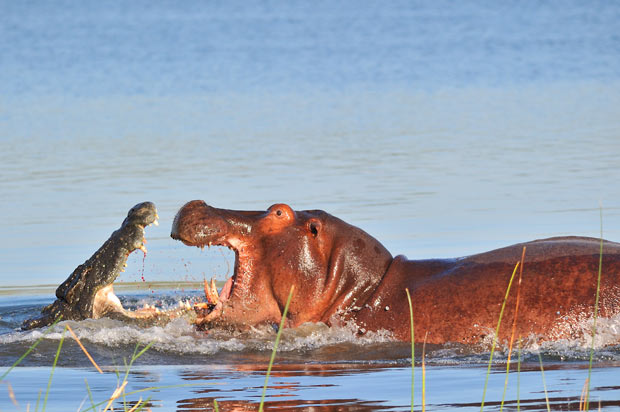
- First of all, combating an invasive species by introducing another invasive species DOES NOT WORK.
- Like in Hawaii, they had a rat problem. People coming to the islands unintentionally brought rats which were mucking up the local ecosystem so someone got the bright idea to introduce Mongooses hoping they would eat the rats…
- Rats are nocturnal and mongooses are not. So the two species almost never came into contact with each other. So the rats kept screwing up the cane fields and the mongooses started destroying local bird and turtle populations.
- This is typically how introducing non-native species works.
- So without an insane amount of research, they were bound to have issues. Ecosystems are insanely complex and you can’t just bring in a new species and hope they fit like a glove.
- Like in Hawaii, they had a rat problem. People coming to the islands unintentionally brought rats which were mucking up the local ecosystem so someone got the bright idea to introduce Mongooses hoping they would eat the rats…
- Not to mention, Hippos are aggressive AF.
- I talked about this on Episode #75 titled Cocaine Hippos.
- They are territorial and unpredictable. One minute a hippo is chill as hell and the next they just flip out. Scientists believe this unpredictable aggression is something the Hippo evolved to have in order to survive in the harsh African environment.
- If you look like a giant ball of tasty meat and live among apex predators like lions and hyenas, it’s probably going to turn your species into some hard mofos.
- They can run or gallop at top speeds of 19 mph which means they can be outrun… by Usain Bolt… the fastest man alive.
- They kill more people than any other large animal in Africa
- Despite these drawbacks, Louisinana’s 3rd Congressional district couldn’t resist the idea that these river monsters could potentially solve the south’s Water Hyacinth and meat shortage problems at the same time.
- There were a lot of prominent politicians in favor of this bill.
- OnPasture.com writes about one:
William Irwin “W.N.” Irwin was a researcher with the US Department of Agriculture’s Bureau of Plant Industry. He noted that in the past, the United States had dealt with shortages by expanding to the west. But with the frontier closed and nowhere further to expand, the country must now figure out how to turn the unproductive deserts and swamps into areas that would provide food for a rapidly expanding population. He told the listening Congressmen, “We ought to have more creatures than we are raising here.” He told the Washington Post, ” I hope to live long enough to see herds of these broad-backed beasts wallowing in the southern marshes and rivers, fattening on the millions of tons of food which awaits their arrival; to see great droves of white rhinoceri…roaming over the semiarid desert wastes, fattening on the sparse herbage which these lands offer; to see herds of the delicate giraffe, the flesh of which is the purest and sweetest of any known animal, browsing on the buds and shoots of young trees in preparation for the butchers block.” Irwin believed that this was a test of American ingenuity and resolve. According to him. “To defend our freedom and way of life, some generations of Americans are called to go to war; this generation was being called to import hippopotamuses and eat them.”

- Two congressmen, Frederick Russell Burnham and Frederick “Fritz” Joubert Duquesne who were usually at odds with each other supported the Lake Bacon bill.
- Did I say they were at odds with each other? No, more like they spent a decade trying to kill each other in the African bush!
- I will let TodayInHistory.blog explain the lives of these two mad lads and their beef with each other:
Major Frederick Russell Burnham had argued for the introduction of African wildlife into the American food stream, some four years earlier. A freelance scout and American adventurer, Burnham was known for his service to the British South Africa company, and to the British army in colonial Africa. The “King of Scouts’, commanding officers described Burnham as “half jackrabbit and half wolf”. A “man totally without fear.” One writer described Burnham’s life as “an endless chain of impossible achievements”, another “a man whose senses and abilities approached that of a wild predator”. He was the inspiration for the Indiana Jones character and for the Boy Scouts. Frederick Burnham was the “most complete human being who ever lived “.

—OnPasture.com— (next two paragraphs)
Major Frederick Russell Burnham suggested we should continue to add to the country’s food stocks from the global pantry, and that given time, hippo roast would become just as normal as a beef roast. It was a project he knew required working against “overwhelming difficulties and the loud guffaws of the ignorant,” yet he firmly believed it was an idea that could restore the feeling of promise in America.
He saw nothing unusual in the idea of adding hippo, giraffe, dik-diks (weighing six to ten pounds and perfect for a Christmas feast), and more to the American dinner table


Frederick Russell Burnham (Above), Fritz Joubert Duquesne (Below)
Frederick “Fritz” Joubert Duquesne was a Boer of French Huguenot ancestry, descended from Dutch settlers to South Africa. A smooth talking guerrilla fighter, the self-styled “Black Panther” once described himself as every bit the wild African animal, as any creature of the veld. An incandescent tower of hate for all things British, Duquesne was a liar, a chameleon, a man of 1,000 aliases who once spent seven months feigning paralysis, so he could fool his jailers long enough to cut through his prison bars.
Duquesne was destined to be a German spy and saboteur, through two world wars. Frederick Burnham described his mortal adversary, thus: “He was one of the craftiest men I ever met. He had something of a genius of the Apache for avoiding a combat except in his own terms; yet he would be the last man I should choose to meet in a dark room for a finish fight armed only with knives“.

During the 2nd Boer war, the pair had sworn to kill each other. In 1910, these two men became partners in a mission to bring hippos, to America’s dinner table.
- These two impressive dudes literally swore to kill each other, yet both agreed hippos in the south would be a good idea.
- And you know, Hippo is a common food in West Africa even today. Why wouldn’t American’s like it?
- As we know from Pablo Escobar’s hippos (again, see Who’d a Thunk It? Episode #75 Cocaine Hippos), these water horses will flourish in Columbia so there’s little doubt they couldn’t do the same in the Gulf coast of America.

- So what happened to the Lake Bacon bill?
- It was shot down by just one vote. We were 1 vote away from being a nation infested with hippos lol.
- Representative and eventual-Senator Broussard kept the bill close for the rest of this life. When he died they found it in his desk and listed on his agenda as a pressing matter to bring up the bill again at a later date.
- Time passed and we American’s embraced factory farming and the use of hormones so our meat problem went away.
- Today the state of Louisiana alone pays $2Million a year just to keep herbicidal control over the water hyacinth.
- While having hippo ranches might have caused a crazy ecosystem in America, that doesn’t mean hormones and factory farming policies of today are any better.
The effluent of factory farms from Montana to Pennsylvania works its way into the nation’s rivers and streams, washing out to the Mississippi Delta to a biological dead zone, the size of New Jersey.
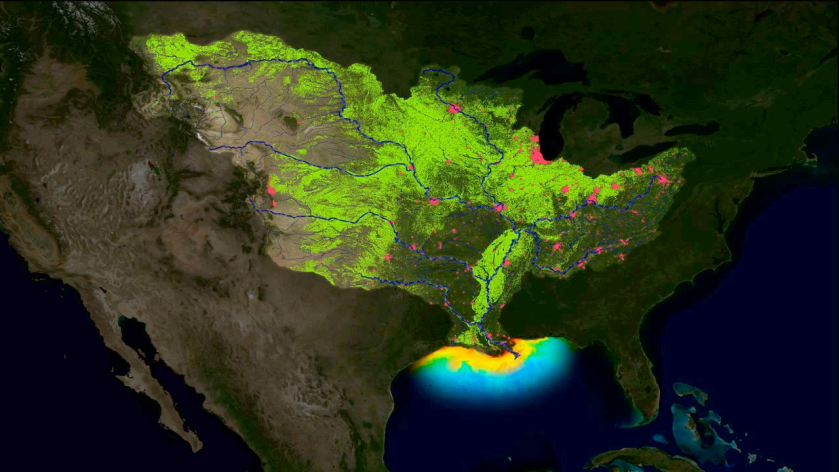
- Today the only Hippo Herds roaming around are the ones in our imaginations.
- Some today seem to think it would have been a better alternative to the way farming is done today. I know factory farming certainly is not a perfect system.
- But I have to think introducing the Hippo …
- Let alone all the other animals…
- I mean, the bill wanted to use $250,000 to import a wide variety of African animals suited to different American environments
- Can you imagine the havoc that would wreak on the North American continent’s ecosystem?
- Let alone all the other animals…
- But in the safe confines of the imagination where I don’t have to worry about the reprocussions of introducing African Wildlife to North America… I like to think it would be cool!
- Think about what a “Hippoboy” would be like LOL. What a profession.
- If we introduced them in 1910 perhaps we would have a more docile domesticated version of the hippo by now. cool to think about…
- Plus… I wanna try me some Hippo meat now lol
- But seriously… what would America look like now?


CREDIT:
- https://todayinhistory.blog/2018/12/23/december-23-1884-lake-bacon/
- https://www.nytimes.com/1910/04/12/archives/lake-cow-bacon.html
- https://onpasture.com/2016/04/18/u-s-hippo-ranches-and-lake-cow-bacon/


 The Journal of A_C_Unit