Categories
Uncategorized

Unheard History

The content below is from Episode #158 of the Who’d a Thunk It? Podcast

RECOMMENDATION SEGMENT

  • I recommend you read Yertle the Turtle
    • It’s a Dr. Seuss book, my favorite in fact.
    • Dr. Seuss’s Yertle the Turtle raises questions about justice, political rights, political authority, and the responsibilities a ruler has to their subjects.
    • It is a simple kids book, but I still enjoy it today.
    • I’m the kind of person that only learns things the hard way, so when I learn an intended lesson on the first try it is memorable moment.
    • The first time I read Yertle the Turtle I understood what it was trying to tell me about power.
      • I think that is the truly special thing about Dr. Seuss
    • But I’ve never seen myself as one of the other turtles on Sala-Ma-Sond. No, I’ve always seen myself as Yertle. I’ve always been afraid of abusing what little power I have in this world.

NOW FOR THE MAIN EVENT

  • This week I’m having a hard time finding the motivation to dig deep into one topic… so I didn’t.
    • I’ve decided to share short little snippets of historical stories I’ve accumulated over the years. I hope you enjoy.

— + —

Aztecs

Bernal Diaz del Castillo’s The True History of the Conquest of New Spain

A priest died during the time with Cortez and when they went through his belongings they found an adult toy made of leather.

— —

The University of Oxford is older than the Aztec Empire. The University of Oxford first opened its doors to students all the way back in 1096. By comparison, the Aztec Empire is said to have originated with the founding of the city of Tenochtitlán at Lake Texcoco by the Mexica, which occurred in the year 1325.

— —

While holding Montezuma hostage in what is now Mexico City, the men tasked with guarding him treated him relatively decently. He was a king and had lots of gold after all. Anyway, while the Spanish guards were on duty he accidentally farted on Montezuma… directly in his face.

The guard felt very embarrassed. He began apologizing profusely. He had just humiliated a noble.

Montezuma wanted to assure the apologetic guard so he gave him a piece of the vast amount of gold he had.

That’s when things shifted. The guard looked at the gold dumbfounded for a bit then proceeded to fart right into Montezuma’s face expecting more gold.

I like to imagine the guard was like “ah you like that don’t you, you dirty boy. Well here! Take some more!” Perhaps this was the first unintentional example of kink sex work lol.

— —

The Aztecs were such a cool culture. They built their city Tenochtitlan on a big artificial island and it was so big it could be compared to London and Constantinople at the time.

Some say the main reason they (a huge civilization with a huge army) were beaten by a handful of stinky Europeans (I say stinky because the hygiene of Europeans at the time was WAY worse than the Aztecs) was because the sacrifice-happy Aztecs made so many enemies. The Aztecs pissed off so many of their neighboring populations that Cortez was able to get like 100,000 soldiers of neighboring tribes to help him.

Montezuma (right) looks cool as hell in this painting. Cortez is on the left.

— + —

WWII

 In 1945, a balloon bomb launched by Japan landed in Oregon. It fell upon a woman and five children, who died when it exploded. These were the only World War II casualties on US soil.

— —

In WWII there was a guy named Juan Pujol Garcia (Allied code name Garbo). He was from Spain and was NOT a fan of the Nazis or any other fascist for that matter.

He wrote to the US and the UK governments offering his services as a spy against Germany. Both governments declined his offer.

Garbo thought he didn’t need government backing and decided to do the damn thing anyway. He got a job in the Spanish government. The idea was to become just powerful enough to catch the eye of German intelligence and it worked. To the Germans he was a Nazi-loving guy inside the Spanish government willing to spy for them, so he became a German agent.

Germany asked him to spy on London. He went to Lisbon Portugal instead. Whenever German intelligence asked him for information he just looked at English magazines and newspapers so he could make up bogus intel to feed to the Nazis. All while collecting a Nazi paycheck.

Eventually, British intelligence caught on to the fact that German resources were being sent to the wrong places on a consistent basis and figured there must be someone behind it. They were able to make contact and hired Garbo as a spy.

Germany was sending Garbo (whom they dubbed Alaric) tons of funding and resources because he was telling German high command that he was building a large spy network behind English lines. In reality, it was just a dude named Juan collecting all these resources and telling Jolly Old England anything they wanted to know. The Germans called his fabricated spy network “Arabal.”

At its peak, Arabal was being funded for 27 agents. Many of which Garbo could blame for any false info he may have given to the Nazis.

The Brits were so impressed they moved Garbo and his entire family to the UK.

His misinformation was a big factor in Allied Operation Fortitude, the intelligence operation undertaken to divert as many German troops away from Normandy as possible.

By the time the war was over Garbo had the distinction of receiving military decorations from both sides of the war – being awarded the Iron Cross and becoming a Member of the Order of the British Empire.

I love Garbo’s sneaky grin in this pic.

— —

We now know the Avengers as Captain America, Hulk, Iron Man, Thor, and so on from their big Hollywood hits. But “The Avengers” was also a group of Jewish assassins who hunted Nazi war criminals after World War II.

Nakam (Hebrew: נקם, ‘revenge’) was a paramilitary organization of about fifty Holocaust survivors who, after 1945, sought revenge for the murder of six million Jews during the Holocaust. Led by Abba Kovner, the group sought to kill six million German people in a form of indiscriminate revenge, “a nation for a nation”. In the end they poisoned 2,283 German prisoners of war.

I’m not sure poisoning prisoners of war without a trial is a very ethical thing to do, even if they are Nazis.

— —

Russia ran out of vodka celebrating the end of World War II! When the long war ended, street parties engulfed the Soviet Union, lasting for days—until all of the nation’s vodka reserves ran out a mere 22 hours after the partying started.

— + —

Ancient Rome/Greece

Cato the Elder was a Roman was a Roman Senator who would end all of his speeches with “Carthago Delenda Est.” It means Carthage (a city constantly at arms with Rome) must be destroyed. Years after he died Carthage was destroyed.

Cato’s son Cato the Younger was appointed Senator years later during Julius Ceasar’s time. Ceasar was reading a note during a big government meeting, the equivalent to checking your text during a staff meeting these days. Cato the Younger seeing an opportunity accused Ceasar of being a spy thinking he might be able to take out a powerful rival.

Ceasar denied being a spy and was like, “what’s the big deal Cato the Younger? I’m definitely not a spy.”

So Cato the Younger says “oh yeah? Then why don’t you read that note to the entire class if you don’t have anything to hide!”

Ceasar agreed to read the note… it was a steamy love note from Cato the Younger’s sister LMAO

— —

The Romans, like any culture, were not perfect. But they did have what some today might consider progressive views on Religion and Sexuality.

Rome conquered a lot of different peoples, each one having a different god or goddess. Instead of making the locals worship their Roman gods, the Romans would pray to the local gods. They would pray to the local deities asking they abandon the local government structure and have the local population join the Roman empire. If the Romans were successful they would officially recognize or even fully adopt the local god into their own religion.

Some Emperors saw it as spiritually hedging their bets. Why piss off gods that might be real when you can make friends with a bunch of gods, that way, if one or some of them are real you’ll have a nicer time in the afterworld.

And when it came to sexuality, the concept of gay didn’t exist. Neither did straight for that matter. The same goes for the Ancient Greeks. They only saw sexuality in terms of dominant or submissive. Didn’t matter what fleshy bits you had.

That’s why I’ve always had an issue with the one scene from 300 where Leonidas gave an insult to King Xerxes by calling him and his men “boy lovers.” LOL in reality the Spartans constantly had sex with boys (in what we would DEFINITELY now consider pedophilia) while ancient Persia had laws against homosexuality. Most Spartan soldiers had the equivalent of a squire accompanying them on military campaigns and it was common for that squire to polish BOTH of his masters’ swords if you catch my drift.

Around 250 BCE, during the Parthian Empire, the Zoroastrian text, the Vendidad, was written. It contains provisions that are part of the sexual code promoting procreative sexuality that is interpreted to prohibit same-sex intercourse as a form of demon worship, and thus sinful.

So when Girard Butler’s character Leonidas calls Xerxes a “Boy-Lover” it’s not only a historical inaccuracy, it’s an ass-backward comment (pun intended) lol.

Um… these are the Spartans that Hollywood would have you believe hate “Boy-Lovers” LMAO

— —

 In Ancient Greece, they believed redheads became vampires after death! This was partly because redheaded people are very pale-skinned and sensitive to sunlight—unlike the Mediterranean Greeks, who had olive skin and dark features.

— + —

Salem

During the Salem witch trials, the accused witches weren’t actually burned at the stake. The majority were jailed, and some were hanged. But none of the 2,000 people accused ever got burned alive.

Think about that every time you see a movie or show depicting a woman being burned alive in Salem… IT. DIDN’T. HAPPEN.

— + —

Napoleon

Famous conqueror Napoleon Bonaparte was once attacked by a horde of bunnies! He had requested that a rabbit hunt be arranged for himself and his men. When the rabbits were released from their cages, the bunnies charged toward Bonaparte and his men in an unstoppable onslaught.

— + —

Alexander

Alexander the Great was accidentally buried alive. Following Alexander’s death in Babylon, his body was initially buried in Memphis by one of his generals, Ptolemy I Soter, before being transferred to Alexandria, where it was reburied.

Scientists believe Alexander suffered from a neurological disorder called Guillain-Barré Syndrome. They believe that when he died, he was actually just paralyzed and mentally aware!

General Ptolemy is actually believed to be Cleopatra’s ancestor. As far as historians can tell, Egypt’s famous femme fatal was actually Greek! She was a descendant of Alexander the Great’s Macedonian general Ptolemy. So yeah, she wasn’t Egyptian.

CREDIT

Categories
Uncategorized

Lake Bacon

The content below is from Episode 157 of the Who’d a Thunk It? Podcast

RECOMMENDATION SEGMENT

  • This week I recommend you open Netflix and watch Altered Carbon
    • I will admit I didn’t finish season 2 of the show as I thought it felt like a completely different show from season 1.
    • But season 1 is still worth the watch
    • I got Shannon into it and she seems to enjoy this futuristic sci-fi private I concept.
    • Plus, I am currently listening to the audiobook and that of course has more detail.
    • The world of Altered Carbon is a rich one with all sorts of different sci-fi concepts you’ve probably never considered a possibility (even with imagination) before.
    • Here’s the summary:
      • More than 300 years in the future, society has been transformed by new technology, leading to human bodies being interchangeable and death no longer being permanent. Takeshi Kovacs is the only surviving soldier of a group of elite interstellar warriors who were defeated in an uprising against the new world order. His mind was imprisoned for centuries until impossibly wealthy businessman Laurens Bancroft offers him the chance to live again. Kovacs will have to do something for Bancroft, though, if he wants to be resurrected. Bancroft’s request of Kovacs is to solve a murder — Bancroft’s. “Altered Carbon” is based on Richard K. Morgan’s cyberpunk noir novel of the same name.
    • Joel Kinnaman plays Takashi Kovacs in season 1 and I’ve always thought Kinnaman brings a captivating grittiness to the roles he plays. I loved his work in The Killing (now on Hulu).
    • Anthony Mackie plays the main character in season 2 and IDK… Mackie was cool as Captain America’s sidekick in The Avengers, but I think he isn’t gritty enough to play Takashi Kovacs. so season 2 didn’t do it for me.
    • One of the best characters in the show (which is not in the book, at least not up to chapter 13) is Poe, the Artificial Intelligence hotel that “craves guests like humans crave sex” (direct quote from the book).
      • He’s an AI that runs the Hotel Raven and named himself after Edgar Allen Poe.

NOW FOR THE MAIN EVENT

water-hyacinth-eichornia-crassipes
Water Hyacinth
  • In 1884 the Japanese delegation at the World’s Fair presented the Water Hyacinth (Eichornia Crassipes).
    • It is a beautiful aquatic plant with yellow spots on purple and blue flowers.
    • Its seeds spread by various means (floods, wind, birds, and stuck to the bottom of boots) and stay viable for 3 decades.
    • While the Water Hyacinth is regarded for its beauty in its native Japan, it is now known as a terror to the ecosystems of North America. The Eichornia Crassipes is VERY aggressive invasive species that chokes the life out of the waterways by blocking light and growing thick roots that stop even boats from navigating the waters of the American South. On top of that it is highly toxic to most mammalian species if ingested and to remove it is costly beyond imagining.
    • So while the people at the 1884 World’s Fair thought it was pretty, they had no idea the damage they were doing for future generations by introducing this alpha plant to a foreign environment that had no means to combat its spread.
    • Some say the Water Hyacinth is an aquatic equivalent to the Japanese invasive perennial Kudzu, the “vine that ate the south.”
    • Louisiana got it worst, but much of the South was hit hard by the Water Hyacinth.
Eichhornia_crassipes_field_at_Langkawi
  • A few decades go by and the ecosystems of the American south are still far away from figuring out how to cope with this Japanese invader.
    • The population in America at this time is booming. Food shortages are becoming more commonplace as a result. The American family especially notices a lack of meat. By 1910 it was a crisis.
    • Overgrazing and a lack of cattle legitimately had the American people rethinking their stance on the beloved canines and felines they had in their homes.
      • No joke, people were about to eat their dogs and this scared the hell out of the elected officials.
  • Robert Foligny Broussard, House of Representative from Louisiana, had a proposition to solve both America’s invasive water plant AND meat problems with one solution… something he called Lake Bacon.
    • Louisinana’s 3rd Congressional district put it in writing and proposed the “American Hippo” bill H.R. 23621.
    • The thought was that Hippos would eat the invasive Water Hyacinth plant and WE humans would eat the hippos… win-win right?
    • President Theodore Roosevelt (a man who deserves his own Who’d a Thunk It? episode someday) was all for this bill LOL. Which doesn’t surprise me. On paper it seemed to be a great solution and would put a new tasty meat on the American menu.
      • The agriculturalists estimated that a free-range hippo herd would make a million tons of meat per year…
      • Plus, Teddy Roosevelt was a known meat lover
    • The Bill also had support from the New York Times. I have a paragraph from their 1910 article

NY Times – April 12, 1910, Page 10 -:

“Lake cow bacon, made from the delicious hyacinth-fed hippopotamus of Louisiana’s lily-fringed streams, should soon be obtainable from the Southern packing houses. Properly seeded, Southern streams and marshes will grow thirty to fifty tons of hyacinth to the acre, and on 6,400,000 now useless acres in the Gulf States 1,000,000 tons of the most delicious of flesh foods, worth $100,000,000, may be grown yearly.”

  • I could have accessed the entire 1910 article, but that would cost money and I don’t make jack off Who’d a Thunk It? so that’s not happening lol. Buy your own NY Times Subscription lol

Lippincott’s monthly magazine (a publication out of Philadelphia from 1868 to 1915) wrote:  “This animal, homely as a steamroller, is the embodiment of salvation.  Peace, plenty and contentment lie before us, and a new life with new experiences, new opportunities, new vigour, new romance, folded in that golden future, when the meadows and the bayous of our southern lands shall swarm with herds of hippopotami”.

  • The Hippo is a big-ass animal.
    • Males get to be about 3,300 to 4,000 pounds and females are about 2,900 to 3,300 pounds.
    • Where as male cows (bulls and steer) weigh around 2,400 pounds and females 1,600 pounds.
    • The word hippopotamus comes from the Greek term for “River Horse.” They are the 3rd heaviest land animal alive today.
    • When most people look at hippos they think they look like pigs, but they are actually more closely related to cetaceans (whales, dolphins, and porpoises)
    • Pretty cool huh?
      • Now picture it. I come from a farming region of Pennsylvania so it is easy for me to picture a farm with livestock roaming a fenced-in hill or field.
      • I’d like you to picture it too. You are driving across America and see a bunch of farms with Cows, pigs, sheep, goats and “Oh Look! a herd of Hippos!”
      • The idea got people very excited

But there are a couple of issues with the Lake Bacon idea…

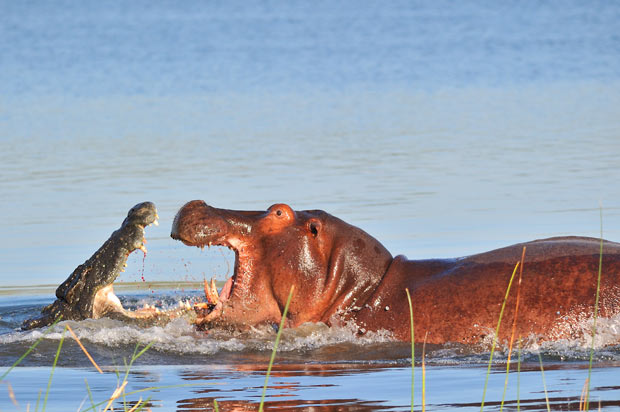
hippo-crocodile_1887702i
  • First of all, combating an invasive species by introducing another invasive species DOES NOT WORK.
    • Like in Hawaii, they had a rat problem. People coming to the islands unintentionally brought rats which were mucking up the local ecosystem so someone got the bright idea to introduce Mongooses hoping they would eat the rats…
      • Rats are nocturnal and mongooses are not. So the two species almost never came into contact with each other. So the rats kept screwing up the cane fields and the mongooses started destroying local bird and turtle populations.
      • This is typically how introducing non-native species works.
    • So without an insane amount of research, they were bound to have issues. Ecosystems are insanely complex and you can’t just bring in a new species and hope they fit like a glove.
  • Not to mention, Hippos are aggressive AF.
    • I talked about this on Episode #75 titled Cocaine Hippos.
    • They are territorial and unpredictable. One minute a hippo is chill as hell and the next they just flip out. Scientists believe this unpredictable aggression is something the Hippo evolved to have in order to survive in the harsh African environment.
      • If you look like a giant ball of tasty meat and live among apex predators like lions and hyenas, it’s probably going to turn your species into some hard mofos.
    • They can run or gallop at top speeds of 19 mph which means they can be outrun… by Usain Bolt… the fastest man alive.
    • They kill more people than any other large animal in Africa
  • Despite these drawbacks, Louisinana’s 3rd Congressional district couldn’t resist the idea that these river monsters could potentially solve the south’s Water Hyacinth and meat shortage problems at the same time.
  • There were a lot of prominent politicians in favor of this bill.

William Irwin “W.N.” Irwin was a researcher with the US Department of Agriculture’s Bureau of Plant Industry. He noted that in the past, the United States had dealt with shortages by expanding to the west. But with the frontier closed and nowhere further to expand, the country must now figure out how to turn the unproductive deserts and swamps into areas that would provide food for a rapidly expanding population. He told the listening Congressmen, “We ought to have more creatures than we are raising here.” He told the Washington Post, ” I hope to live long enough to see herds of these broad-backed beasts wallowing in the southern marshes and rivers, fattening on the millions of tons of food which awaits their arrival; to see great droves of white rhinoceri…roaming over the semiarid desert wastes, fattening on the sparse herbage which these lands offer; to see herds of the delicate giraffe, the flesh of which is the purest and sweetest of any known animal, browsing  on the buds and shoots of young trees in preparation for the butchers block.” Irwin believed that this was a test of American ingenuity and resolve. According to him. “To defend our freedom and way of life, some generations of Americans are called to go to war; this generation was being called to import hippopotamuses and eat them.”

  • Two congressmen, Frederick Russell Burnham and Frederick “Fritz” Joubert Duquesne who were usually at odds with each other supported the Lake Bacon bill.
    • Did I say they were at odds with each other? No, more like they spent a decade trying to kill each other in the African bush!
    • I will let TodayInHistory.blog explain the lives of these two mad lads and their beef with each other:

Major Frederick Russell Burnham had argued for the introduction of African wildlife into the American food stream, some four years earlier.  A freelance scout and American adventurer, Burnham was known for his service to the British South Africa company, and to the British army in colonial Africa. The “King of Scouts’, commanding officers described Burnham as “half jackrabbit and half wolf”.  A “man totally without fear.”  One writer described Burnham’s life as “an endless chain of impossible achievements”, another “a man whose senses and abilities approached that of a wild predator”.  He was the inspiration for the Indiana Jones character and for the Boy Scouts.  Frederick Burnham was the “most complete human being who ever lived “.

Major Frederick Russel Burnham was inspiration for the Boy Scouts. The organization hoped to teach boys the outdoor skills and strength of character that had made Burnham famous.

OnPasture.com— (next two paragraphs)

Major Frederick Russell Burnham suggested we should continue to add to the country’s food stocks from the global pantry, and that given time, hippo roast would become just as normal as a beef roast. It was a project he knew required working against “overwhelming difficulties and the loud guffaws of the ignorant,” yet he firmly believed it was an idea that could restore the feeling of promise in America.

He saw nothing unusual in the idea of adding hippo, giraffe, dik-diks (weighing six to ten pounds and perfect for a Christmas feast), and more to the American dinner table

Major_Frederick_Russell_Burnham_DSO_1901

Capt_fritz_duquesne
Frederick Russell Burnham (Above), Fritz Joubert Duquesne (Below)

Frederick “Fritz” Joubert Duquesne was a Boer of French Huguenot ancestry, descended from Dutch settlers to South Africa.  A smooth talking guerrilla fighter, the self-styled “Black Panther” once described himself as every bit the wild African animal, as any creature of the veld.  An incandescent tower of hate for all things British, Duquesne was a liar, a chameleon, a man of 1,000 aliases who once spent seven months feigning paralysis, so he could fool his jailers long enough to cut through his prison bars.

Duquesne was destined to be a German spy and saboteur, through two world wars.  Frederick Burnham described his mortal adversary, thus:  “He was one of the craftiest men I ever met. He had something of a genius of the Apache for avoiding a combat except in his own terms; yet he would be the last man I should choose to meet in a dark room for a finish fight armed only with knives“.

in-1910-President-Roosevelt-supported-a-bill-that-would-have-released-hippopotamuses-into-Louisiana-to-eat-an-invasive-plant-species-and-to-provide-delicious-hippo-bacon-to-hungry-Americ

During the 2nd Boer war, the pair had sworn to kill each other.  In 1910, these two men became partners in a mission to bring hippos, to America’s dinner table.

  • These two impressive dudes literally swore to kill each other, yet both agreed hippos in the south would be a good idea.
    • And you know, Hippo is a common food in West Africa even today. Why wouldn’t American’s like it?
    • As we know from Pablo Escobar’s hippos (again, see Who’d a Thunk It? Episode #75 Cocaine Hippos), these water horses will flourish in Columbia so there’s little doubt they couldn’t do the same in the Gulf coast of America.
Hippo Steak
  • So what happened to the Lake Bacon bill?
    • It was shot down by just one vote. We were 1 vote away from being a nation infested with hippos lol.
    • Representative and eventual-Senator Broussard kept the bill close for the rest of this life. When he died they found it in his desk and listed on his agenda as a pressing matter to bring up the bill again at a later date.
    • Time passed and we American’s embraced factory farming and the use of hormones so our meat problem went away.
    • Today the state of Louisiana alone pays $2Million a year just to keep herbicidal control over the water hyacinth.
    • While having hippo ranches might have caused a crazy ecosystem in America, that doesn’t mean hormones and factory farming policies of today are any better.

The effluent of factory farms from Montana to Pennsylvania works its way into the nation’s rivers and streams, washing out to the Mississippi Delta to a biological dead zone, the size of New Jersey.

13453_gulf-of-mexico-dead-zone-image-credit-noaa
Gulf of Mexico dead zone, image credit NOAA
  • Today the only Hippo Herds roaming around are the ones in our imaginations.
    • Some today seem to think it would have been a better alternative to the way farming is done today. I know factory farming certainly is not a perfect system.
    • But I have to think introducing the Hippo …
      • Let alone all the other animals…
        • I mean, the bill wanted to use $250,000 to import a wide variety of African animals suited to different American environments
      • Can you imagine the havoc that would wreak on the North American continent’s ecosystem?
    • But in the safe confines of the imagination where I don’t have to worry about the reprocussions of introducing African Wildlife to North America… I like to think it would be cool!
    • Think about what a “Hippoboy” would be like LOL. What a profession.
    • If we introduced them in 1910 perhaps we would have a more docile domesticated version of the hippo by now. cool to think about…
    • Plus… I wanna try me some Hippo meat now lol
  • But seriously… what would America look like now?
Hippo ranch illustration by Mark Summers.
howmanyhipposinusa

CREDIT:

Categories
Uncategorized

Anchorage Parking Fairies

The content below is from Episode #156 of the Who’d a Thunk It? Podcast

RECOMMENDATION SEGMENT

  • This week I recommend you check out the YouTube Channel Ze Frank and their True Facts videos.
  • They are mostly about different species in nature and have a TON of research to back what they show on their videos. However, they also sprinkle in a TON of humor.
    • These are educational videos with mind-blowing facts that just happen to be downright hilarious for adults.
    • The humor is not meant for kids and I think most kids wouldn’t get the majority of the jokes.
    • The voice actor is a pro and arguably makes the video.
    • Check out their video on beavers below.

NOW FOR THE MAIN EVENT

  • Once upon a time, in a land far to the north, there was a city called Anchorage Alaska.
    • Back in the 90’s it was a lot more common to come across a mom & pop gas station. While they still exist today, you are much more likely to happen upon a Sheetz, Wawa, Rutters, or any of the other big company gas stations than you are to come across a Bob’s Convenience and Gas place.
    • And thats where our story this week takes place, Anchorage Alaska in the 90s
  • Today we learn the story of a woman named Carolyn Pacillo, everyone called her Linny.
    • Linny was born in 1959 and her family moved to Anchorage in 1988 and ran what would become Anchorage’s last independent gas station: Courtney’s Tudor Service.
    • It was a place with character. It had tacky pink decorations and held seasonal events like the most rotten pumpkin competition for Halloween and a beach promo that had the place filled with sand.
      • They were a family shop run by sassy opinionated sweet ladies on a street full of much better-funded competition.
  • In the year 1994 Linny was out and about on the town running errands. When she returned to her car she found a nice little $75 ticket on her windshield.
    • The truck she parked with was newly purchased and the previous owner put the parking registration sticker on the wrong side. She appealed to the court, and they reduced her ticket to $25.
    • Linny got pissed and went to the local news giving an interview saying “So, I’m mad now, and I got a big mouth,” on the Anchorage Daily News.

Parking fairy Linny Pacillo prepares to plug a parking meter near a car in downtown Anchorage on July 19, 1994. Linny and her sister Susan Pacillo plugged meters as a protest against Anchorage parking enforcement. (Jim Lavrakas / ADN) from https://www.adn.com/alaska-life/2020/01/06/the-anchorage-parking-fairies-how-a-75-ticket-started-a-movement/ – Look at that woman… I wouldn’t want to mess with her LOL

  • The APA (Anchorage Parking Authority) was known for being aggressive as hell in their enforcement of parking violations. They didn’t cut anyone a break and sometimes even blatantly gave out citations that weren’t necessary.
    • They are a parking authority, yet they gave out tickets for people having their snow tires still on out of the season… like, why?
    • They even ticketed people for cracked windshields.
  • Linny, like her fellow Anchorage citizens knew about this bad rep that the APA had so she decided to do something about it.
    • Using her gas station as a means to reach the people she put a $75 reward for the best/worst APA story that was submitted.
      • From Anchorage Daily News’s ADN.com: In one submission, a woman was ticketed for parking in a handicapped spot. Her car was properly tagged for handicapped parking, but she was downtown for several hours while her children participated in a spelling bee at the Performing Arts Center. The bee was long, so, during the lunch break they left. They returned and parked around the corner from their morning spot. She was told it was “illegal to park twice in the same block in the same day.” In another submission, a man claimed he was ticketed for parking 10 inches from the curb — even though Anchorage code allows a gap of 18 inches.
  • Linny’s sister Susan started to get behind Linny’s plight and came up with a genius plan: The Parking Fairies!
    • Apparently, the Pacillo sisters were known for being sassy, taking revenge, and not really caring if they embarrass themselves along the way.
    • You see Susan had worked in downtown in the 80s and was painfully aware of how bad the APA was and how unbending they were when it came to citations.
    • So Linny and Susan put out an old coffee can on the counter at Courtney’s Tudor Service gas station asking for donations to fill expired parking meters.
    • They received about $86 on the first day and the sisters pitched in to round up to $100.
  • Now, My first thought was: wait a minute, won’t giving the $ to parking meters be like giving the money to the APA directly? Not really, you see most parking authorities make most of their revenue on writing people citations than they do on parking fees. It is in their best interest to catch someone breaking the rules.
    • Well here’s some info I found from TopViewNYC.com and their article How Much 25 Major Cities Make in Parking Ticket Revenue Per Capita:
      • While parking tickets can be frustrating for drivers, cities often apply the revenue to beneficial transportation projects such as improving bike and bus infrastructure. Unfortunately, some cities have leased their parking meters to private companies, eliminating profit that could have been funneled into city infrastructure.
      • Since private companies took over Chicago’s parking meter system, prices have steadily risen. According to the Chicago Sun-Times, Chicago’s parking meter system raked in $134.2 million in 2017, putting private investors on course to recoup their entire $1.16 billion investment by 2021 with 62 years left on the lease.
        • Unfortunately, Anchorage wasn’t one of those 25 cities, but it was enlightening to know that private parking authorities practically rake in the money from a city. It honestly sounds like a parasitic business model to me.
        • While a city government-run parking authority can take that revnue and put it to better use in the city and is kept in check by their voters, a private parking authority is incentivized to over-ticket the population and give none of it back.
          • Granted, governments don’t always run parking authorities in an ethical way, but at least they are supposed to.
  • It sounds to me like the Anchorage Parking Authority had it good and was enjoying raking in all that over-ticketing money… until they messed with Linny.
Parking fairy Linny Pacillo plugs a parking meter near a car in downtown Anchorage on July 19, 1994. Linny and her sister Susan Pacillo plugged meters as a protest against Anchorage parking enforcement. (Jim Lavrakas / ADN) from https://www.adn.com/alaska-life/2020/01/06/the-anchorage-parking-fairies-how-a-75-ticket-started-a-movement/
  • With their $100 raised at Courtney’s Tudor Service gas station, they put on tights, tutus, and fairy wings before heading out to pay parking meters.
    • They were quickly called the Parking Fairies. Seen as civic heroes looking for parking meters that ran out of time. They saved their fellow Anchorage citizens from outrageous parking tickets and took money away from the APA while they were at it.
    • Linny and her sister Susan were having fun. They went out and bought a 3-wheeled 1973 Cushman vehicle… the same vehicle the parking authority used to get around back in the day. Except the Pacillo sisters painted their Cushman “Courtney Pink.” It was their Fairy Mobile. Nowadays the APA was too cheap to give their meter maids a vehicle and made them leg it every day so the Parking Fairies had an advantage over them.
      • I think it’s hilarious they went out and bought the vehicle the APA used to use and were driving it around to legally take money away from the APA.
      • Linny said, “We went downtown, and we weren’t allowed to leave until the money was gone.”
Parking fairy Linny Pacillo gets a contribution from a pedestrian on July 18, 1995, while cruising downtown Anchorage in the new Fairy Mobile. (Erik Hill / ADN) from https://www.adn.com/alaska-life/2020/01/06/the-anchorage-parking-fairies-how-a-75-ticket-started-a-movement/
  • The APA’s head honcho Dave Harbour thought it was cute… at first. He thought it was no threat to the APA public relations and nothing but a mere advertising campaign for their gas station. He, like most, thought the donations for the Parking Fairies would dry up within a few weeks… but he was wrong.
    • The media caught wind of the Parking Fairies and put the spotlight on them. USA Today, a national news source, did an article about them in 1994.
    • The donations flowed like a river.
      • People on the street would run down the fairies just to give them cash. Cars stopped in the middle of the street to donate.
      • Office workers would hear the Fairy Mobile coming down the street and would throw donations out the window.
    • When a community feels it can make a difference in a universally supportive (and peaceful) way it is a beautiful thing.
  • In less than a year they collected over $100,000…
    • I can see how most people would be willing to donate to this cause, but with a number like $100K in under a year… those Pacillo sisters must have been persistent.
    • David Harbour, the APA head honcho was feeling the pressure by 1995. He knew he had to make changes, but refused to acknowledge the Parking Fairies.
    • He said “We are doing different things now. Some of them came up during the dialogue with the Assembly.”
    • By 1996 David Harbour resigned from his position at the APA…
    • By 1997 the citizens of Anchorage had spoken. Their votes left the parking enforcement in their city with sworn police officers only.
The parking fairies, sisters Susan, left, and Linny Pacillo, campaigned for Proposition 3 on April 15, 1997, and then headed to election central at the Egan Center. (Bob Hallinen / ADN) from https://www.adn.com/alaska-life/2020/01/06/the-anchorage-parking-fairies-how-a-75-ticket-started-a-movement/
  • In 1996 the fairies gathered some volunteers outside the Town Square. They still filled meters, but their main goal was to raise money for hungry children in less fortunate countries.
    • After David Harbour’s departure, a one Charles Wohlforth tried to appeal to the Fairies in an attempt to bring back the Parking Authority, but he failed.
    • In 1998, the fairies ended their time in Anchorage. There was a ceremonious burning of their wings outside City Hall.
    • State Representative Fred Dyson officially recognized the good work the Pacillo sisters did under the name of the Parking Fairies.
Parking fairies Susan, left, and Linny Pacillo drop their wings into a burn barrel in a retirement ceremony on Sept. 29, 1998, at City Hall in Anchorage. Earlier, state Rep. Fred Dyson presented the sisters with copies of a legislative citation recognizing the substance and unique style of their efforts to change parking enforcement policy in Anchorage. “By their actions, the Pacillo sisters have reminded all of us that government must serve the people,” the citation said. (Erik Hill / ADN) from https://www.adn.com/alaska-life/2020/01/06/the-anchorage-parking-fairies-how-a-75-ticket-started-a-movement/
  • Sadly, in 2003 the Courtney Tudor Service closed down as Anchorage’s last independent gas station.
    • and in 2006 Linny died at the age of 47. She had been battling with muscular dystrophy for a while on top of injuries from a car accident.
      • Her sister Susan Pacillo said: “When she’d come into the room she’d charge every ion in the room.”
        • Wow, what a great compliment.
    • The very next year in 2007 they named the new parking garage the Linny Pacillo Parking Garage in her honor. It opened in 2008. The parking garage has a nice glass mural of the Parking Fairies putting money in parking meters. They also made a plaque that has the history of the Parking Fairies on it.
    • Surprisingly the parking garage won an architect award, the 2010 American Institute of Architects Merit Award.
      • An award almost unheard of to be won by a parking structure.
      • The people who voted on the award winner said “It’s not easy to do a beautiful parking structure — but this one manages to reach a very high level of design.”
  • Before she died, Linny saw a vote to revive the parking authority again. The votes keep the APA dead won by a landslide.
    • Today Anchorage parking is run by a couple private companies competing with each other. They are only allowed to enforce actual parking regulations and not the huge range of offenses like cracked windshields.

Linny Pacillo Parking Garage

  • While the parking garage named after Linny may have beautiful architecture, the authority running it seems to overcharge with a $20 fee.
    • But that isn’t the only legacy they Pacillo Parking Fairies left:
    • From ADN.com:
      • A better honor for the parking fairies is the score of imitators across the country. The Anchorage parking fairies appear to be the first to receive national attention in America. There were similar meter maids in Australia dating back to 1965, but they dressed in tiny, golden bikinis. In other words, they weren’t exactly making the same point. One of the most colorful successors was a clown street performer in Santa Cruz, California, named Mr. Twister. He garnered national media coverage in 1995 after he was ticketed for putting a quarter in an expired meter.
      • Business associations in Canada and America have seized upon the idea of parking fairies. In 2004, a group of Coconut Grove, Florida, business owners hired an actor to work as a parking fairy, hoping to make customers feel more comfortable about parking in the area. The Coconut Grove fairy’s wings and tutu borrow directly from the Pacillos. In 2013, the city of Keene, New Hampshire, sued a group of meter maids, there called the Robin Hoods. The New Hampshire Supreme Court ruled in 2015 in favor of Keene Robin Hoods, allowing them to continue. Linny would have been happy.

CREDIT:

  • https://www.adn.com/alaska-life/2020/01/06/the-anchorage-parking-fairies-how-a-75-ticket-started-a-movement/
    • A Special thanks to Achorage Daily News as their articles are the best source for this story.
      • I tried to find other sources, but a parking story doesn’t seem to have many sources. I couldn’t find that 1994 USA Today article… but I did find a weird website LOL (see below)
  • https://www.parkingtoday.com/articledetails.php?id=2831&t=fighting-the-parking-fairies
    • There is a website for parking enthusiasts and parking professionals called ParkingToday.com LOL
      • In my opinion, they take themselves and parking way too seriously. The article suggests parking authorities should put emojis on parking tickets to seem nicer to the people they ticket and appeal to the millennials LOL.
      • Here is what they said about the Parking Fairies:
    • “I know this isn’t a happy story for the parking authority, the municipality or the meter manufacturer involved. It’s probably a horror story to anybody within the parking industry. I can see how disruptive, antagonistic and damaging this kind of behavior would be to an organization that is doing difficult and necessary work. So, I’m not condoning it, even though I find the story entertaining. I especially like the part where they dressed up like fairies. I appreciate people with that kind of self-confidence.”
    • “I wouldn’t wish the parking fairies on any city. I am trying to imagine at what point in the story the Anchorage parking authority could have placated these angry imps. I think it’s safe to say, a friendly gesture made pretty early on in the scenario could have changed everything.”
  • https://www.upi.com/Top_News/2006/11/20/Anchorage-parking-fairy-dies/49901164079481/
    • “When she’d come into the room she’d charge every ion in the room,” Susan Pacillo said.

Categories
Uncategorized

Ancient Computer

The content below is from Episode 155 of the Who’d a Thunk It? Podcast

RECOMMENDATION SEGMENT

  • This week I recommend having your own garden.
    • If you have land of your own or land you are able to plant on (like a community garden or something like that) great!
    • But even if you live in an apartment you can still grow a little herb garden on your windowsill.
    • Shannon and I now have lived in our house for a little over a year. Last year’s garden was a success, but we now have a better understanding of what plants flourish and which don’t grow very well.
    • If it were up to me, we would just grow Arugula, green onions, and tomatoes LOL
    • I can’t express how satisfying it is to be doing yard work and all of a sudden just pluck a fresh Arugula leaf from your own garden and enjoy that peppery goodness.

NOW FOR THE MAIN EVENT

  • What is a computer?
    • A computer is a machine that can be programmed to carry out sequences of arithmetic or logical operations automatically. Modern digital electronic computers can perform generic sets of operations known as programs. These programs enable computers to perform a wide range of tasks.
    • A computer is a machine that deal in 1s and 0s a few million at a time.
  • What about an analog computer?
    • An analog computer or analogue computer is a type of computer that uses the continuous variation aspect of physical phenomena such as electrical, mechanical, or hydraulic quantities to model the problem being solved.
    • It is a computational device that uses mechanical principles instead of digital math to make calculations.
      • A good example is a wind-up clock or a wind-up kitchen timer.
    • When did Analog computers first appear? There’s some debate on that.
      • Most think it was the astronomical clocks that were invented and used during the 14th century. Or at least that WAS thought to be the beginning of analog computers until 1901…
  • In 1901, near Antikythera Greece, a discovery was made.
    • Captain Dmitrios Kontos took a crew of sponge divers from the island of Siamese out to sea in the year 1900.
      • As they were checking out the depths off the island of Antikythera looking for sponges…
        • I wasn’t aware Sponge Diver was an occupation, but OK…
      • One of the crew surfaced in a panic. He was frantically talking about a bunch of underwater mummy ghost ladies and freaking everyone out.
      • Captain Kontos filed the report and sent it off to the Greek Navy not thinking much of it.
    • A year later the Hellenic Royal Navy went to investigate.
      • At about 45 meters (150 feet) down the navy found an ancient shipwreck and plundered it. They found a treasure trove of bronze and marble statues!
        • These statues are what spooked the sponge diver into thinking ghost mummies were on the ocean floor LOL
      • They also found coins, glassware, pottery, jewels and all sorts of expensive ancient stuff that would end up in a museum.
    • The Ship contained a bunch of EXPENSIVE Greco-Roman art pieces and with all this super expensive stuff was a box….
      • Some think the ship was meant for Julius Ceasar himself as a gift from the Island of Rhodes.
      • The island of Athens cataloged the artifacts found on the ship but seemed to overlook the box. There were so many more eye-catching items. Little did they know, that lump of bronze and wood inside the box would be a lot more famous than any of the artifacts.
  • In 1902 an archeologist Velerios Stais was walking through the Athens museum when he noticed what he thought was a gear wheel stuck in a rock.
    • He examined the lump of rock further and thought it had to be an astronomical clock. When he told museum officials they laughed at him and told him ancient Greeks/Romans didn’t have that technology.
      • The Museum officials explained the gear wheel as a piece of another, much more modern ship that had fallen off and glided right into the ancient ship wreck.
  • For 7 or so decades after its discovery, experts either thought this device was either a fake or a fluke because the technology was so advanced beyond what historians thought possible.
    • The Antikythera Mechanism sat in the Athens Museum in relative obscurity as a mysteriously weird-looking lump as humanity went from the Industrial Revolution to the Computer Revolution.
      • The device wasn’t picked apart or disturbed for all that time, keeping it preserved.
  • In 1951, Derek J. de Solla Price from Yale University decided to look at the device more closely. He was a physicist and liked clocks. Solla Price would come to be known as the grandfather of information about the mechanism.
    • One of his first discoveries were markings denoting the calendar month Libra.
    • Based on that discovery he started to reconstruct (a simulated reconstruction via paper) the pieces to make a Greco-Roman calendar.
    • It took Solla Price 20 years to convince the Museum officials the device was more than just a lump of rock found in a shipwreck.
    • In 1971, along with nuclear physicist Charalampos Karakolos, Solla Price was able to convince the Museum to allow them to examine the actual device.
    • They scanned it with XRays to avoid damaging the device.
    • In 1974, they published a 70 page paper showing the 82 fragments of the mechanism.
      • The paper showed just how complicated the device is, not just in its innerworkings, but also in its implied understanding of the solar system, or the the understanding the device’s creator had.
      • Most experts thought it had to be a fake.
  • Since the Solla Price paper in 1974 the mechanism has been examined down to the very tiniest of parts.
    • Now the academic community, by and large, considers it to NOT be a fake and in fact is from ancient Greco-Roman times.
    • It is mostly made of Bronze and has a bunch of intricate gears and locking mechanisms which it uses to complete complex mathematical procedures to rectify the solar year
    • It utilizes rod and pin technology which again, wasn’t thought to be available to the ancient Greeks and Romans
    • Experts think it had at least 40 gears when it was intact
    • The device is thought to be able to calculate the exact position and size of a celestial body such as the moon at any point during an 18-year period
    • It could also calculate the position of planets in their then-known orbit
    • This thing could have allowed Julius Ceasar to accurately predict eclipses, full moons, and the speed of the moon across the night sky.
    • And because the device is in much disrepair after 2 thousand years of laying at the bottom of the sea, they think this analog device could have done much more
    • The Romans did understand astrophysical concepts that were only rediscovered in Europe during the 16th century or later.

  • You might be able to guess what happened next
    • Anthropologists and historians started to go nuts with the implications of this device.
      • Was there any other ancient tech we didn’t know about?
    • The precision needed to create this astronomical math machine was astonishing. The user could turn one gear and dozens of other gears would turn to reveal the position of celestial bodies in our solar system
    • There are even a bunch of these smaller gears that track the sun and moon throughout their 19-year cycle and can tell the wielder of the device where each will be in the sky
    • There is a lot of complicated astronomical stuff this device calculates and some of the most ingenious parts are how it accounts for the tilt of the Earth causes the Moon to appear to speed up or slow down as it crosses our night sky.
      • The Atikythera Mechanism uses canted gears to accurately show how the moon moves from our perspective down here on Earth.
    • A major difference or tell about the ancient Greco-Roman astronomers is that this device seems to accurately predict the positions of the planets, sun, and moon from the perspective that the EARTH is the center of the solar system instead of the sun.

  • Some historians believe this device could have inspired Copernicus and Galileo to solve the problem the device was making.
    • They may have known about the device and may have used its flaw to come up with the idea that the Earth was NOT the center of the solar system.
  • From the shipwrecked and multi-thousand-year remains of the device, experts were able to piece together that it could do all this, but they now think it had more components that didn’t survive the time underwater and therefore probably had other abilities.
    • It could probably predict solar and lunar eclipses and track the time of the Olympic games.
    • They found inscriptions on the back of the mechanism that suggests it could, at one time, do all this.
    • There were dials on the front and back of the device that allowed the user to spin the dial to a solar day and the back would show the precise lunar day on the 235 month cycle on the other side.
    • Experts think this device was instrumental in planning ahead for things like Military campaigns and religious ceremonies/.
      • Think about it, if you are a general it would be helpful to know if your army needs to prepare for a FullMoon night where the enemy has visibility or for a new moon night where it is pitch black. It would also be helpful to know how many hours of sunlight the day will have in the future.
      • Same applies for an ancient greco-roman priest trying to schedule a sacrifice or feast during a lunar eclipse or something of that nature.

  • Some of the inscriptions suggest the device was used to teach astronomy classes to students
  • So who made this thing?
    • Some speculate it was Archimedes
      • Greek mathematician, physicist, engineer, astronomer, and inventor from the ancient city of Syracuse in Sicily. Although few details of his life are known, he is regarded as one of the leading scientists in classical antiquity
      • But there is no proof it was him
    • Regardless of who made it, this machine wasn’t a simple tool. It is the product of thousands of hours of research, planning, and engineering.
    • Although no other device has been found, it is very unlikely that only one of these things ever existed.
    • It is too accurate and precise to be the result of a one-time experiment.
  • Today the device is still under analysis. Scientists use microfocus x-rays, CT scans, and computer tomography, and polynomial texture mapping to unlock its secrets.
    • No, I don’t understand all of those big words, but they all sound very technical and cool.
  • They are trying to know all the abilities of the machine and just how it was constructed.
    • Master clockmakers have studied it and recreated it using the ancient methods thought to be available to the device’s original creators.
      • The lack of corrections or addition of materials to a gear after its first construction suggest this machine was made perfectly the first time it was contsructed. So either the person that made it was an absolute master of his craft OR the ancient Greeks/Romans had specialized assembly lines for the purpose of making these Antikythera Mechanisms…
        • Both are daunting possibilities.
        • One thing most agree on is that the maker definitely had done this kind of work before. So what other devices were created with this level of complexity and precision in the ancient world?
    • When it was discovered to be a machine historians thought it had to be the most powerful analog device ever created in its time, but the skill level needed to make it suggests it was the product of years perhaps generations of skillful clock makers…
    • These people were accurately mapping the positions and trajectories of Venus and Saturn!
  • So if these were made en masse, where are all the other Antikythera Mechanisms?
    • Well, they were made of bronze and time likely destroyed them.
  • The Antikythera Mechanism, when first discovered by a sponge diver at the turn of the 1900’s, was thought to be a hunk of junk amidst a treasure trove of beautiful statues and jewels. But over a century since then it has come to be known as one of the greatest archeological discoveries of all time.
    • What was once thought to be a worthless hunk of bronze in a box is now regarded as one of the most expensive devices ever created in the ancient world.
    • This thing went from an irrelevant box among treasure to a focal point of historical understanding.

And I thank my friend Cory for suggesting this topic.

Thanks for listening/reading Who’d a Thunkers!

Until next time

CREDIT

Categories
Uncategorized

EMDR

The content below is from Episode 154 of the Who’d a Thunk It? Podcast

RECOMMENDATION SEGMENT

  • This week I recommend you check out the YouTube channel @BrianLagerstrom
    • Brian is a charming dude who makes common foods, but with a totally-from-scratch attitude.
    • For example, Shannon and I recreated one of his videos where he made an adult version of PB&J
    • We baked the bread, made the jam, and processed peanuts into peanut butter and it was delicious.
      • I think I may have mentioned this before, if not here, on my social media accounts.
    • Well, now I’m getting into a bunch of his videos like the adult grilled cheese where he makes his own tomato soup, sandwch bread, and butter.

NOW FOR THE MAIN EVENT

  • This episode was created with much less script than usual because I live with an expert and figured her raw responses would be better than researched reports.
    • Shannon my wife is trained in EMDR and is really liking it.

From the American Psychological Association website apa.org

Eye Movement Desensitization and Reprocessing (EMDR) therapy (Shapiro, 2001) was initially developed in 1987 for the treatment of posttraumatic stress disorder (PTSD) and is guided by the Adaptive Information Processing model (Shapiro 2007).

Unlike other treatments that focus on directly altering the emotions, thoughts and responses resulting from traumatic experiences, EMDR therapy focuses directly on the memory, and is intended to change the way that the memory is stored in the brain, thus reducing and eliminating the problematic symptoms. 

During EMDR therapy, clinical observations suggest that an accelerated learning process is stimulated by EMDR’s standardized procedures, which incorporate the use of eye movements and other forms of rhythmic left-right (bilateral) stimulation (e.g., tones or taps). While clients briefly focus on the trauma memory and simultaneously experience bilateral stimulation (BLS), the vividness and emotion of the memory are reduced.

The treatment is conditionally recommended for the treatment of PTSD.

From EMDR.com

FOR LAYPEOPLE

EMDR (Eye Movement Desensitization and Reprocessing) is a psychotherapy that enables people to heal from the symptoms and emotional distress that are the result of disturbing life experiences.  Repeated studies show that by using EMDR therapy people can experience the benefits of psychotherapy that once took years to make a difference. It is widely assumed that severe emotional pain requires a long time to heal.  EMDR therapy shows that the mind can in fact heal from psychological trauma much as the body recovers from physical trauma.  When you cut your hand, your body works to close the wound.  If a foreign object or repeated injury irritates the wound, it festers and causes pain.  Once the block is removed, healing resumes.  EMDR therapy demonstrates that a similar sequence of events occurs with mental processes.  The brain’s information processing system naturally moves toward mental health.  If the system is blocked or imbalanced by the impact of a disturbing event, the emotional wound festers and can cause intense suffering.  Once the block is removed, healing resumes.  Using the detailed protocols and procedures learned in EMDR therapy training sessions, clinicians help clients activate their natural healing processes.

More than 30 positive controlled outcome studies have been done on EMDR therapy.  Some of the studies show that 84%-90% of single-trauma victims no longer have post-traumatic stress disorder after only three 90-minute sessions.  Another study, funded by the HMO Kaiser Permanente, found that 100% of the single-trauma victims and 77% of multiple trauma victims no longer were diagnosed with PTSD after only six 50-minute sessions. In another study, 77% of combat veterans were free of PTSD in 12 sessions. There has been so much research on EMDR therapy that it is now recognized as an effective form of treatment for trauma and other disturbing experiences by organizations such as the American Psychiatric Association, the World Health Organization and the Department of Defense. Given the worldwide recognition as an effective treatment of trauma, you can easily see how EMDR therapy would be effective in treating the “everyday” memories that are the reason people have low self-esteem, feelings of powerlessness, and all the myriad problems that bring them in for therapy. Over 100,000 clinicians throughout the world use the therapy.  Millions of people have been treated successfully over the past 33 years.

EMDR therapy is an eight-phase treatment.  Eye movements (or other bilateral stimulation) are used during one part of the session.  After the clinician has determined which memory to target first, he asks the client to hold different aspects of that event or thought in mind and to use his eyes to track the therapist’s hand as it moves back and forth across the client’s field of vision.  As this happens, for reasons believed by a Harvard researcher to be connected with the biological mechanisms involved in Rapid Eye Movement (REM) sleep, internal associations arise and the clients begin to process the memory and disturbing feelings. In successful EMDR therapy, the meaning of painful events is transformed on an emotional level.  For instance, a rape victim shifts from feeling horror and self-disgust to holding the firm belief that, “I survived it and I am strong.”  Unlike talk therapy, the insights clients gain in EMDR therapy result not so much from clinician interpretation, but from the client’s own accelerated intellectual and emotional processes.  The net effect is that clients conclude EMDR therapy feeling empowered by the very experiences that once debased them.  Their wounds have not just closed, they have transformed. As a natural outcome of the EMDR therapeutic process, the clients’ thoughts, feelings and behavior are all robust indicators of emotional health and resolution—all without speaking in detail or doing homework used in other therapies.

For answers to the questions below, listen to the podcast audio version HERE

  • What drew you to EMDR?
    • Your career as a therapist has been growing (proudly I might add) and I know there are A LOT of specializations out there, so why EMDR?
  • What have you noticed about practicing/learning about EMDR that sticks out?
  • You once mentioned that EMDR was (or still is) considered a “woo-science.” What did you mean by that?
    • and do you think that reputation is changing?
  • Is EMDR something you can do through telehealth or does it require in-person treatment?
  • To me, a layman, EMDR looks similar and the description even sounds similar to hypnotism. Whats the difference?
  • How does EMDR help people?
  • Are there different ways to administer EMDR?

CREDIT

Categories
Uncategorized

JOHN PAUL JONES

The content below is from episode #153 of the Who’d a Thunk It? Podcast

RECOMMENDATION SEGMENT

  • This week I recommend you check out a YouTube channel called Pitch Meeting
    • It is a very simple concept. One dude Ryan George
      • Ryan George was born on 21 June 1989 in Montreal, Quebec, Canada. He is an actor and writer, known for Screen Rant Pitch Meetings (2017), Oddballs (2022) and Campus Law (2017).
    • Plays two characters: One is a studio exec who listens to the movie pitches of a writer (the other character he plays). Both characters make exaggerated faces and weirdly reacts to what the other character says.
    • But in the guise of this fake pitch meeting are what I consider to be great movie critiques. The fake pitch meetings are of movies that have already come out. So for example, they might do a Pitch Meeting video for the latest Batman movie and make fun of how incredibly dark it is, both the content and lighting.
    • I recommend this YouTube channel because by all means, I should hate it. All videos are almost completely the same, yet I can’t stop watching. It is funny and makes very good points about movies.

https://www.youtube.com/@PitchMeetings

The Studio Exec version of Ryan

The writer version of Ryan

NOW FOR THE MAIN EVENT

  • Today’s episode is about a true historical badass that I’ve wanted to do an episode on for awhile now, ever since I saw a meme on the subReddit r/HistoryMemes.
  • Today we talk about the Father of the US Navy: John. Paul. Jones.
  • Here’s his Wikipedia summation:
    • John Paul Jones (born John Paul; July 6, 1747 – July 18, 1792) was a Scottish-American naval captain who was the United States’ first well-known naval commander in the American Revolutionary War. He was a Freemason, and made many friends among U.S political elites (including John Hancock and Benjamin Franklin) as well as enemies (who accused him of piracy), and his actions in British waters during the Revolution earned him an international reputation that persists to this day. As such, he is sometimes referred to as the “Father of the American Navy”
    • Jones was born and raised in Scotland, became a sailor at the age of thirteen, and served as commander of several merchantmen. After having killed one of his mutinous crew members with a sword, he fled to the Colony of Virginia and around 1775 joined the newly founded Continental Navy in their fight against the Kingdom of Great Britain in the American Revolutionary War. He commanded U.S. Navy ships stationed in France, led one failed assault on Britain, and several attacks on British merchant ships. Left without a command in 1787, he joined the Imperial Russian Navy and obtained the rank of rear admiral.
  • He started his life in Scotland on the Solway Coast, the son of a modest gardener. By the time he was a pre-teen he was a sailor.
    • He began his seafaring life as ship’s boy on the brig ‘Friendship’, sailing out of Whitehaven, across the Solway, and plying its trade to the West Indies and Virginia. Aged 17, he became the third mate on the on the ‘King George’ of Whitehaven.
    • Two years later, in 1766, he transferred as first mate to another slave ship.
      • At first he was on merchant ships and was making quite a lot of booty on the Atlantic slave trade. But he hated the life of a slave trader calling it an ‘abominable trade’.
      • While one of the slave ships he was working on was put to port in Jamaica he resigned his post.
      • It should be noted, he gave up the life of a slaver AFTER he made a fortune selling human lives.
    • The following years saw his career mired in controversy, with accusations of abuse and murder.
      • He worked on a brig known as “John” and took command of the vessel when the captain and first mate mysteriously died.
      • Whether gained through suspicious means or not, John Paul Jones’s was a natural seaman. His skills as a navigator impressed the owner of the brig John so much that he was appointed Ship Master.
  • JPJ was living life to the fullest as Ship Master until one day…
    • He swung into the port at Tobago in 1773. His crewmate was acting unruly and mutinous so, naturally, JPJ had him tied to the mast of the ship and flogged violently. He believed a show of force was necessary to command the power of a ship.
    • Unfortunately, JPJ flogged too violently and the punished crewmate died from his injuries.
    • JPJ’s reputation was shot to pieces and he was wanted for cruelty and murder.
      • Other versions say the crewmate didn’t die that day. He charged JPJ with acts of cruelty against him. JPJ won in court and wasn’t charged… but the crewmate mysteriously died a few days later and the authorities were certain JPJ murdered the guy out of retaliation.
    • Either way, the important part was that JPJ had anger issues that cost a man his life and what did he do?
      • Well he did what most Europeans did back then when they were wanted criminals… he fled to the American Colonies.
    • JPJ set sail for Fredericksburg Virginia (boy home of George Washington is in Fredericksburg and so is my old college buddy Panda)
      • Panda, if you are listening, sup buddy! Hope you are enjoying life in Fredericksburg. Thanks for having us as your guests last month.
    • In Fredericksburg JPJ’s brother had a big rich estate where he could crash. It the sweet life and JPJ was comfortable there… but not for long. JPJ is a wild-ass SOB and living the comfortable life isn’t sustainable for men like him.
      • Luckily JPJ didn’t have to live the quiet life for too long. A little thing called the Revolutionary war was about to kick off.
  • In 1775, with events working up to the American Revolution, Jones returned to Virginia and joined the fledgling ‘Continental Navy’ – the navy of the United States during the American Revolutionary War.
    • The colonies decided they wanted to go up against the British, but the British had the undisputed largest Navy in the world while the colonies had the equivalent of a few fishing boats.
    • Desperate for the closest thing to a fighting Navy they could scrounge up, the Colonists called upon men like JPJ to get ships and good naval commanders on their side.
      • They didn’t care too much about the criminal history of these men because most colonists had sketchy pasts and they were desperate.
    • When JPJ joined the Continental Navy he was given the rank of Senior First Lieutenant.
    • He was the first man to hoist a United States Naval Ensign over a US vessel, the 30-Gun Alfred, on which he served as second-in-command.
    • JPJ’s first couple months aboard the Alfred were full of sailing along the East coast laying waste to any British ship he could find. He and the continental navy sacked merchant ships and slow the supply line from Britain to their troops in America. It was pissing off the British royalty.
  • He ran successful campaigns enough times to get himself the command of his own ship the 12-Gun Sloop named Providence.
    • He captured 16 British ships in just 6 weeks.
    • It was November 2nd of 1776 when he went up against the British Coal Fleet at Isle Royale. He destroyed most of the fleet, rescued American POW’s, and stole a bunch of winter gear from the British that was supposed to go to British troops stationed in New York and Canada.
cincinnatus1.jpg
  • Then JPJ got an upgrade to the 18-Gun Frigate named the Ranger.
    • If you ask me, the Ranger sounds way cooler than the Providence.
    • JPJ was sent to France to garner support for the Americans. We went straight to Paris and met up with his friend Ben Franklin. The two networked around trying to get the French Navy on the side of the Colonists. While doing so they apparently partied it up hitting up local pubs and cavorted around with French ladies.
    • JPJ and Ben Franklin were successful in getting the French on their side and when that became official JPJ high tailed it to Jolly Old England. As he left, the Ranger got an official military solute from the French Fleet. This was the very first time an American ship was officially saluted by a foreign vessel of war.
    • When he reached England he went for the town of Whitehaven and began an assault in the dark of night. He and 16 of his crew rowed ashore and set ablaze to the fleet stationed there. He and his crew aboard the Ranger did the same to the estate of the Earl of Selkirk.
      • The objective was to capture the Earl of Selkirk and hold him for ransom, but the Earl wasn’t in that night.
  • The Ranger ravaged the British coast and Isles until his had to head back to France for resupply.
    • On the way back to France she encountered the British 20-Gun Sloop-o-War HMS Drake. A naval battle ensued, that which lasted 1 hour. The Ranger was vitorious killing 40 enemy sailors including the captain. JPJ captured the HMS Drake and subsequently boosted American morale back home. This was the first American naval victory over the Brits.
  • His reputation had slowly grown up until this point, but with the Ranger’s victory over the HMS Drake, JPJ was now reaching naval supernova status.
    • He returned to France and was put in charge of a squadron of US Warships and captain of the USS Bonhomme Richard (a 42-Gun Frigate refitted from a French Merchant vessel).
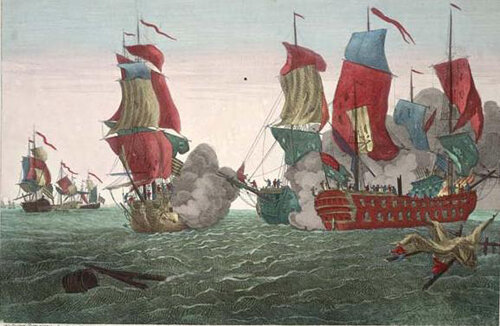
    • In September of 1779 the Bonhomme Richard encountered a massive fleet of 40 British merchant ships. This Fleet was guarded by the 44-Gun Frigate Serapis and the 28-Gun Countess of Scarborough.
    • Ben Thompson from one of my favorite blogs BadassOfTheWeek.com writes:

”  Jones ordered his ships on the attack, and the Bonhomme Richard and the Serapis closed and became involved in a brutal Frazier-and-Ali style old-school life-or-death face-smashing brawl.  Devastating broadsides from Serapis blew apart theBonhomme Richard‘s sides, knocking out several of her main deck cannons and crippling the ship.  Jones fired back with broadsides of his own, but continued fire from the larger and more heavily-armed Serapis raked his ship, driving in his counters and quarters, forcing him to abandon all of his lower-deck guns, and catching Bonhomme Richard on fire in several places.  At one point in the battle, a volley from Serapis blew a large portion of the Bonhomme Richard‘s mast off, causing Captain Pearson of Serapis to ask whether Jones had struck his colors in surrender.  Jones took a look at the burning wreckage of his crippled warship, which taking on water and littered with dead bodies, set his jaw, and declared:


‘Surrender?!  I have not yet begun to fight!

Jones then rammed Serapis with Bonhomme Richard, fouling both ships together.  Serapis attemped to pull away from the Bonhomme Richard so she could bring the full might of her artillery to bear on the almost-defenseless American ship, but Jones threw hooks over the side and lashed the two ships together.  His desperate men poured musket fire and hurled hand grenades at the Serapis‘ deck, setting fire to the ship and inflicting heavy casualties.  A large contingent of British marines forward in an attempt to board the American vessel, but Jones was able to repulse the boarding party before leading a group of his own men over to Serapis, where he was able to capture the vessel and effect her surrender.

By the time the sun set that night, both ships were crippled, had lost over half of their men and were on fire in numerous places.  Bonhomme Richard had to be abandoned the following morning when attempts to bail several feet of water out of her hold proved fruitless.”

  • JPJ won. He was knighted by the King of France, Kin Louis. He was given the order Military Merit from the French and the Medal of Valor from the US Continental Congress in 1787. The British Government hated him.
  • When JPJ captured the Serapis he sailed it into a Dutch Port and there was some political tension that arose from this the details of which are messy and complicated. But what came out of it was that JPJ flew his own flag over the Serapis, thought to be designed by Benjamin Franklin (ambassador to Paris at the time).

This SOB flew his own made up flag lol.

  • Now after the American Revolution JPJ found himself home in the US with no wars to fight.
    • The war hound was restless. So he set sail for Russia and enlisted his services for Empress Catherine II in the Russian navy.
      • Jones served as a Rear Admiral for a Black Sea Russian Fleet under the appointment of Catherine the Great. He went by the name Pavel Dzhones.
      • He became Vice Admiral and commanded the Vladimir, an 24-Gun flagship of the Imperial Navy.
    • Under the Russian flag he defended the Liman Region of the Black Sea from the Ottoman Turks. He was awareded the Order of Saint Anne from the Russian Monarchy.
  • He retired to Paris in 1790.
    • Two years later in 1792 he died. His remains were barried in Saint Louis Cemetary.
"An honorable Peace is and always was my first wish!  I can take no delight in the effusion of human Blood;  but, if this War should continue, I wish to have the most active part in it."
“An honorable Peace is and always was my first wish! 
I can take no delight in the effusion of human Blood; 
but, if this War should continue,
I wish to have the most active part in it.”
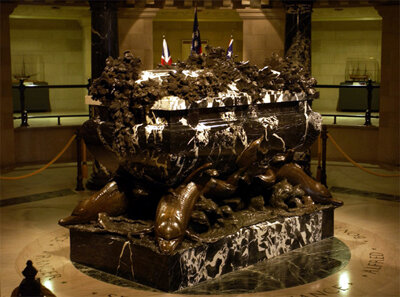
  • The French, anticipating the US government would one day wish to return Jones’s remains to America, buried him in an expensive lead casket that was filled with rum for preservation. 
  • In 1905, after an extensive four-year search funded by the US Ambassador Horace Porter, Jones’s body was rediscovered.
  • JPJ’s body was exumed and returned to the US Military escorted by many battleships. He was burried with full military honors at the US Naval Academy chapel in a sarcophagus.
  • President Theodore Roosevelt would have Captain John Paul Jones reinterred at a specially built chapel at the US Naval Academy in Annapolis, Maryland. Renewed interest in John Paul Jones led to Congress allocating $50,000 in June 1909 for a memorial to be built for him on the National Mall.
  • The memorial includes a bronze statue of Jones, 10 feet high, sculpted by Charles Henry Niehaus of New York City. It shows Jones standing with his left hand on the hilt of his sword. The rest of the memorial has a 15-foot marble pylon behind him, with two bronze dolphins on either side shooting water. This part was designed by the firm of Carrere & Hasting also of New York City.
  • The john Paul Jones Memorial was dedicated on April 17, 1912 which, by happenstance, was just two days after the British steamship Titanic sank. The memorial was dedicated by President William Howard Taft. The statue was unveiled by Spanish American War hero Admiral George Dewey. 
  • Jones is also remembered by his adversaries. The quaint Scottish cottage on the estate of Arbigland, where the gardener’s son, the future John Paul Jones, grew up has been preserved as a museum.
  •  Furthermore, the British Port of Whitehaven, raided by Captain Jones during the American Revolution, decided to pardon him in 1999.

CREDIT:

Categories
Uncategorized

Mr. Big

The content below is from episode #152 of the Who’d A Thunk It? Podcast

RSS Feed: https://anchor.fm/s/12f7e6f0/podcast/rss

RECOMMENDATION SEGMENT

Joel Edgerton (left) plays an undercover cop and Sean Harris a suspected child killer in gripping Netflix drama The Stranger. 

  • This week I recommend you watch The Stranger on Netflix

NOW FOR THE MAIN EVENT

********SPOILERS AHEAD****************

  • The Real Crime
    • Daniel James Morcombe (19 December 1989 – 7 December 2003) was an Australian boy who was abducted from the Sunshine CoastQueensland on 7 December 2003 when he was 13 years old.
      • Morcombe was abducted from an unofficial bus stop under the Kiel Mountain Road overpass in the Woombye district of the Sunshine Coast approximately 2 kilometres (1.2 mi) north of the Big Pineapple on Sunday, 7 December 2003. Witnesses reported seeing Morcombe at approximately 2:10 pm under the overpass. Morcombe planned to catch the 1:35 pm bus to the Sunshine Plaza Shopping Centre for a haircut and to buy Christmas presents, but the bus had broken down. When a replacement bus eventually arrived, it did not stop, because it was behind schedule and the stop was unofficial; the driver radioed the depot for another bus to go and pick up Morcombe. The driver and other witnesses later reported seeing two men near Morcombe. When the second bus arrived three minutes later, Morcombe and the men were gone.
        • Morcombe’s disappearance was one of the most extensively investigated crimes in Queensland’s history. By 12 December 2008 rewards of A$250,000 from the Government and A$750,000 donated privately had been offered.
    • Eight years later, Brett Peter Cowan (born 18 September 1969), a former Sunshine Coast resident, was charged with Morcombe’s murder. In the same month, DNA tests confirmed bones in the Glass House Mountains were Morcombe’s. On 13 March 2014, Cowan was found guilty of the murder,and was sentenced to life imprisonment for indecently dealing with a child and interference with a corpse.
    • Brett Peter Cowan(born 18 September 1969) is an Australian murderer and child rapist.
      • The 13-year-old Daniel Morcombe’s abduction led to an eight-year investigation involving various suspects.
      • Cowan was living in the town of Beerwah around the time of Morcombe’s disappearance. He was approached by police because of his criminal history and his proximity to the area in which Morcombe was last seen. Just days after the disappearance, however, he denied his involvement. A former police officer believed Cowan to be suspect from just one encounter: he stated that “Look, if he’s not good for that, he’s good for something. I left with the distinct impression of guilt.” A police interview with Cowan was conducted in July 2005 in the Gold Coast. Detective Tracey Barnes, who handled the interview, asked Cowan if he would admit being involved and he responded with “probably not”
      • As a result of these investigations Cowan led under cover police to a potential burial site. He was charged with the murder that same month and Morcombe’s remains were discovered days later on 17 August. Cowan was sentenced to life imprisonment, (being eligible for parole in 2031) on 13 March 2014 in a trial that attracted worldwide attention. Cowan had two previous convictions for sexually abusing children, the earliest dating back to 1987
  • The Movie
    • In 2022, an Australian crime thriller movie based on the events surrounding Daniel Morcombe’s murder and more so the investigation into his murderer was released titled The Stranger. It was written and directed by Thomas M. Wright.
    • In the movie “The Stranger,” actor Sean Harris stars as Henry Teague (the criminal based on Brett Peter Cowan) and actor Joel Edgerton, also one of the film’s producers, plays Mark Frame, an undercover cop tasked with getting the truth out of Teague years after the crime.
    • The movie is mostly about the investigation and operation to get Teague/Cowan to confess to the murder of the boy.
    • Australian police create a VERY elaborate sting with multiple undercover cops acting as a fake organized criminal enterprise. The undercover cop character Mark Frame is the one that works the most with Teague/Cowan.
    • If the audience is unfamiliar with the Daniel Morcombe case (as most American viewers likely will be unfamiliar) than the movie has a big twist in the end.
    • It starts out with Teague being recruited by Mark Frame into the organized criminal group. They go on multiple jobs together to gain Teague/Cowan’s trust.
    • As the audience watches they realize something is a bit off in more ways than one. First, you realize that Mark Frame isn’t who he says he is and that gradually comes out as he is an undercover cop… but you aren’t sure why, you think maybe he is a rat agains the organized crime group.
      • At the same time you realize the character you’ve been watching from the very beginning, the Teague/Cowan Character is creepy as hell and has a disturbing past he wants to keep secret from the organized crime group he is trying to become a part of.
    • Then of course you realize Mark Frame isn’t trying to rat out the organization, he is trying to get Teague/Cowan to confess.
    • As Mark Frame and Teague/Cowan go on fake crime runs together it becomes increasingly creepy.

Just to try and help you the reader keep things straight: Joel Edgerton (left) plays Mark Frame, the undercover cop. And Sean Harris (right) plays the Teague character based on the real-life child molester&murderer Brett Peter Cowan.

  • The movie the Stranger 2022 was first released at the Cannes Film Festival and had a short run in the theaters in Australia before it was released on Netflix in October of 2022. It is still on Netflix in the US and was on the Top 10 list of movies for weeks.
    • Leslie Katz from CNet writes:
      • The film is a spare, perfectly paced psychological thriller that explores the uneasy friendship between Teague and Frame, as well as the formidable burden and cost of keeping one’s true identity a secret, as both men do. 
    • It won some recognition andwas nominated for 11 Australian Academy of Cinema and Television Arts Awards this year, including best film, best direction, best lead actor, best supporting actor, best supporting actress and best cinematography, a much deserved recognition of the movie’s lyrical visuals, which build the moody suspense.    
    • The movie wasn’t created just from news headlines and research. There was a book The Sting: The Undercover Operation That Caught Daniel Morcombe’s Killer written by a crime reporter by the name Kate Kyriacou. The book goes into great detail about the undercover operation the Queensland police pulled off to get Cowan to confess.
    • What sets this story apart from other investigation stories is the elaborate procedure.
      • A covert police operation that had been used in Canada drew the attention of an investigator involved in Morcombe’s case. The procedure, known as Mr. Big, consists of police officers who pose as members of a corrupt criminal gang to gain the confidence of the alleged suspect, enlisting the suspect’s participation in an escalating series of often elaborate fictional crimes, particularly theft, prostitution and the drug trade. Once the suspect’s trust has been gained, the police persuade the suspect to confess to the earlier, real crime. In this case, an undercover police officer, posing as a crime boss known as “Paul Fitzsimmons” or “Fitzy”, befriended Cowan on a flight to Perth in April 2011. Fitzsimmons gained the trust of Cowan and the two became friends. Due to the absence of any physical evidence, a confession by Cowan was needed. Over the following months, Cowan’s gang of friends initiated him through an array of fake criminal scenarios. Cowan was issued a subpoena for his alibi in Morcombe’s case; however, he denied any involvement. In August 2011, at an interview at the Perth Hyatt Hotel, an undercover officer gained Cowan’s trust, saying he “only wanted to help Cowan”, and that Cowan could trust him with anything. Cowan subsequently disclosed his involvement in Morcombe’s abduction and the confession was captured on video.
    • While the movie The Stranger does change the names of the characters involved, it is very close to the real story.
    • Both Daniel MorCombe and the fictional boy James Liston from the movie were abducted under an overpass in Queensland Australia at a bus stop. Like the movie, there was a huge undercover police operation and one undercover officer did “befriend” the abductor/murderer.
  • After the crime, investigation, and trial, Brett Peter Cowan is rotting in prison.
    • He is currently 53 years old sentenced to life in prision in 2014. His defense was that his confession was false and was given under false pretenses. But he was convicted and during sentencing Justice Roslyn Atkinson of Brisbane Supreme Court described his crime as “entirely abhorrent,” stating “you have tragically and pointlessly snuffed out a young life.”
    • It is a fairly well-known fact that prison systems don’t take kindly to the type of crime that Cowan committed.
      • In 2016 inside the high-security section of Wolston Correctional Centre, a fellow inmate of Cowan’s threw a bucket of boiling water on him burning 15% of his body, mostly on the head, chest, and legs.
      • In 2018 he was stabbed in the neck with a makeshift shive carved out of a toothbrush.
        • These are extremely violent acts that in this particular situation probably don’t garner much sympathy for the victim.
  • The undercover cop from the real story is faceless and only ever given a fake name for obvious reasons.
    • Paul “Fitzy” Fitzsimmons is the name given to the real-life undercover cop, but don’t be surprised to find that is a fake name. The identity of the undercover cop who did most of the groundwork on the Mr. Big investigation procedure is kept under lock and key for his safety.
    • The actor Joel Edgerton said he did not even try to meet the real-life counterpart to his fictional Mark Frame character. He told the Sydney Morning Herald he’s never met or spoken with the real Frame “because we were investigating the truth, taking that truth and telling a fictionalized version of it, which is about protecting everyone involved.”
    • There is no way to confirm if the real undercover cop on the case has a son like the fictional version does. That may have been an added detail to get the audience to feel more tension while viewing the film.


Joel Edgerton standing on a dirt road in a forest
In The Stranger on Netflix, Joel Edgerton plays Mark Frame, an undercover cop who finds himself getting close to someone who may have committed an unspeakable crime.  Ian Routledge/Netflix
  • The movie seems to be a hit with most people.
    • It currently has a 91% on Rotten Tomatoes which is a damn-good score.
    • But not all enjoy the movie. When a real-life crime of this gruesome of nature comes out, the victims seldom give anything but scorn.
    • Daneil Morcombe’s parents Denise and Bruce strongly disapprove. Denise tweeted “The movie The Stranger is not supported by the Morcombe family. Individuals who make money on a heinous crime are parasites … We find the making of the movie morally corrupt and cruel.”
    • The parents have said on the news “The actual predator looks exactly like Brett Peter Cowan,” Bruce Morcombe told Australia’s ABC News. “Of course, it’s not a fictitious story. Only an idiot would suggest that.”
  • Daniel Morcombe’s parents run the Daniel Morcombe Foundation to educate children about staying safe in physical and online environments. The red T-shirt Daniel wore on that December day he went missing has become a symbol of child safety awareness in Australia. People dress in red for an annual National Day of Action for Child Safety, held on the last Friday in October. The event’s called Day for Daniel.
Crowd dresses in red in honor of Daniel Morcombe, who wore red the day he went missing as a 13-year-old
Members of the Sunshine Coast community wear red as a symbol of child safety awareness on this year’s Day for Daniel. Daniel Morcombe Foundation

CREDIT

Categories
Uncategorized

Doc Ellis and the No-No

The content below is from Episode 151 of the Who’d a Thunk It? Podcast

RECOMMENDATION SEGMENT

  • This week I recommend you go buy some cheap crap.
    • LOL, it sounds odd, but do it. Go to a thrift store, a dollar store, or if you are feeling boujie go splurge at a Five Below.
    • You’d be surprised what fun things you can find.
    • Dollar stores have some of the best quality playing cards
    • We got a back massager at Five Below and it is so satisfying to work out those knots on our backs and plus the cat LOVES it
    • Have you ever gone shopping at a Thrift Store in a rich neighborhood? We found a crystal flower vase for $3 LOL

NOW FOR THE MAIN EVENT

  • Dock Phillip Ellis Jr. (March 11, 1945 – December 19, 2008) was an American professional baseball player.
    • Although his name would become more associated with the city of Pittsburgh later in his career, Doc was a born and raised a Californian, born in LA.
    • He went to Gardenia High School and right around the time of his Freshman year (14 years old) he started to experiment with drugs and alcohol.
    • He joined the school basketball team and did well, but refused to join the school baseball team after a player referred to him as a “spearchucker.”
    • However, he would eventually play for Gadena high baseball.
    • One day Doc got caught drinking and smoking pot in the high school bathroom senior year. The school principal made a deal: play baseball for the school or get expelled.
    • Doc appeared in 4 high school baseball games and was named an all-league player.
    • Not long after, Doc was diagnosed with sickle cell anemia at age 17. The diagnosis was later changed to sickle cell trait.
  • He played in Major League Baseball as a right-handed pitcher from 1968 through 1979, most notably as a member of the Pittsburgh Pirates teams that won five National League Eastern Division titles in six years between 1970 and 1975 and won the World Series in 1971. Ellis also played for the New York YankeesOakland AthleticsTexas Rangers and New York Mets. In his MLB career, Ellis accumulated a 138–119 (.537) record, a 3.46 earned run average, and 1,136 strikeouts.
    • He was flamboyant, passionate about the rights of his fellow African American players, and known for enjoying all sorts of recreational drugs.
  • Sports Illustrated tells tales of Doc’s sports career better than I could:
    • “As a player, Ellis was equal parts ferocious and flamboyant. Once, in 1974 against the Reds, he made it his mission to plunk every Cincinnati batter in an attempt to intimidate the nascent Big Red Machine; he got five hitters into it, nailing the first three and throwing over the heads of Tony Perez and Johnny Bench, before he was pulled. Another time, as a member of the Athletics in ’77, he he took pitching charts he’d been ordered to fill out and burned them in the locker room, setting off the sprinklers. And he had to be expressly told by Commissioner Bowie Kuhn in ’73 not to wear hair curlers onto the field. Ellis was more than just a character, though: He was a key part of the 1971 World Series champion Pirates and the ’76 Yankees, who won the pennant, and started the ’71 All-Star Game for the National League opposite Oakland’s Vida Blue—the first time two pitchers of color had ever started the Midsummer Classic.”
    • In a video I watched, Doc defiantly says “get the hell out of here” to the people from his past telling him not to wear curlers in his hair. I’m not a fan of the look myself. I think curlers look tacky, however, there is something badass about a guy wearing a hair style typically associated with feminity and just not caring what anyone else thinks about it. The photos of Doc wearing his curlers looks so damn cool to me, especially the ones where he is in uniform.
  • There have been 318 no-hitter baseball games recognized by the Major League BaseballPlayers Association.
    • This story is about one of those games, played on June 12th of 1970. The thing that set’s Doc Ellis’s first and only no-hitter apart from the other 317 was that he was, as Doc puts it: “High as a Georgia Pine.”
  • On that day, June 12th 1970, the Pittsburgh Pirates baseball team faced off against the Padres in the old San Diego Stadium.
    • Sport Illustrated wrote:
      • Ellis took the mound having dropped acid earlier that day and blanked the Friars, walking eight batters and hitting another (otherwise known as an A.J. Burnett Special). It was the first and only no-hitter of Ellis’ career, and almost certainly the lone MLB no-hitter pitched under the influence of LSD. (If you know otherwise, drop us a line.)
  • Two days before the game kicked off he went to go visit a lady friend in LA. While there he took some Acid and partied all night doing an assortment of drugs and drinking alcohol. He partied so hard that he passed out in the wee hours of the morning and didn’t wake up until the following day.
    • So he went to his lady friend’s house on Wednesday, partied so late into the night that he slept through all of Thursday. When he woke up Friday morning he thought it was still Thursday. So he popped another Acid around noon.
    • Two hours after taking Acid and thinking he didn’t have to pitch until the next day, his friend in LA informed him that it was in fact Friday and his ass better be on the mound in San Diego before the game started.
    • Doc got his ass moving the best he could. He hopped on the next flight to San Diego and was able to make it to the Stadium about 90 minutes before the game commenced… but the thing about Acid is that it doesn’t wear off like alcohol or any other drug for that matter.
  • LSD is no joke
    • Lysergic acid diethylamide (LSD) is a popular psychedelic drug that alters the state of your mind in significant ways. This potent drug binds to specific brain cell receptors and alters how the brain responds to serotonin, a neurotransmitter that regulates emotions, moods, and perceptions.1 By binding to these receptors LSD modifies neural pathways, producing visual hallucinations and altering the perception of things such sound and time.2-3
    • The mind-altering effects experienced during an “acid trip” could last for up to 12 hours…
  • I’m personally impressed that Doc Ellis was able to scrape himself off the couch, put on his uniform, and fly to LA … let alone pitch a whole game no-hitter.
    • Doc had recounted the day himself multiple times. He said the ball would look gigantic and as if it were speeding right towards him and scare him into flinching for one play, only to have it fall short of the mound. In the next play the ball would appear as small and fragile as a robin’s egg inside his mit.
    • He expressed the lack of vision to the point where he could only tell which side of the play the batter was on and could barely read the signals his catcher was giving him.
  • In 1984 Doc  recounted:
    • “I started having a crazy idea in the fourth inning that Richard Nixon was the home plate umpire, and once I thought I was pitching a baseball to Jimi Hendrix, who to me was holding a guitar and swinging it over the plate,” “I remember diving out of the way of a ball I thought was a line drive. I jumped, but the ball wasn’t hit hard and never reached me.”
    • “I can only remember bits and pieces of the game,” Ellis recalled in 1984. “I was psyched. I had a feeling of euphoria. I was zeroed in on the [catcher’s] glove, but I didn’t hit the glove too much. I remember hitting a couple of batters, and the bases were loaded two or three times. The ball was small sometimes, the ball was large sometimes, sometimes I saw the catcher, sometimes I didn’t.
    • “Sometimes, I tried to stare the hitter down and throw while I was looking at him. I chewed my gum until it turned to powder. They say I had about three to four fielding chances. I remember diving out of the way of a ball I thought was a line drive. I jumped, but the ball wasn’t hit hard and never reached me.”
  • Now, it should be mentioned that Ellis is the one and only source for this story and he didn’t share it publicly until 14 years after the event. So naturally some have doubted that he was under the influence when he pitched his No-No.
    • Today you can only watch bits and pieces of the game. Despite the game being televised, the MLB has not released the video of the game in its entirety.
    • Not to mention that although it was a No-Hitter, it wasn’t a pretty performance.
  • The Guardian writes:
    • In some ways, Ellis’s performance for the Pirates against San Diego Padres on Friday 12 June 1970 was not exactly a pitching masterclass. Ellis recorded more walks (eight) than strikeouts (six), hit another batsman, allowed three stolen bases, and was bailed out by highlight-reel plays in the field by second baseman Bill Mazeroski and centerfielder Matty Alou. 
  • It was his teammate, Danny Cash, the 2nd baseman, who kept telling Doc “you got a No-No going,” referring to the No-Hitter.
    • Doc said he wanted him to shut the hell up. It was bad luck to put attention on a no-hitter, especially just after the first inning.
      • I can relate to that. I tell my buddies when we are playing video games or any type of game that if I am doing well, DON’T tell me in the moment. Feel free to praise my performance afterwards, but if you bring the fact that I’m doing really well to my attention mid-game, I’m going to choke.
      • Every time, without fail, if a buddy says “damn dude, you are killing it!” I immediately get in my own head and play terribly.

During his 12 years in the major leagues, Dock lived the expression “Black is Beautiful!” He wore curlers on the field. He stepped out of his Cadillac wearing the widest bell bottoms and the broadest collars. When he put on his uniform, he was one of the most intimidating pitchers of the 1970s.

Dock was often at the forefront of controversy and has been called the “Muhammad Ali of Baseball.” He was an outspoken leader of a new wave of civil rights in sports, when black athletes were no longer content to accept second-class treatment or keep their mouths shut about indignities. For this, the press labeled him a militant.

When he wasn’t playing ball, Doc was making waves in the name of equal rights… and this was back in the 70s when equality was a lot more sparse than they are today.

  • When he wasn’t playing ball, Doc was making waves in the name of equal rights… and this was back in the 70s when equality was a lot more sparse than they are today.
    • I have mad respect for the man for this.
    • It is well known now that Baseball (among MANY other facets of life) were institutionally racist, and Doc wasn’t having none of that shit.
  • On another note of standing up for what he believed in, Doc didn’t hide the fact that he did drugs. At a time when Nixon (Ol’ Tricky Dick) with his SUPER anti-drug policies some of which are still being felt today and are widely regarded as unreasonable, Doc was dropping Acid and going to games LOL.
    • Regardless of how you feel about substance abuse, you must recognize the gumption of the man.
      • It should be noted that sometime after he left baseball, Doc got sober. Not only did he change his life around, but he launched a career around helping others kick their addictions as well. He was a drug addiction counselor specializing in helping prison inmates get sober.
    • After Dock retired from baseball, he was as outspoken about his addictions to alcohol and amphetamines (aka “greenies”) as he had been about racial prejudice during his career. He spent his last decades using that blunt honesty as a counselor helping other addicts.
    • It was a drive to do good that was a constant in his life after retirement, when he got sober and worked with the Pennsylvania Department of Corrections to rehabilitate black prisoners, helped start the Black Athletes Foundation for Sickle Cell Research and served as the coordinator of an anti-drug program in Los Angeles. As he explained to enrollees, he self-medicated to cope with the fear of both losing and winning. He came to bemoan the feat he’s most associated with simply because it “robbed him of his greatest professional memory”.
      • I mean… how honorable, yet still rebellious is that?
      • Kinda reminds me of Johnny Cash doing a concert in Folsom Prison

Since then, the Internet has fueled the legend of Dock Ellis. This will be the first time his legend – and the story of the man behind it – will be told in a feature film.

It was in 2008 that Doc died of cirrhosis of the liver. His legendary baseball career, and commendable lifestyle will not be forgotten.

CREDIT

Categories
Uncategorized

Space Poop

The content below is from Episode #150 of the Who’d a Thunk It? Podcast

RECOMMENDATION SEGMENT

  • This week I recommend you make something from scratch!
    • Last week I saw a YouTube video of a guy making a PB+J sandwich completely from scratch. He baked the bread, made the jam, and blended his own peanut butter. It looked fun and delicious.
    • So Shannon and I replicated it.
    • The first attempt at making jam turned out to be more of a blackberry-flavored rock lol.
    • But jam 2.0 came out great.
    • THIS is how you make a PB+J
    • The coolest discovery was how easy it is to make your own peanut butter which is much less sweet than store PB.
    • Just buy peanuts (Spanish peanuts are best if you can find them), put in oven 300F for 30 minutes, then blend on high for about 10 minutes. Careful, they get hot in the blender.
  • So pick a favorite snack and look up how to make it from scratch. Bonus points if you make it with someone you love!

NOW FOR THE MAIN EVENT

  • Episode #87 of this podcast titled “Where does our poop go?” examined where human waste ends up… down here on Earth.
    • This episode I wanted to look into a question that randomly popped into my head the other day: “How do astronauts poop? Where does all of their bodily waste go?”

WARNING

  • This episode will contain language and topics meant for adults. Listener discretion is advised.
  • When we shit or piss down here on earth it usually goes in one direction: down.
    • Thanks to gravity our waste is pushed down and away from the rest of our bodies. For eons we humans popped squats in the woods or the savannah and now most of us use the toilet. Both methods require gravity.
    • But for someone in zero gravity, they can’t rely on that downward force to make sure their waste goes down the drain. Your average toilets don’t work in space.
      • Sure, if you have a nice solid shit, there is less mess, but what if you and the crew just had space chimichangas the night before? You don’t want all that nasty mess floating around you and getting into all that expensive space equipment.
  • Back in the beginning of space travel, when toilets were the least of everyone’s problems over at NASA, the first American mission in space didn’t even have a plan for a bathroom break.
    • it was in 1961 when Alan Shepard became the first American to go to space. It was supposed to be a very short trip and so mission command didn’t even bother with a bathroom plan. When launch was held up for over 3 hours after Alan Shepard had already strapped himself in he asked if he could pee LOL
    • Mission command found it would cost a whole lot of money to let him out of the rocket and start all over so they concluded he could just piss himself inside his space suit LOL.
    • The first American in space did the thing with piss sloshing around his toes.
  • Jump to the year 2000 and a space toilet was invented for American astronauts.
    • Though it was only designed for men, it was later used by women as well… though they had to awkwardly pee standing up.
    • To take a dump they had a pretty standard toilet, but with straps on the side to keep the astronauts ass tighter to the toilet rim creating a seal so none of the shit got out.
      • This model was flawed, didn’t work very well, and it wasn’t a fun job to clean this bad boy.
  • The toilets used today are meant for women and men so they are more comfortable.
    • Directly from Buffalo.edu:
      • In 2018, NASA spent over $23 million on a new and improved toiletDownload pdf for astronauts on the International Space Station. To get around the problems of zero-gravity bathroom breaks, the new toilet is a specially designed vacuum toilet. There are two parts: a hose with a funnel at the end for peeing and a small raised toilet seat for pooping.
  • When the astronauts go to use this high tech toilet, they have to strap down their hands and legs so they don’t drift away mid-dump or mid-piss LOL.
    • To piss they just pick up the funnel around their naughty bits and press hard enough to their skin so no piss leaks out.
    • To shit they lift the lid of the most expensive toilet ever created and sit down. As soon as that lid is lifted the toilet begins suction to make sure no shit particles escape and to keep the smell to a minimum.
    • Space toilets have a smaller hole than the ones down here on earth and that is to make sure the seal between the toilet seat and the ass is more secure.
  • So, I know what you are saying: “Zeb, this is great stuff. I love hearing about shit in space and how it is done, but I want to know more! I need to know what happens to it!”
    • Well have no fear Who’d a Thunker! … but first a quote:

If you’ve ever seen a shooting star, it might have been a meteorite burning up in Earth’s atmosphere — or it might have been flaming astronaut poo.

Tracy Gregg
  • First, let’s talk about the piss.
    • Ok, so piss is 90% water right?
    • And to transport anything to space, to the International Space Station for example, costs a lot of money… Can you see where I’m going with this?
    • Here’s a direct quote from the National Aeronautics and Space Administration (NASA) themselves:
      • An astronaut on the International Space Station (ISS) requires about one gallon of water each day, and at $83,000 per gallon to lift into space, the costs can quickly add up. It is approximately $500,000 per day to supply water to a crew of six astronauts on the ISS using launch vehicles for resupply. High costs have driven NASA to develop and utilize systems that recycle water in space.
    • All astronaut pee is collected and turned back into clean, drinkable water. Astronauts say that “Today’s coffee is tomorrow’s coffee!
    • When you think about it, it makes perfect sense. They drink their own recycled pee and that is precisely what any human would need to do on a long-distance space mission.
  • Now for the space shit.
    • On occasion, they will bring astronaut crap back to earth to be studied. Astronauts are above Earth’s protective magnetic field and therefore are subject to cosmic radiation. That fact coupled with the fact that scientists will literally study anything is why they might study astronaut shit.
    • But for the most part, space poop is burned.
      • Their shit, along with all wipes, TP, and gloves, gets vacuumed up into plastic waste bags that are then put into airtight sealed containers.
        • The gloves are a space thing. Zero G makes wearing gloves a necessity for shitting in space apparently LOL
      • The airtight containers are loaded onto a special spacecraft that was just used to bring supplies to the space station. That poop filled spacecraft is then shot back to earth, but not with the intent of landing. No, the spaceship (or spaceshiT) is intentionally burned up in Earth’s atmosphere.

The image above is of a Russian Progress spacecraft. These spacecrafts bring supplies to the ISS and take on trash and waste, which are then burned up in the atmosphere with the spacecraft. NASA/Wikimedia Commons

Above are some space toilets

  • Vox did an article titled “Apollo astronauts left their poop on the moon. We gotta go back for that shit.
    • The article has some cool insights into space shitting that I thought was interesting so here is the premise:
      • It’s been nearly 50 years since the Apollo 11 moon landing. Neil Armstrong’s iconic footprint is still there, undisturbed; there’s no atmosphere, no wind on the moon to blow it.
      • But the bigger human footprint on the moon is, arguably, the 96 bags of human waste left behind by the six Apollo missions that landed there.
      • Yes, our brave astronauts took dumps on their way to the moon, perhaps even on the moon, and they left behind their diapers in baggies, on humanity’s doorstep to the greater cosmos.
      • The bags have lingered there, and no one knows what has become of them. Now scientists want to go back, and answer a question that has profound implications for our future explorations of Mars: Is anything alive in them?
      • Human feces can be disgusting, but they’re also teeming with life. Around 50 percent of their mass is made up of bacteria, representing some of the 1,000-plus species of microbes that live in your gut. In a piece of poop lives a whole wondrous ecosystem.
      • Planet Earth has hosted this life and so much more for upward of 3.9 billion years. The moon, as far as we know, has been sterile and lifeless that whole time.
      • With the Apollo 11 moon landing, we took microbial life on Earth to the most extreme environment it has ever been in. Which means the human feces — along with bags of urine, food waste, vomit, and other waste in the bags, which also might contain microbial life — on the moon represents a natural, though unintended, experiment.
    • That is the gist of it. They go into the logistics for both possible outcomes: the bacteria is alive or the bacteria is not alive. They also talk about what this means for future missions to Mars in the hopes of colonization and the possible insights the moon poop could give in relations to the beginning of live on Earth.
      • Was life on earth started by an alien civilization dropping their shit off here billions of years ago?
    • See! You didn’t think space poop could be this interesting did ya? LOL
  • The last section of this episode isn’t necessarily about poop. This is the most mature section of the episode. Where before I was just using curse words, this part is truly not meant for children. YOU’VE BEEN WARNED… AGAIN
  • The real question that popped into my head the other day was: do astronauts masterbate while in space?
    • Some missions are brief like Alan Shephard’s brief flight in 1961, but what about Astronaut Scott Kelly’s famous 340 day stay on the International Space Station (ISS)? Are you telling me he went that long without climaxing? And STILL was able to keep a cool head?
      • I thought: it can’t just be done willy nilly or the ISS would look like a snowglobe with floating ejaculate flying around at all times.
      • Then I thought: do they shoot it out into space?
    • Luckily I wasn’t the only one who thought this would be an interesting topic. VICE did an article about it.
  • VICE’s Shamani Joshi (a Gen Z-focused culture reporter who curates conversations on tech, drugs, sex, and unconventional lifestyles.) wrote an article titled: Can Astronauts Masturbate in Space? An Investigation. We know space sex might come with significant logistical difficulties, but what about self-pleasure?
    • Apparently sex in space, contrary to how Carl Sagan wrote about it in his famous book adapted to Hollywood movie Contact, is not fun. I just recently listened to the VERY long unabridged Contact book. It was great, but was a lot of talk about how sex is unimaginably great in space in the book. That is in stark contrast of what I found out looking stuff up for this podcast LOL
    • Apparently Zero G makes it hard to hold on to your partner and to stay in the desired position.
    • Plus, having your expensively trained astronauts bumping uglies is an unnecessary risk to the mission. When people do the deed, drama is bound to follow. They are all coworkers up there after all.
    • Those are the realistic arguments against sex in space and NASA doesn’t really ever entertain any questions related to it… but what about just cranking one out on your own? … a solo mission if you will? LOL
    • Here’s a paragraph directly from the VICE article
      • “A few years ago, Marjorie Jenkins, a NASA advisor and expert on sex and gender health, wrote in a paper titled ‘Effects of Sex and Gender on Adaptations to Space: Reproductive Health’ that ejaculation was essential for men to avoid the risk of bacteria building up in their prostate, which could then lead to genitourinary infections. Many studies also conclude that masturbation is a great way to relieve stress and anxiety, so it would make sense for someone in a high-pressure space mission to want some form of escape.”
    • While NASA won’t discuss their astronauts beating it in space, Russian Cosmonauts don’t seem to have an issue LOL (us Americans, we’re so uptight about sex compared to other countries it seems).
      • To be fair, I understand why NASA doesn’t talk about it. It degrades the little amount of privacy these astronauts have up there on the station being on camera all the time. But I’m just curious of the logistics of it all ya know. So, I’m glad some Cosmonauts talked about it
    • Valeri Polyakov, a retired cosmonaut, kept a diary and said  “Psychological Support Service sent us some nice, ‘colorful’ movies which help to recover our will, to act like a normal adult male. There is nothing to be ashamed of.”
    • Valeri even said his higher ups told him to pack a sex doll for his 14-month stay in space (a record). But Valeri didn’t bring the doll for fear he might fall in love with the doll over an actual woman LOL
    • I mentioned cameras being fixed on the astronauts all the time, but the VICE article pointed out that the astronauts control these cameras and could probably just have the cameras avert their gaze and “rub one out while they’re having a shower or when huddled in their phone booth-sized sleeping quarters.”
  • Then comes the final question, the last tid bit to satiat my curiosity: what happens to the cum?
    • LOL, I know I’m so immature
      • Here’s what VICE said: “Finally, there’s also the question of what happens to the cum if an astronaut were to touch themselves. While tissues and wipes are available on the spacecraft, they may choose to dispose of these bodily fluids the same way they throw out piss: by dumping it in space where it freezes into ice crystals. Not quite the big bang you imagined.”

Remember that quote from Tracy Gregg I said earlier? Well here’s my unabridged version:

“If you’ve ever seen a shooting star, it might have been a meteorite burning up in Earth’s atmosphere — or it might have been flaming astronaut poo. ” – Tracy Gregg

“or apparently flaming astronaut nut.” -Zeb MC

LOL THANKS FOR LISTENING/READING WHO’D A THUNKERS

UNTIL NEXT TIME

CREDIT:

Categories
Uncategorized

JFK and the Coconut

The content below is from Episode 149 of the Who’d a Thunk it? Podcast

RECOMMENDATION SEGMENT

  • Next Level Chef
    • Yes, it isn’t my typical kind of show and if it weren’t for my wife Shannon, I probably wouldn’t watch any reality competition show like this. But I’m glad I do.
    • It started with the Great British Baking show which is such a happy feely baking show. Then we binged a couple seasons of Master Chef.
    • Well the latest food competition show we are obsessed with is Next Level Chef starring Gordon Ramsay.
      • We love watching Gordon lol
      • I particularly love the fact that he is known for being a hardass on his adult shows, but when he is working with children he turns into the sweetest guy on the planet LOL.
    • The plot of the show: Chefs Gordon Ramsay, Nyesha Arrington and Richard Blais recruit talented chefs and take them under their wings as they face unique cooking challenges in a one-of-a-kind culinary gauntlet with the goal of finding the food world’s newest superstar.
    • It is in Vegas and the 3 storied kitchens makes this show unique. There is the basement kitchen which has dull knives and very little options for cooking. There is the the middle kitchen which is like a standard mid level restaurant kitchen, then the 3rd level is a kitchen with REALLY expensive equipment.
      • The contestants don’t know what ingredients they get until they are lowered on a platform through the three levels. So the 3rd floor gets first pick, 2nd floor gets 2nd dibs, and the basement gets the last picked ingredients.
    • Shannon and I enjoy it. I think you might too

NOW FOR THE MAIN EVENT

  • John Fitzgerald Kennedy was born May 29th 1917 (During WW1)
    • At the age of 43 on January 20th 1961 he would become the 2nd youngest US President. The 35th President of the country’s history.
    • He would infamously be assassinated on November 22nd of 1963.
    • If you ask someone on the street what the first thing they think of when you bring up JFK, they will most certainly say his death… but the man lived a… colorful life.
    • Today’s eipsode is about one small story from his life, before he ever became president of the Free world.
John F. Kennedy and the crew of PT-109 in the Solomon Islands in 1943. Back row, left to right: Allan Webb, Leon Drawdy, Edgar Mauer, Edmund Drewitch, John Maguire, Lt. j.g. John F. Kennedy. Front row, left to right: Charles Harris, Maurice Kowal, Andrew Kirksey, and Lenny Thom. Photo courtesy of the John F. Kennedy Presidential Library and Museum.

Above Image:

John F. Kennedy and the crew of PT-109 in the Solomon Islands in 1943. Back row, left to right: Allan Webb, Leon Drawdy, Edgar Mauer, Edmund Drewitch, John Maguire, Lt. j.g. John F. Kennedy. Front row, left to right: Charles Harris, Maurice Kowal, Andrew Kirksey, and Lenny Thom. Photo courtesy of the John F. Kennedy Presidential Library and Museum.

  • Many young Americans of all backgrounds volunteered for military service in 1941, including young John F. Kennedy.
    • He was 26 years old when he almost died in action serving in the South Pacific. A Japanese destroyer ran into his patrol torpedo boat. This event lasted like 8 days and when it was all over two heroism awards were given out. Through it all, a coconut was involved. This coconut would go from the waters of the south pacific to the Oval Office.
  • It was one of those dark dark nights with no moon and clouds blacking out the stars on August 1st of 1943. The patrol torpedo boat PT-109 was in the Blackett Strait just south of Kolombangara of the Solomon Islands. PT-109 was under orders to run silently through the night to avoid being detected by enemies.
    • At the helm was skipper Kennedy, a lieutenant junior grade. He scanned the horizon and spotted the “Tokyo Express,” the name US naval personnel gave to the Japanese destroyers tasked with escorting supplies and soldiers to Guadalcanal.
    • PT-109 fired 30 torpedoes at 3 battleships and one escort vessel… none hit their targets.
      • A splendid waste of Tax Payer dollars
  • Then the PT-109 received orders to return to base. Four boats including the PT-109 got into formation to head back to base but still cover their retreat. All was well until one boat suddenly broke off formation to pursue a Japanese target.
    • The ship that broke formation was the only boat with radar capabilities so when it left it left the other three boats practically blind.
    • To make matters worse, the waters of the Solomon Islands have phosphorescent plankton residing within them and the skippers of the blind boats knew that going through these glowing plankton plumes would leave a glowing trail behind their boats. This would be like a giant glowing arrow for aircraft. They were literally glowing targets to enemy aircraft. So they trudged onward towards what they thought was the direction of home base using only 1 of 3 engines.
      • Hopefully the slowed retreat would disturb less glowing plankton.   
John F. Kennedy (JFK) navy PT-109 coconut coffee or die
Oil painting depicting the moment PT-109 was rammed by the Japanese destroyer Amagiri during WWII. This painting hung in one of the cabinet rooms of the White House. Photo courtesy of the John F. Kennedy Presidential Library and Museum.
  • That night around 230AM, as the 3 boats retreated, Kennedy noticed a black shape coming for the PT-109. At first he thought it was another patrol torpedo boat, but as it came closer he noticed it was a Japanese destroyer vessel called the Amagiri.
    • Traveling at about 40 knots about to collide with the PT-109, Kennedy suddenly tried turning his boat right to aim at the enemy destroyer. He hoped he could get the torpedoes out and strike the enemy, but it was too late.
    • From the time they noticed the Japanese Destroyer to when it struck the PT-109 was about 10 seconds. The Amagiri rammed and cut the PT-109 in half. The impact killed two US sailors instantly. Kennedy had just barely escaped his cockpit and with the 10 other survivors was left floating in South Pacific in the dead of night.
  • The Amagiri sped off and its massive wake put out the flames of the impact. Kennedy was clinging to wreckage from the PT-109 with 4 other members of the crew.
    • He called out for more survivors and heard replies from 6 other men.
    • Motor Machinist Mate Patrick McMahon was badly burned from the PT boat’s fuel tank exploding on impact.
    • Gunner’s Mate Charles Harris was severely wounded.
    • The 6 survivors not by Skipper Kennedy’s side were about 100 yards from the wreckage of the PT-109. But it took Kennedy 3 hours to rescue them in the pitch black night.
    • Once all were together they talked about what to do next.

“There’s nothing in the book about a situation like this. A lot of you men have families and some of you have children. What do you want to do? I have nothing to lose.”  

Kennedy
John F. Kennedy (JFK) navy PT-109 coconut coffee or die
Lt. j.g. John F. Kennedy aboard PT-109 in the South Pacific, 1943. Photo courtesy of the John F. Kennedy Presidential Library and Museum.
  • There wasn’t much debate amongst the survivors, I suppose the dire situation made the sailors much more agreeable.
    • They ditched the PT-109 wreckage and tried for swimming to the nearest island named… I kid you not… Plum Pudding. But Plum Pudding was three and a half miles away…
    • The distance was manageable for Kennedy, who had been on the Harvard swim team. But he also took on the arduous task of towing McMahon, holding McMahon’s belt in his teeth. Several of the other men were good swimmers, but two couldn’t swim at all — they had to be pushed and pulled along on a plank the entire distance.
      • I’m not sure if the two sailors who couldn’t swim were unable to do so because of injury or if they just didn’t know how to swim…
      • but I am always baffled by people who can’t swim. I realize not everyone has the same opportunities as myself and so not everyone gets the opportunity to learn how to swim as a child. But it just seems like such a huge risk like every body of water is a death sentence…
      • It is especially baffling that US Naval personnel didn’t know how to swim.
  • The first to arrive at Plum Pudding island was Kennedy himself, though he was completely exhausted. The survivors of PT-109 quickly dubbed their refuge Bird Island because there was so much bird crap on the bushes.
    • McMahon (the burn victim) had to help Kennedy for the last few yards to shore. Kennedy was that exhausted.
      • I’ve had to drag people in a swim before. It is insanely frustrating, awkward, and just sucks the energy out of you at an astonishing rate.
        • I should note the time I had to drag someone in the water was when I was teenager. My friend Adam and I were swimming in a river in upstate Pennsylvania. Adam got unexpectedly swept underwater and panicked (as I’m sure most people would). To keep him from panicking himself to the point of drowning I approached him and began to drag him to shore. I’m a decent swimmer, but He was punching and kicking and I made very little progress. Luckily my dad was watching from a rock about 8 feet above the water. He jumped in and took over the rescue.
        • So my experience is very limited, but I have a vague idea as to how hard it is to drag people while swimming for just a few yards.
          • Back when I was a teenage athlete working out regularly and younger it was taxing as hell. Now I’m a nearly 30 year old work from home dude that goes to Planet Fitness only like 3 times a week. I doubt I could even swim drag someone a few yards now.
        • I cannot imagine swimming 3.5 miles in the pitch black, in the pacific ocean, in enemy waters, with not one teenager, but a full grown men in tow.
    • Once he had a chance to regain some strength, Kennedy swam to Ferguson Passage. The passage was commonly patroled by American PT boats.
    • Swimming over sharp coral reefs for over an hour Kennedy eventually gave up on the idea of being rescued that night. He began swimming back to Plum Pudding island but the currents that night were deceptively strong. Kennedy nearly drowned trying to get back to his crew before he gave up and settled on Leorava island southeast of Plum Pudding island.
  • Kennedy Island (local name Kasolo Island, also known as Plum Pudding Island), is a 1.17 hectares (2.9 acres), uninhabited island in Solomon Islands that was named after John F. Kennedy, following an incident involving Kennedy during his World War II naval career. Kennedy Island lies 15 minutes by boat from Gizo, the provincial capital of the Western Province of Solomon Islands.
  • The crew spent the night on Plum Pudding island and Kennedy on Leorava island. They regrouped as soon as possible.
    • Instead of sitting and waiting for rescue, they decided to get up and move. They began swimming from island to island looking for water and food.
    • Ensign George Ross accompanied Kennedy in exploring the last island in the chain Naru Island.
    • From Naru they were able to see Ferguson Passage. They sneaked down to the beach and discovered a Japanese wreck where they were able to get their hands on a carepackage full of Japanese candy.
      • Candy may not have much nutritional value, but it has calories and can be a major morale booster.

  • Not far from the Japanese candy, Kennedy and Ensign Ross found a canoe stashed in some bushes and then spotted two guys paddling away in a canoe. They approached the men the very next day and found they were coast watchers for the Allies. There names were Biuku Gasa and Eroni Kumana.
    • The islanders’ canoe couldn’t carry all the survivors. It could barely hold two men.
      • These allied scouts helped the allies by reporting on Japanese positions, but they did not speak english. So Kennedy thought of another idea:
John F. Kennedy (JFK) navy PT-109 coconut coffee or die
A coconut shell with a message from John F. Kennedy carved on the surface. After the crash of PT-109, Kennedy gave the coconut to two natives to deliver to the PT base at Rendova so he and his crew would be rescued. His father later had the coconut shell encased in plastic on a wood base, and Kennedy used it as a paperweight on his desk in the Oval Office. Photo courtesy of the John F. Kennedy Presidential Library and Museum.
  • Biuku Gasa and Eroni Kumana took the coconut message.
    • This message, after rowing their dugout canoe at great risk through 35 nmi (65 km) of hostile waters patrolled by the Japanese, was then delivered to the nearest Allied base at Rendova.
    • The next morning, the two men returned with a letter from Australian coast watcher commander Lt. A. Reginald Evans. The letter informed Kennedy to travel with the islanders to Gomu Island in Blackett Strait. The islanders hid Kennedy under a pile of palm leaves and paddled him to meet with Evans.  
  • At this point, PT-109 had sank 6 days ago. When Kennedy reached Rendova he told the rescuers they had to let him guide them through reefs and shallows.
    • On the night of Aug. 7, Kennedy signaled the rescue boats with three shots from his revolver and a fourth from a rifle while standing in a canoe. He didn’t anticipate the recoil from the rifle and was knocked off balance, falling out of the little boat and into the water. PT-157 arrived at the rendezvous point and pulled Kennedy aboard.
    • On the morning of Aug. 8, the remaining PT-109 crew survivors were rescued. They reached the US base at Rendova at 5:30 a.m. The ordeal was finally over.
  • The island scouts Biuku Gasa and Eroni Kumana had enabled the ensuing return to Olasana and the successful American rescue operation on the 7th and 8th of August.
    • Kennedy was awarded the Purple Heart and the Navy and Marine Corps Medal, the only US president to receive such honors. He was honorably discharged from the Navy in 1945.
  • Eroni Kumana died in 2014 at the age of 93 and Biuku Gasa died in 2005 at the age of 82
    • Kennedy later invited them to attend his presidential inauguration in 1961, but the pair was duped en route in Honiara, the Solomon Islands capital, by British colonial officials who sent other representatives instead.[5] Another version of the story is that they were turned back by British officials at the airport due to not speaking English.[6] The story from Biuku’s descendants is that the British officials did not want to send Biuku and Eroni because they were simple village men and not well dressed (by the British authorities’ standards). The legend of these two men survives to this day among their descendants in the Western Province of the Solomon Islands.
    • Another scout, Alesasa Bisili, wrote of his experience during the 1942 Japanese landing at Munda in Scouting in Western Solomons. He expressed sadness and anger over the unjust lack of recognition or award given to Solomon Islanders for their services during the war.
    • However, in recognition of his help, Gasa lived in a house paid for by the Kennedy family ($5,000), National Geographic ($5,000) and the balance ($15,000) by Brian and Sue Mitchell
    • Kennedys also constructed a house for Eroni Kumana. It collapsed in the 2007 tsunami, but Kumana survived the storm.[8]

CREDIT:

41:49 The coconut on the desk actually has quite a cool story to it. During WW2, John Kennedy was on a patrol boat which was attacked by a Japanese destroyer. The patrol boat sank and Kennedy, along with 10 other men, swam ashore and hid in the jungle. Kennedy carved his name, location and situation into a coconut and asked a local islander to deliver it to a nearby Australian man. That man was actually a spy who was in contact with the US. The entire party was rescued. Kennedy was saved by the delivery of that coconut. He later received the coconut back from the Australian, had it encased in resin and displayed it on his desk all the way up to his death.