Categories
Uncategorized

Corpse Flower

The content below is from episode 168 of the Who’d a Thunk It? Podcast

RECOMMENDATION SEGMENT

  • This week I recommend you get a world map.
    • Whether it is a poster, a globe, or perhaps the background on your phone… doesn’t matter.
    • I recommend you have a world map somewhere in your life that you see it on a regular basis.
    • I have one right above my office computer and I think having it there helps me keep a global perspective.
    • It is easy for us to get into a SUPER local mindset where the things right in front of us become the only things we worry about and try to fix.
      • On a practical level it makes sense and I’m not saying it is a bad thing to focus on your home and the people in your daily life.
    • But I think it is healthy to realize every once in awhile that the world is BIG place. All 8.1 Billion of us inhabit this Earth and having that fact in the back of my mind has allowed me to be more empathetic to strangers (my fellow humans).
    • It also helps me ease my anxiety that stems from my everyday problems.
      • Because yes, I have X amount of tasks to do for work, yes the grass needs mowed, yes I need to get groceries today… all those things need to get done. That is a fact.
      • But realizing the other fact That our world is huge and the entire world map is filled with 8.1 Billion other people dealing with similar every-day problems (some easier than mine and A LOT being worse than mine) gives me peace of mind. Because my problems seem a lot smoaller in the big scheme of things.
  • IDK, maybe having a world map hanging on your wall won’t have the same effect on your as it does me… or maybe it will.
  • Allow me to take you to a corner of our wonderful globe that you may not have heard much about. The Island of Sumatra is where this week’s main event begins…

NOW FOR THE MAIN EVENT

  • The Indonesian island of Sumatra has a native plant that can only be found there: the Titan Arum (AKA the Corpse Flower)
    • the technical name is Amorphophallus titanum has also been dubbed the corpse bride, corpse plant, and the world’s smelliest flower.
    • Unfortunately, the very common story of habitat loss has caused this awe-inspiring plant to become very rare to spot in its natural habitat.
      • The corpse flower is classified as endangered, with fewer than 1,000 individuals left in the wild.
    • Thankfully, due to its spectacular nature and advances in horticultural technology in recent decades, it has found homes in botanical gardens all around the world.
  • The corpse flower is huge, we’re talking up to 12 feet tall.
    • The titan arum’s inflorescence can reach more than 10 feet in height. And just the leaf structure alone can reach up to 20 feet tall and 16 feet across. The plants underground stem, or corm, can weigh up to 110 pounds.
    • It is called the Corpse Flower because when its flower unfurls it has little male and female flowers at the base of its immense spike gives off a nasty smell that mimics the stench of rotting flesh (some say it smells like really stinky laundry).

Discovery.com:

The corpse flower’s scent is a chemical combination of dimethyl trisulfide, isovaleric acid, dimethyl disulfide, benzyl alcohol, indole, and trimethylamine. The odor is meant to mimic decomposition in order to attract its native pollinators– carrion beetles and flesh flies– who are drawn to the smell of decaying meat.

The potency of the stench gradually increases from late evening until the middle of the night– when pollinators are most active. The smell tapers off in the morning.

Amorphophallus titanum is the largest flowering plant with unbranched inflorescence in the world. It is also referred as corpse flower due to its humiliating smell. Titanum also often called titan arum.
  • The Titus Arum doesn’t abide by your typical flowering cycle. Young plants can take up to a decade for their first bloom to occur and mature Corpse Flowers take years to bloom again. They aren’t easily predicted and that makes plant nerds really excited when they do bloom… that and its gigantic size… and its really rare smell.
    • The Titus Arums is a bit of a rockstar in the botanical world.
    • People wait in huge lines with expensive cameras at the ready whenever these things bloom.
    • Flower enthusiasts travel from all over the world to witness this infrequent occurance. Visitors will return day after day to conservatories, greenhouses, and botanical gardens with a predicted corpse flower bloom so as not to miss the short window.
  • Right now there are two of these Titus Arums blooming in California
    • One is in SanFrancisco at the San Fran Conservatory of Flowers
      • San Fran’s corpse flower named Scarlet bloomed in 2019 and “she” began blooming again earlier this week.
    • the other in San Diego Botanic Gardens.
      • This plant wasn’t named to my knowledge and has already shriveled. it last bloomed in 2021.
https://www.instagram.com/p/CuP5OJDB4Am/?utm_source=ig_embed&utm_campaign=loading

NPR.com:

What are people saying? Ari Novy, president and CEO at the San Diego Botanic Garden, spoke to NPR’s Daniel Estrin about witnessing the symphony of stench in real time.

His own description of the corpse flower’s perfume:

The way I describe it is it smells like if you took your teenager’s dirty laundry and you put it in a big black garbage bag, and then you added in some hamburger meat, maybe some fish, a little garlic and some parmesan cheese. And you left that by the side of the road on a very hot desert day for about 24 hours. And then you came back to it. That’s not even exaggerating. That is really what the smell was.

On why the corpse flower has evolved to smell this rank:

There are insects out there that really like the smell of rotting flesh or other fetid or rotting odors. And those insects can pollinate plants. There are several plants that utilize this strategy of using rotting flesh odors that humans find repulsive to attract a bunch of insects who actually love that smell.

On the public reaction to the bloom:

This is like the rock star plant of the plant world. It’s kind of like a panda if you were in a zoo. It’s amazing, people come from all over the place. We had one bloom about 18 months ago and a guy saw it on the webcam in Texas and immediately got in his car so that he could make it for the blooming. And he drove day and night and got to San Diego 14 hours later. This plant really brings out people, and for a smell that’s so putrid and disgusting for human beings, somehow we’re still pretty attracted to it.

  • Unfortunately, the blooms were happening around the 4th of July and these events don’t last forever.
    • This rare event only lasts 24 to 36 hours. Generally, the flower will open mid-afternoon and stay open all through the night and into the next morning.
    • The whole reason they are so popular is because they are rare. Their beautiful stenchy brilliance doesn’t last long at all. You can visit their shriveled remains of their bloom, but no stench can be smelt at this point…
    • bummer. I actually want to smell this artificial dead stink… I think it would be cool. N

NPR.com:

Novy says better luck next time: “At this point in the blooming cycle, it’s done with its formal flowering. The flowers have done their work and so it doesn’t have that much of a smell. There’s some residual, but the real pungent punch typically comes in the evening, early morning on the first and second nights of flowering.”

  • But blooming does not mark the end of the corpse flower’s lifecycle. If pollinated, the titan arum will produce fruit for about the next nine months. Once the fruit has ripened, the plant will die and emerge again as a leaf after a yearlong period of dormancy, then begin its lifecycle again.
    • Corpse flowers are in cultivation in Europe, North & South America, Australia, and Asia. Check out your local botanical gardens to see if a corpse flower near you

DENVER, CO - AUGUST 19: After a nearly three-hour wait, patrons of the Denver Botanic Gardens finally get a chance to view and photograph the Corpse Flower, Amorphophallus titanium, August 19, 2015. The pungent flower blooms after 8 to 20 years of vegetative growth and lasts for up to 48-hours. Thousands waited in line for hours to get a glimpse, smell and have their picture taken close to it. Folks can view the flower until midnight Wednesday and 6 a.m. until  midnight Thursday and regular hours on Friday from 9 a.m. until 9 p.m. (Photo by Andy Cross/The Denver Post via Getty Images)

CREDIT:

Here is a cool timelapse of a Corpse Flower bloom

https://huntington.org/corpse-flower

Categories
Uncategorized

Modern Falconry

The content below is from Episode 167 of the Who’d a Thunk It? Podcast

RECOMMENDATION SEGMENT

This week’s recommendation ties in nicely with the main event 🙂

  • Live like royalty for a bit.
    • Not all can afford this, I really shouldn’t be able to myself, but travel to a nice all-inclusive resort and just live like a lazy emperor for a week or so.
    • My wife and I (mostly my wife) threw quite the banger for our wedding. We had a blast and we had like 140 people attend.
    • Those people were kind enough to give us money towards our honeymoon and despite my boring urge to save it and put it towards an extension on our house, we did in fact spend that on a luxurious vacation.
    • We went to Costa Mujueres near Cancun Mexico.
      • We drank, ate, enjoyed entertainment, explored Isla Mujueres, and completly broke our mundane routine. It was phenomenal.
    • It cost lots of money, but was worth it and the money we spent was given to us to enjoy it the exact way we actually enjoyed it.
    • We met new people and talked about things that normally wouldn’t enter our minds had we stayed in our little valley mountain home in western Pennsylvania.
  • One thing I learned while at this fabulous resort was that it is common for resorts to employ falconers to scare away pesky birds that might poop in resort guests’ cocktails… and that shizznit intrigued me to no end!
    • So of course, it is this week’s main event.

NOW FOR THE MAIN EVENT

  • So there I was, having a Bohemian Negra beer delivered to me poolside, as I smelled the salt coming in from the Mexican Gulf.
    • I was doing my typical people-watching when I spotted someone who looked different from the rest. Usually, you see relaxed guests getting drunk or chatting about, or perhaps a smiling and hardworking staff member busting their ass to make everyone happy. But I was looking at a woman wearing a white outfit, a white hat, and one giant leather glove on her left arm. Perched upon this glove was a badass-looking bird of prey wearing blinders.
      • All of a sudden the Great Tailed Grackles, gulls, and other tropical/sea birds in the area started losing their damn minds!
  • It was such a bizarre experience.
    • One minute there were beautiful birds swooping down for people’s fries and squawking about… the next it was pandemonium. And within a few minutes, all the birds were gone except the blind falcon sitting on its owner’s arm at the edge of the pool.
    • One of the guys in our group told me he had read a few articles about this resort falconry. His name is Gabe and he explained how resorts in the US don’t employ this technique as often due to environmental groups causing a fuss.
      • When this brand of scare-away falconry is used, it scares the local bird species to flee for an extended period of time, which upsets the local ecosystem.
      • Apparently, during covid’s travel restrictions, the resorts were mostly empty so falconry wasn’t used as much and so a lot of bird species that had previously been scared away were now returning to a lot of tourist destinations.
  • Now, if you’ve ever thought about falconry before (chances are you haven’t seeing as it isn’t a popular thing), but if you have…
    • you’ve probably pictured some Mongolian warrior from centuries past wearing steppe wolf coats and training a falcon to gather intel or hunt small game.
  • Or perhaps a European noble in more recent centuries who’s taken up the rare hobby of falconry to impress his mates down at the pub.
    • I actually knew Falconry was still a thing because when I took Weight Training class in highschool and injured my knee, I was required to write essays each class about various sports. I found it more interesting to write about sports that were less common or bizarre… I thought it was a blow-off assignment because the teacher for Weight Training was the head football coach and I knew my coach wouldn’t flunk me no matter what… especailly since I was the #1 bench and squat lifter in my school… Turns out I actually learned something! LOL

Wikipedia says this about the sport of Falconry: Falconry is the hunting of wild animals in their natural state and habitat by means of a trained bird of prey. Small animals are hunted; squirrels and rabbits often fall prey to these birds

  • But the thing that astonishes me is that falconry is still practiced for practical means in the tourist industry.

Though falconry has historically been used for hunting, the modern practice has found a home at resorts across North America, Britain and the United Arab Emirates. The birds of prey function as a pseudo force field, providing an environmentally conscious form of pest control. According to the Los Angeles Times, there were 137 active permits issued by the U.S. Fish and Wildlife Service for predatory-bird pest management between 2007 and 2019, with hotels, museums, vineyards, airports and even landfills getting involved.

“The presence of these predatory birds is a natural, nonlethal means of intimidating and scaring away nuisance birds,” said Paige Hansen, a falconer at coastal Georgia’s Sea Island Resort.

  • Paige Hansen is one of these falconers who gets paid to walk around Sea Island GA in the spring and summer months with a freaking raptor perched on her arm.
    • She helps the local merchants and tourists by scaring away local birds (such as the Boat-Tailed Grackle) from stealing produce and boardwalk fries.
    • Sea Island GA hires a total of 3 falconers to keep the birds away.
      • The falconers don’t just parade the raptors around, they have to weigh and feed, train and perform hunting exercises and clear their enclosures (scoop out bird crap) daily.
      • The resort has 6 Harris’s hawks, 1 Peregrine falcon, 1 Eurasian eagle owl, 1 barn owl, and an Eastern screech owl. (all pictured below)
Harris Hawk
Peregrine Falcon
Eurasian Eagle Owl
Barn Owl
Eastern screech owl
  • Well, Sea Island Resort noticed that guests didn’t just appreciate the lack of loud grackles flying around and stealing fries… Some guests actually would come to get a closer look at these birds of prey.
    • The resort’s falconry program also served as a major draw for nature lovers and animal enthusiasts over the past decade.

According to Jon Kent, the property’s director of outdoor pursuits, the falconry program debuted in 2011 strictly as a pest-control measure. But interest from guests created demand for organized activities ranging from a brief Hawk Walk — where guests head to nearby Rainbow Island, try on a falconer glove and practice recalling the bird — to the full Falconry Experience, a program that offers an opportunity to watch Earth’s fastest bird, the peregrine falcon, hunt its flying prey.

Wikipedia explains: “The peregrine falcon is the fastest bird, and the fastest member of the animal kingdom, with a diving speed of 389 km/h (242 mph).”

On Mexico’s Caribbean coast, just north of Playa del Carmen, the Rosewood Mayakoba employs a small army of falconers equipped with Harris’s hawks — a species prized for its intelligence and agreeable disposition.

While there is no specific training regimen that the hawks require to scare off pesky birds, raptors are rewarded handsomely for their presence with abundant opportunity for fine dining, free flying and getting some much-needed beauty sleep.

Manuel García, the engineering director at Rosewood Mayakoba, said the hawks get a “high-quality diet” of quail, rabbit, chicken and rat, which helps domesticate them. Biologists and veterinarians who are trained to care for birds of prey tend to the hawks’ health needs. And while the birds are earning their keep, they have been known to slack off on occasion, going off-property to soak in the splendor of the Yucatán coast from a literal bird’s-eye view.

“From time to time, hawks feel like flying a little further and visiting the neighboring hotels, prompting their handler to run across the property in search of the bird,” García said.

  • That was going to be the end of this episode, but I wanted more of that ancient Mongolian steppe falconry because it is so badass!
    • These crazy bastards use 17 pound eagles to hunt!
      • From NomadicTrails.com:

The Kyrgyz, Kazakh, and Mongol traditions date back 900 years to the time of the Mongol Empire. Like traditional practices elsewhere in the world, the art of hunting with eagles is on the verge of extinction. But Mongolian Falconry is alive and well kept in Kazakh culture here in Mongolia.

Moreover, people all around the world practice the primal culture of hunting. But hunting with birds of prey is more challenging, as it takes three to four years to teach a bird to hunt. Further, the Golden Eagle weighs 3 to 7kg (7 to 17pounds) and the hunters have to keep their bird on a stretched arm. Not only this style of hunting makes it a difficult sport but at the same time, it offers an invaluable glimpse of the past and present of traditional hunting.

CREDIT:

Categories
Uncategorized

Georgia Guidestones

Content below is from episode 166 of the Who’d a Thunk It? Podcast

RECOMMENDATION SEGMENT

  • This week I recommend you leave that bug alone!
    • LOL, I shall explain…
    • All my life Ive hated bugs. Id kill them at any chance.
    • But I’ve realized they are an important part of the ecosystem.
      • Exception being invasive bugs that destroy ecosystems they weren’t supposed to be in…
    • But bugs like spiders, wasps, ants, and so-forth… let them be. … if you can. Unless they are an immediate threat… just let them go.
    • Our planet is lacking insect numbers. The scientist have noticed a drop in numbers of all sorts of insect species. Chances are, that’s not healthy for the world’s ecosystem.

NOW FOR THE MAIN EVENT

  • About 100 miles east of Atlanta Georgia was the site of the Georgia Guidestones.
    • In 1981 the Elberton Granite Finishing Company published a 50-page book about one of the strangest jobs they had ever been hired to complete.
    • They had erected the Georgia Guidestones in a cow pasture about 7 miles outside a small farming community in the rural American south. It was all done under a cloud of mystery.
  • The New Yorker‘s Charles Bethea Writes:

Elberton bills itself as the “Granite Capital of the World,” owing to a massive deposit of fine-grained bluish-gray rock beneath it, which is used in two-thirds of U.S. headstones. The book celebrated a much different undertaking. The company had spent the previous year quarrying, sawing, refining, engraving, and positioning six stones—standing nearly twenty feet tall and collectively weighing a quarter of a million pounds—in a Stonehenge-like configuration. It was meant to function, partly, as a solar calendar. Of greater interest, though, were ten guiding principles engraved on the stones, in eight languages, including Chinese, Sanskrit, and Swahili; they seemed to anticipate a post-apocalyptic future. The instructions ranged from the sensible (“Be not a cancer on earth—leave room for nature” and “Protect people and nations with fair laws and just courts”) to the eccentric, or even troubling (“Unite humanity with a living new language” and “Maintain humanity under 500,000,000 in perpetual balance with nature”). It was, by far, the town’s most popular tourist attraction.

The idea for the Georgia Guidestones, as they came to be called, had not originated with anyone at the Elberton Granite Finishing Company—nor, it seemed, with any Georgian at all. They had been commissioned, down to the most exacting detail, by a nattily dressed middle-aged man who showed up in town one June day in 1979 and introduced himself to Joe Fendley, the president of the granite company, as Robert C. Christian. This turned out to be a pseudonym. Christian shared his real identity with just two known Elbertonians: Fendley and the president of the local bank, Wyatt Martin, who acted as Christian’s escrow agent during the financing of the monument’s laborious and costly construction. (Payments were never wired from the same location twice, Martin said.) Fendley died in 2005, and Martin, who exchanged letters with Christian for years after the creation of the guidestones, passed away last December. 

  • So we know who physically made these things, but the public will probably never know who came up with the idea or who paid for the job.
    • And no one can agree on what they actually mean. The inscriptions are ambiguous as all hell.
    • They were written in 8 modern languages and 4 dead languages.
      • English, Spanish, Swahili, Hindi, Hebrew, Arabic, Traditional Chinese, and Russian
      • Some sources also say Sanskrit was on there

On the stones are ten instructions:

  1. Maintain humanity under 500,000,000 in perpetual balance with nature.
  2. Guide reproduction wisely — improving fitness and diversity.
  3. Unite humanity with a living new language.
  4. Rule passion — faith — tradition — and all things with tempered reason.
  5. Protect people and nations with fair laws and just courts.
  6. Let all nations rule internally resolving external disputes in a world court.
  7. Avoid petty laws and useless officials.
  8. Balance personal rights with social duties.
  9. Prize truth — beauty — love — seeking harmony with the infinite.
  10. Be not a cancer on the earth — Leave room for nature — Leave room for nature.

Many hate the stones. When Randall Sullivan of Wired visited the stones in 2009, they had been vandalized, “Death to the new world order” painted on them in polyurethane paint.

Sullivan writes:

The astrological specifications for the Guidestones were so complex that Fendley had to retain the services of an astronomer from the University of Georgia to help implement the design. The four outer stones were to be oriented based on the limits of the sun’s yearly migration. The center column needed two precisely calibrated features: a hole through which the North Star would be visible at all times, and a slot that was to align with the position of the rising sun during the solstices and equinoxes. The principal component of the capstone was a 7\8-inch aperture through which a beam of sunlight would pass at noon each day, shining on the center stone to indicate the day of the year.

But today, astronomers say the astronomical features on the guidestones are crude—”an abacus compared to Stonehenge’s computer,” Loris Magnani of the University of Georgia told Neimark.

It’s unlikely the mysteries of the Guidestones will ever be revealed now, as the monument was destroyed by an explosive device Wednesday morning, the New York Times’ Livia Albeck-Ripkareports. Footage released by the Georgia Bureau of Investigation (GBI) shows a detonation reducing one of the side stones and part of the capstone to rubble around 4 a.m., and a car leaving the area shortly after.

Though part of the monument was still standing after the explosion, the entirety had to be demolished by officials in the aftermath out of safety concerns. Investigators currently haven’t released any kind of suspect description or possible motive, according to the AP, and are asking the public for assistance in figuring out who was behind the attack. Prior vandalism to the monument led to the county installing cameras at the site that were able to capture footage of a silver sedan fleeing the scene.

The Guidestones have been the subject of controversy since their erection in 1979 by an anonymous individual known only as R.C. Christian, the New York Times reports. Wyatt Martin, who assisted Christian with installing the monument, claims to be the only individual to know Christian’s true identity and says he’ll never divulge the benefactor’s secret.

Standing 19 feet high outside of the small city of Elberton, the stones both serve as an astrological calendar (a hole in the center stone allows the midday sun to shine through on the day’s respective date) and as a mysterious message to humanity.

The first two rules have led some to imply that the stones endorse eugenics or genocide, per the Independent’s Graig Graziosi. Backlash of that kind and that the stones were “built for cult and devil worship” began upon the monuments’ unveiling, and only increased in the advent of the internet era. Prominent conspiracy theorist Alex Jones has linked them to the Illuminati.

“We’ve seen this with QAnon and multiple other conspiracy theories, that these ideas can lead somebody to try to take action in furtherance of these beliefs,” Katie McCarthy, a conspiracy theory researcher for the Anti-Defamation League, tells CBS. “They can attempt to try and target the people and institutions that are at the center of these false beliefs … [These conspiracy theories] do and can have a real-world impact.”

  • Were these stones part of some satanic cult’s agenda!?
    • No, I doubt it. But I can see why people would speculate as much. They weren’t cheap and they likely would have lasted a long time against the elements had it not been for someone blowing them up .
  • On the other hand: Do I think what was written on them was going to be a civilization-building pillar for furture generations to look to for guidance?
    • No, I don’t think that either. Does the OG Stonehenge guide our civilization today? Does Gobekli Teppe (arguably the most exciting archeological discovery of the past 3 decades)? Do the Pyramids?
    • No they don’t . They are certainly marvels from the ancient world and they do draw on our collective curiosities, but we don’t need them to kickstart civilization. That comes out of hundreds, thousands, millions, and now billions of people believing in a common idea or set of ideas. THAT’s what makes a civilization… not ten instructions written on some pretty white stones…
      • Not to mention the instructions would likely be frustratingly (or dangerously) ambiguous… or in the case of the population control instruction… unrealistic.
  • The stones are definitely interesting or… they were.
    • I’ve often thought about what as a species could do to relay clearer messages to the archeologists of the distant future. Our ancestors made it damn-hard for us to interpret their messages, requiring rosetta stones found by chance and backbreaking work diggint stuff up.
  • What do you think Who’d a Thunkers?
    • Is it a worthwhile venture for our current society to spend our resources on generations or civilizations of the future (civilizations that will likely be unrecognizable to us now) just to send them a message… just to fatten their history books?
    • I sure-as-shit think so and so do lots of organizations. That’s what time capsules are all about.
      • put some valuable stuff in a sealed durable container, bury it, and hope someone unearths it some day in wonderment. .. knowing full-well you will not be around to see them open it.
        • It is a weird niche version of dreaming. Its cool to me.
    • But I say we go bigger. ! How about we bury an apache helicopter or like gobekli tepe, we could bury a temple, skyscraper, or even a town!

CREDIT:

Categories
Uncategorized

Bomb Sniffing Bees

The content below is from _165__ of the Who’d a Thunk It? Podcast

RECOMMENDATION SEGMENT

This week I recommend you watch Community!

  • The entire show is on Netflix right now (at least in the states) and it is one of the most bingable shows out there. Dan Harmon created this hilarious career boosting show almost a decade and ago (long before his success with Rick and Morty).
  • Here’s the plot:
    • When fast-talking lawyer Jeff Winger (Joel McHale) finds his degree has been revoked, he is forced to go back to school at Greendale Community College. Hoping to score points with a pretty coed, he invents a study group and invites her to join it. Imagine his surprise when she’s not the only one who shows up for help with Spanish from the “board-certified tutor” he proclaims himself to be. Though his command of the language is anything but good, the members continue to meet and end up learning a lot about themselves.
  • I binged this show back in college and decided to rewatch it after they announced the community movie (6 seasons and a move!). … and this one has the Shannon Stamp of Approval!

NOW FOR THE MAIN EVENT

This week is about… bomb sniffing bees LOL

TechnologyReview.com writes:

Last week, scientists at Los Alamos National Laboratory, in New Mexico, buzzed with the results of a rigorous study on sophisticated bomb detectors. Their research suggests that contained bees can be used to identify volatile compounds like TATP, the primary charge associated with last summer’s terrorist plot. Highly reliable and precise, these next-wave detectors are cheap to produce and easy to train.

Los Alamos scientists look to honeybees in their quest to build a better bomb detector.
  • Apparently, in the entomologist world (entomology being the branch of zoology concerned with the study of insects) , it is common knowledge that honeybees are like little bloodhounds.
    • They are great at detecting different scents of all kinds… apparently even explosives
    • On the basis of this Bomb-Sniffing Bee idea, Los Almos National Laboratory launched SISP (Stealthy Insect Sensor Project) with a dude named Timothy Haarmann as the lead investigator.
      • Timothy and his team have actually trained bees to “extend their proboscises–tubular organs used to suck the nectar from flowers–in the presence of explosives.”
      • To layman’s eyes, it 100% looks like the bees are being kept in cages and coaxed into sticking out their tongues to lick explosive materials. … But scientists like to complicate things so I guess a bee’s tongue is called proboscises-tubular organ.
  • The idea is that the bees lick the explosives and are given a treat right after. Similar to most pavlovian experiments, the bee associates the explosives with nutrients and therefore will seek out explosives…
    • Now, I’m going to remind you, this isn’t the plot of one of those abysmally crappy movies that first aired on the Sci-Fi channel in the 2000’s, this is reality.
    • I read a headline and saw a few seconds of a clip of these things being trained… I couldn’t believe it was real. Bees only live for a few months and the idea of releasing bees into an airport, train station, or any public space… it just didn’t seem like a practical tactic for security… but its real.
    • The first factor that made me think… OK, maybe they can pull this off for real was that the training is apparently pretty easy.
      • Bees are super programmable. It takes 3 hours to train about 50 honeybees.
      • “If you hold up sugar water [to bees], they stick out their proboscis,” Timothy Haarmann says.

TechnologyReview.com :

By combining a target substance with sugar water and then presenting the compound to the bee, the researchers manipulate the insects into recognizing a distinct smell. By the end of the session, successfully trained bees extend their proboscises toward explosives.

Bees trained at one concentration of vapor easily recognize lower doses. Chemist Robert Wingo, who works on the project, says that the bees proved to be more sensitive than many sophisticated man-made devices. “They are capable of detecting TATP, and the instruments I have available in the lab are not able to detect TATP,” he says.

Honeybees can also pick explosives out of more complicated bouquets–like the myriad scents that surround a typical human being. Trained bees can identify explosives whose odors were masked by “lotions, underarm deodorants, and tobacco products,” Wingo says. “Much to our surprise, the bees are capable of picking out TNT in motor oil … Even in the presence of insect repellent, we can train them to detect TNT.”

In Haarmann’s system the bees are contained in tubes so that their proboscises can be easily monitored. Unfortunately, a contained bee only lasts about two days. “We find that after about 48 hours you start to get a high mortality rate,” Haarmann says. Being confined is “hard on them.” Plus, not all bees prove to be up to the task of detecting explosives. Like dogs, some of the insects are more successfully trained than others. “We like to think of bees as these nice little robots, but there were certain bees that did better than others,” Haarmann says.

  • At the University of Montana’s biological sciences division there’s a bee expert Jerry Bromenshenk… which is a cool name. BROmenshenk.
    • Anyway, Bromenshenk pioneered the bee detection system. He was one of the first to train bees and bee colonies to detect stuff like explosives, meth labs, and dead bodies.
    • But Bromenshenk’s training methods differ from Timothy Haarmann method.

Bromenshenk works primarily with free-flying bees that are allowed to roam large, outdoor spaces. When the bees detect the target scent, they tend to slow down and circle the area. Using audio, video, and laser systems, Bromenshenk and colleagues can analyze the flight patterns of thousands of trained bees and produce a density map indicating the most likely locations of the target substance. With tens of thousands of bees searching, they can quickly canvass an area of a mile.

But Bromenshenk says Haarmann’s “bee in a box” approach still has its place.

“Free-flying bees don’t work well in airports,” he says.

  • An entomologist by the name of Jim Tumlinson from the Center for Chemical Ecology at Pennsylvania State University believes in the science of training insects (not a big shocker when you’ve dedicated your life to studying insects)… but Jim says finding a practical way to utilize trained insects is a challenge.
    • Jim works with boll weevils and parasitic wasps. Researching their biomechanics to improve man-made systems. Like right now, Jim is working on a mechanical sensor that works like an insect’s antenna.

Moving from the laboratory to the real world can introduce complicated obstacles, he says. “If you’re in the laboratory, you can get these insects to respond fairly reliably,” Tumlinson says. “In any field situation, the conditions are hard to control. It gets much more difficult.” But, he says, the high sensitivity of these insects is too fascinating to ignore.

“It’s very tempting to think we can do something with it, and maybe we can,” he says. “We’re in the process of learning as much as we can about how natural systems operate.”

  • There are many skeptics out there (myself included) who think the whole bomb sniffing bee project won’t work.
    • But Timothy Haarmann’s SISP team have conducted field trials and they think they will be implemented within the year.

He envisions remotely controlled robots in battlefields, capable of carrying a small army of honeybees to a suspected IED (improvised explosive device) or car bomb. If the bees stick out their tongue, a bomb is close by.

“You lose a couple bees, and that’s disturbing to me,” says Haarmann, who keeps his own hives and used to teach beekeeping in South America. “But I’m the only one who is disturbed.”

Wingo, a SISP team member working with Timothy Haarmann, who had never worked with bees prior to this project, estimates that he received “hundreds” of stings during the 18-month research-gathering period. “It’s proven to be extraordinarily interesting,” he says, “but being stung is not fun.” 

CREDIT:

Through ‘classical conditioning training’, bees learn to associate a particular smell with food, so that they automatically stick out their tongues. In this instance then, honey bees are being trained to respond by sticking their tongues out when they sniff the aroma from explosives. What is this?

Categories
Uncategorized

The Last Queen of Hawaii

The content below is from Episode 164 of the Who’d a Thunk It? Podcast

RECOMMENDATION SEGMENT

  • This week I recommend the Apple TV short film The Boy, The Mole, The Fox, and The Horse.
    • I have never experienced a more important children’s book. And I only call it a Children’s book because it is simple enough for children to understand… yet… as the book’s intro explains, it is just as important to read it “if you are eighty or eight.”
  • I came across a clip of this movie on Facebook reels. That clip was under a minute long and yet it conveyed such meaning that I got a little choked up.
    • Here is that clip:
    • ===play audio clip===
  • I started searching for the title and found it is included with AppleTv.
    • I immediately sat down and watched the whole 34 minutes. … I cried. Good thing I was home alone, just with my dog and cat, because I cried deep and ugly… but I didn’t cry for just sorrow, I felt so much better after I watched it.
    • I knew the person or people responsible for this had lived one hell of a life and had experienced quite a lot of suffering… yet they were on the other side of that suffering and made this story to tell the world “It’s okay. Love will prevail.”

NOW FOR THE MAIN EVENT

  • In case you haven’t noticed, I like history. History tells the most compelling stories because they actually happened. Typically history is told through events (usually wars) or people (such as biographies). But sometimes history is told through places. Some places just beg to have their story told.
  • History.com summarizes today’s topic:

On the Hawaiian Islands, a group of American sugar planters under Sanford Ballard Dole overthrow Queen Liliuokalani, the Hawaiian monarch, and establish a new provincial government with Dole as president. The coup occurred with the foreknowledge of John L. Stevens, the U.S. minister to Hawaii, and 300 U.S. Marines from the U.S. cruiser Boston were called to Hawaii, allegedly to protect American lives.

  • The first homo sapiens known to reach the Hawaiian Islands so far out at sea were the Polynesian voyagers. It is believed they arrived sometime in the 700s.
    • 1778: Captain James Cook lands at Waimea Bay on the island of Kauaʻi, becoming the first European to make contact with the Hawaiian Islands. Cook names the archipelago the “Sandwich Islands” after the Earl of Sandwich.
      • In the 1700s the first Americans arrived. They were seeking trade of Hawaii’s sandalwood which apparently was very valuable in China at the time.
      • Of course these American traders were kind and respectful to the Hawaiians and didn’t exploit them or see them as lesser than themselves at all… JK.
      • Of course they exploited the Hawaiians.
  • By the 1830s sugar had come to Hawaii and by the middle of the 1800s, sugar was the main product.
    • It was the sugar cane planters and American missionaries that greatly altered Hawaii’s culture, economic system, politics, and religion…
      • Another perspective, that of the natives, is that the colonizers gutted the Hawaiian native way of life.
    • By 1840 a constitutional monarchy was put in charge of the Islands. There was still a Hawaiian monarch in place, but they had virtually no power left.
    • In 1844 a guy named Sanford B. Dole was born on in Honolulu Hawaii.
      • In a way, this made Dole a native to Hawaii as it was the place of his birth, but His parents were American.
  • After the Constitutional monarchy was set up, there were a bunch of treaties and political maneuvering going on between US and Hawaii.
    • By 1887 a little-known US Navy base was built on Hawaii, known as Pear Harbor. It was part of the new Hawaiian constitution.
    • At this point Sugar exports experienced another boom.
    • The sugar planters and investors sank their teeth in even deeper. Their power washed over the islands. They basically controlled US and Hawaiian affairs.
  • King Kalākaua signed the Bayonet Constitution. It was a political document giving more power to the white landowners and farmers that attempted a coup on Hawaii.
    • The 1887 Constitution of the Hawaiian Kingdom was a legal document prepared by anti-monarchists to strip the Hawaiian monarchy of much of its authority, initiating a transfer of power to American, European and native Hawaiian elites
  • National Geographic writes about the so called Bayonet Constitution:

On July 6, 1887, King David Kalakaua signed a new constitution for the kingdom of Hawai’i. Kalakaua signed the law at gunpoint, which led to the document being nicknamed the “Bayonet Constitution.”

The guns surrounding Kalakaua on that fateful day belonged to members of a militia nicknamed the Honolulu Rifles, made up largely of white settlers. Kalakaua’s successor as monarch, his sister Liliuokalani, later speculated Kalakaua would have been killed had he not signed the new constitution.

The Honolulu Rifles were affiliated with a group called the Hawaiian League, which drafted the new constitution to transfer power from the monarchy to the more settler-friendly legislature. The document also granted suffrage to foreigners (generally Americans and Europeans) by linking the right to vote with property ownership.

The leader of the Hawaiian League, Lorrin A. Thurston, was the grandson of one of the first American missionaries to travel to Hawai’i. Many other members of the group operated or worked for Hawai’i’s giant, lucrative sugar plantations.

  • By 1891, following death of her brother King Kalākaua in San Francisco CA in an attempt to negotiate fo his people, Queen Lilioukalani ascended the Hawaiian throne.
    • “Tell my people I tried”, was believed to be his dying words after suffering a stroke… but that was actually made up by novelist Eugene Burns in his 1952 biography of Kalākaua, The Last King of Paradise.
      • The King’s actual last words were “Aue, he kanaka au, eia i loko o ke kukonukonu o ka maʻi!,” or “Alas, I am a man who is seriously ill.”
      • LOL reminds me of Roald Dahl’s final words:
        • That were almost “You know, I’m not frightened. It’s just that I will miss you all so much” to his family. After seeming to fall unconscious, the nurse injected him with morphine to ease his passing, but she pricked him with the needle, and his actual last words were, “Ow, fuck!”
    • She straight up refuses to recognize the Bayonet Constitution, the bullshit law her brother was forced to sign. Instead, she writes her own constitution which legitimizes herself as the ruler of Hawaii and her people.
      • She was a Queen on a mission. She wanted to restore Hawaii’s power back to the Hawaiian people and stop American/European businessmen from taking all of her land’s precious natural resources.
  • This is when things started to come to a head. In 1893, a group of white farmers and business men staged a coup against Queen Liliuokalani.
    • These guys had the audacity to call themselves the “REvolutionary Committee of Safety…” Like… who’s going to say the committee of safety is bad?
      who’s going to oppose that?
    • And to make matters worse, the US military blatantly took the side of the Committee of Safety.
    • It was February 1st when Minister John Stevens legitimized Sanford B. Dole’s new Committee of Safety government and proclaimed Hawaii a US protectorate.

The History.com writes:

President Grover Cleveland sent a new U.S. minister to Hawaii to restore Queen Liliuokalani to the throne under the 1887 constitution, but Dole refused to step aside and instead proclaimed the independent Republic of Hawaii. Cleveland was unwilling to overthrow the government by force, and his successor, President William McKinley, negotiated a treaty with the Republic of Hawaii in 1897.

Unfortunately,  only two years after coming to power, the business owners staged another coup, this time backed by the U.S. military. The landowners removed Lili‘uokalani from power, and after her supporters attempted a coup of their own, she was tried for treason. Lili‘uokalani gave up her powers as monarch in exchange for pardons for her supporters and the U.S. was able to annex Hawaii. Lili‘uokalani continued to fight for a free Hawaii, despite living in exile.

In 1898, the Spanish-American War broke out, and the strategic use of the naval base at Pearl Harbor during the war convinced Congress to approve formal annexation. Two years later, Hawaii was organized into a formal U.S. territory and in 1959 entered the United States as the 50th state.

A powerful female monarch who fought for the rights and the land of her people, under house arrest in the palace, was forced to sign away her power but never backed down. It’d be a powerful film centred around a strong performance – like Elizabeth, in another time and place. 

King Kalakaua was the last Hawaiian monarch recognized internationally and the last to wield independent political power. The monarchy was completely overthrown in 1893, the United States annexed the kingdom in 1898, and Hawai’i became the 50th U.S. state in 1959.

CREDIT

Categories
Uncategorized

Where did I put that Nuke?

The content below is from episode 163 of the Who’d a Thunk It? Podcast

ANNOUNCEMENT

  • I’ve talked about Mead before on the podcast
    • Last year I made about 50 or 60 bottles worth of mead
    • I gave them away and I drank quite a lot of them in the past year… delicious stuff… some of them
    • The 2022 bottles were not the best. I skipped the step that checks the alcohol content and only siphoned them once which left a bunch of dead yeast at the bottom of each bottle.
    • Well, this past weekend my beautiful wife, her twin sister, and her fiance kindly helped me start the 2023 batch!
    • We put away about 8 gallons of mead altogether.
    • There is a 5-gallon bucket of honey and maple syrup (added orange zest), a 2-gallon bucket of Agave nectar and honey, and a 1-gallon jug of mead that Shannon wanted to spice with some Mulling Wine mix she got as a gift.
    • This has nothing to do with today’s topic, I just really like making mead. It is exciting and I look forward to this year’s batch more.
    • For last year’s batch I didn’t really want to gift too much because of the dead yeast in each bottle, if that yeast was disturbed, it clouded the mead and made the taste go sour and gross.
    • This year I plan to double siphon and should eliminate that problem. They should be ready to gift by Christmas so I’m excited to give it away.

RECOMMENDATION SEGMENT

  • This week I recommend you watch MerPeople on Netflix.
    • Here’s google’s super short description:
      • The world of underwater performers who have turned their love of mythical sea creatures into real-world careers.
    • Now hear me out… I pressed play on this 4 part documentary show to get some laughs.
      • I’m no saint and I do enjoy watching shows or videos to laugh at others. I thought a documentary about people dressing up as mermaids would only be entertaining via laughter.
      • But I was wrong.
    • While the show’s first episode opens with some comedic tones and editing (a goofy sound bite added during mermaid permformances) that reinforced my belief that the show was meant to be funny… by the end of episode 4 (final episode), Shannon and I were getting emotional over these people and their lives.
      • I expected to laugh as I laugh at horse people. If you haven’t heard about the people that ride toy stick horses in competitions you are missing out. It is bizarre and funny.
      • But these merpeople all seem to be connected to this way of life. They are mostly rejects and outcasts from society that found something they are deeply passionate about… and that just so happens strapping their legs into huge silicon fishtails and swimming in (surprisingly dangerous) performances.

NOW FOR THE MAIN EVENT

  • Back in November of 2022 I released episode #138 “Philly Bombed Itself” about a cult-like group in the city of Philadelphia that was firebombed.
    • I was inspired to do the episode because I was a bit shocked that a law enforcement agency bombed its own city intentionally.
  • Well, this episode is about another time the US dropped bombs on US soil… but it wasn’t intentional…
  • A B-52 Stratofortress bomber was cruising over the American east coast on January 23 of 1961. It was carrying two thermonuclear Mark-39 bombs.
  • National Archives -Pieces of History writes:
    • “Keep 19,” a Boeing B-52G-95-BW Stratofortress with the 4241st Strategic Wing, was on a 24-hour airborne alert mission off the Atlantic Coast of the United States. At that time, while the U.S. and the Soviet Union were engaged in the Cold War, the Strategic Air Command kept B-52 bombers, armed with nuclear warheads, flying 24 hours a day, seven days a week. The plane was commanded by Maj. Walter S. Tulloch, U.S. Air Force, with pilots Capt. Richard W. Hardin and 1st Lt. Adam C. Mattocks. It was armed with two Mark 39 thermonuclear bombs, each with an explosive yield of 3–4 megatons.
    • The Mark 39 was a two-stage, radiation-implosion thermonuclear bomb produced from 1957 to 1959, with more than 700 built. It was fully fused, meaning it could be detonated by contact with the ground as an air burst, or “lay down”—a series of parachutes would slow the bomb and it would touch down on its target before detonating allowing the bomber time to get clear of the blast zone.
  • During its flight, it had a fuel leak and then it started to fall apart in the air. The plane carrying nuclear weapons was doomed to crash and it crashed over the town of Goldsboro North Carolina.
    • While the B-52 refueled in flight from an air tanker, the tanker’s crew notified Major Tulloch that the B-52’s right wing was leaking fuel. The leak was severe, with more than 5,400 gallons (37,000 pounds) of jet fuel lost in less than three minutes as the B-52 was directed to return to Seymour Johnson Air Force Base in North Carolina to attempt an emergency landing.
    • The plane carrying nuclear weapons was doomed to crash and it crashed over the town of Goldsboro North Carolina.
  • Goldsboro NC
    • Population 32,749
    • Elevation 108ft
    • From GoldsboroNC.com:
      • The City of Goldsboro is the home of Seymour Johnson Air Force Base and famous for the best barbeque in Eastern North Carolina. We are a destination with rich cultural and heritage roots, which captivates visitors and residents alike.
    • I might argue what Goldsboro NC is most known for is having two nukes dropped ontop of it. But hey, that’s just me.
  • The Bombs
    • The Mark 39 was considered a lightweight weapon, weighing 6,500–6,750 pounds, and the bomb measured approximately 12 feet in length, with a diameter of almost 3 feet.  The explosive yield of the Mark 39 was 3.8 megatons, 250 times the explosive power of the bomb dropped on Hiroshima and enough to vaporize everyone and everything within a 17-mile radius—roughly the area inside the Capital Beltway around Washington, DC. 
  • The pilots of the B-52 Stratofortress bomber lost control of the aircraft. One of the bombs accidentally ejected… whoopsie
    • Thankfully the parachute attached to the thermonuclear bomb deployed as designed. Bomb one gently floated through the air and got tangled in some trees.
      • Bomb one never touched ground.
    • Bomb number 2 did not eject. It remained on the aircraft as it crashed and was submerged beneath mud.
      • slammed into a muddy field at over 700 miles per hour and buried itself more than 180 feet deep
    • As they descended, the unbalanced condition created by the disproportionate fuel load made the bomber increasingly difficult to maneuver. The bomber went out of control as the right wing was sheared away, and Major Tulloch ordered the crew to abandon the imperiled aircraft. Five crewmen ejected and one climbed out through the top hatch before the B-52 broke apart and exploded. Its wreckage covered a roughly two square mile area and, sadly, three crewmen—Majors Shelton and Richards and Sergeant Barnish—were killed.
    • This was happening 3 days after President John F Kennedy took office.

Fortunately, the safety mechanism worked and neither bomb detonated, despite coming dangerously close. A forensic investigation found that 5 of the 6  safety switches on the first bomb had triggered inadvertently. The final switch had not, preventing the device from exploding. When excavators located the second bomb, the safety switch was off, and the device was set to “arm.” Had the fail-safes not worked correctly, a nuclear explosion equivalent to nearly 8 million tons of TNT might have devastated the eastern North Carolina town of Goldsboro and the surrounding vicinity.

News of the crash shocked the small farming community, especially as they learned of its deadly cargo. However, information about how close the bombs came to detonation remained classified until 2013, when a FOIA request by Command and Control author Eric Schlosser revealed additional details about the bomb’s safety mechanisms.

Firefighters hose down the smoking wreckage of a B-52 Stratofortress near Faro, North Carolina, in the early morning hours of January 24, 1961. The plane released two atomic bombs when it fell apart in midair.
PHOTOGRAPH BY BETTMANN ARCHIVE, GETTY

To reduce the risk of accidental or unauthorized nuclear detonation, newly elected President John F. Kennedy ordered a reduction of Strategic Air Command alert activity, and the installation of permissive action links (PALs), which required a secret code to activate a nuclear bomb.

  • A mishap like this, involving the loss of nuclear weapons, is known by the military code name “Broken Arrow.” (which is also the name of a cool 90’s movie starring John Travolta and Christian Slater)
    • Official statements indicate that there was no danger of the bombs exploding, while others indicate that five of the six steps (or six of seven) required for a thermonuclear detonation did occur.
  • Recovery of the buried bomb proved to be challenging,
    • but after eight days the ordnance team had recovered most of the bomb, including the 92 detonators and conventional explosive “lenses” of the “primary,” the first stage implosion section. The uranium-235/plutonium-239 “pit”—the very core of the bomb—was recovered on January 29. The “secondary,” however, was never found. 

CREDIT

Categories
Uncategorized

Smartass

The content below is from Episode 162 of the Who’d a Thunk It? Podcast

RECOMMENDATION SEGMENT

  • This week I recommend Chimp Empire on Netflix.
    • My Aunt Toni suggested it to me over this past Memorial Day weekend while I was teaching her how to play Catan
    • Exploring the fascinating world of the largest chimpanzee society ever discovered as they navigate complex social politics, family dynamics and dangerous territory disputes.
    • Shannon and I watched 2 episodes so far and we are baffled by the drama that plays out in the Forrest of Ngogo. No stage pieces, no script, no acting… just chimps.

NOW FOR THE MAIN EVENT

  • To begin with, the job of jester has been around going back to humanity’s earliest recorded history, as well as spanning just about every major culture on Earth. Beyond entertaining the masses, from Egyptian Pharaoh to the first Emperor of China, the wealthy have frequently employed the services of these individuals.
    • Over the centuries this line of work matured and as we get into Medieval times in the Western world, we start to see court jesters that somewhat fit the common stereotype depicted today. Although it should be noted they weren’t called “jesters” at this point, rather usually something like “fool” or “buffoon”. The jester name, deriving from the Anglo-Norman “gestour” meaning “storyteller”, wouldn’t come about until around the 16th century.
  • Were you the class clown in school?
    • If you weren’t, I’m sure you knew who was the class clown. The guy or gal who seemed to bend or break any rule that got in the way or humor.
    • I consider myself a laughter junky and it’s gotten me into quite a few tight spots in my days. Like the time I drew a large blow-up doll in art class or the time I pantsed my buddy in middle school only to accidentally pull down his boxers as well… effectively flashing him to the entire hallway. Yeah, regret does come with the gig sometimes… but what about those who made class clown an official career?
  • Today we have comedians, a profession which I am obsessed with. I watch/listen to comedic podcasts all day long. I watch the stand-up specials of my favorites. They are my favorite live performances to attend. I have so much appreciation for the philosophical nonsense of modern comedy… but where did the job of modern comedy come from?
    • These modern orators getting paid for laughs surely didn’t just spring up out of nowhere… did they?
    • Nope
  • The mideival jester could be seen as a morbid version of the modern comic. A distant relative to Dave Chappelle’s and George Carlins of our society can trace their career’s lineage back to the goofy outfit wearing clowns from centuries ago.
    • I will admit the Jester and the modern comedian are two very different jobs and a good argument could be made that the two are hardly comparable. With their celebrity status, and the more successful comedians pulling in a fortune every year, it is hard to compare them to the often physically deformed humor slaves of medieval kings.
  • During the 11th and 12th centuries, the term ‘minstrel,’ which meant ‘little servent,’ commonly referred to musicians, singers, jugglers, magicians, and tumblers.
    • In the tail end of the 12th century these minstrels started to be called Joculator and Joculatrix. This is when the term follus or “Fool” started to spring up referring to the jesters that had earned their freedom. They would be paid in the form of land. But Fools rarely were given freedom and land on their lord’s estates without some conditions. If the Fool was freed, that usually meant their master liked them and would require the fool to return to perform whatever their brand of entertainment was for certain times of the year, usually during parties.
      •  A fool named Roland le Pettour was given 30 acres of land by King Henry II, probably when he retired, on condition that Roland returned to the royal court every year on Christmas Day to “leap, whistle and fart”.
  • There were two main types of Fools
    • There was the Licensed Fool and the Natural Fool.
      • In both cases, those with physical deformities, such as extreme hunchback, malformed limbs, particularly ugly visages, etc. were prized, as were dwarfs, perhaps the most famous of which being Lord Minimus, who we cover in detail in an episode of our BrainFood Show podcast- Lord Minimus: The Renaissance Dueling Dwarf.
    • The Licensed fools typically wore the patchwork garb you see on Harley Quinn (Joker’s girlfriend) in comics and they would sometimes wear donkey tails.
      • These licensed fools had to be very knowledgeable in the art of entertaining and in the art of companionship as their royal masters spent a lot of time with their fools
      • They were rather quick witted.
    • The Natural Fools were, well, the concept of a Natural Fool didn’t age well.
      • The Natural fool had some sort of mental disability or mental health issue. They were entertaining naturally… See what I mean by it didn’t age well?
      • One attribute the noblemen liked about Natural Fools is that they spoke the unfiltered truth.
  • TodayIFoundOut.com writes about the Natural Fool:
    • An example of a Natural Fool we have William Sommers who replaced King Henry VIII’s previous Natural Fool, Sexton, who was originally gifted to the King by Cardinal Thomas Wolsey.
      • Moving on to Sommers, while he was considered a “natural fool”, it’s not really clear what his particular mental deficiency was. Noted as having an incredibly quick wit, being a master of satire, and occasionally giving wise council to the King, he ultimately became one of Henry’s most trusted advisors. That said, he was otherwise apparently incapable of taking care of himself, to the point that King Henry VIII went so far as to ensure that one William Seyton would be employed to take care of Sommers after the King died.
      • As an example of one of his many antics, according to an early 17th century account by comedic actor Robert Armin, at one point the King’s juggler, Thomas, was doing his thing when Sommers sauntered in with milk and a bread roll in hand mid-performance. Sommers then began singing,
        • This bit Harry I give to thee
          and this next bit must serve for me,
          Both which I’ll eat apace.
          This bit Madam unto you,
          And this bit I my self eate now,
          And the rest upon thy face.
  • He then promptly chucked the milk in Thomas’ face, much to the amusement of all present.
  • Highly favored by the King, Sommers appears in a 1545 portrait “Henry the Eighth and His Family” with the King, one of his former wives Jane Seymour, his daughters Mary and Elizabeth, son Edward, and Mary’s own jester, Jane the Fool, who is thought to have also been a “Natural Fool”.
  • Going back to the Natural Fool’s gift at speaking the “unbridled truth”, it turns out this was also something highly valued in Licensed Fools as well, though contrary to what is often said, while they were far more free to say whatever came to their minds, they still had to be tactful, especially with an audience.
  • For example, as beloved as Sommers was, even as stated included in a family portrait, on a few occasions King Henry VIII got so mad at him, he threatened to kill him. For example, in 1535 when Sommers apparently joked that one of King Henry’s children was a bastard… perhaps a little too close to home on that one.
  • The job of Jester really started to grow during the Tudor era (1460’s to 1603) in Europe. The jesters of this time doubled as servants or the equivalent of modern-day assistants. They followed the head of an estate or court around, entertaining sometimes, but usually delivering messages even in dangerous situations.
    • So these jesters and fools were expected to entertain and entertain well. But even if freed, would be expected to answer their lord’s every beck and call on any given day. The king or lord might ask the Jester to go get a bunch of items on their shopping/grocery list, take care of the family pet/animals, deliver messages, and expected to be able to deliver a 30 minutes standup routine whenever asked for…. it was A LOT.
    • These court jesters were expected to be a jack of all trades when it came to entertainment. If a jester only knew juggling, they would get paid a meeger sum compared the jester who knew how to juggle, spit jokes, and do magic tricks.
  • In 17th century Spain, little people, often with deformities, were employed as buffoons to entertain the king and his family, especially the children.
  • Jesters were like today’s personal assistants… except there were no labor laws… They were personal servants and could be murdered on a whim.
    • A Jester could be asked to deliver unsavory news to a nobleman’s enemy and if the Jester was killed doing so… it was no big deal.
    • Even on the battlefield a Jester could be asked to deliver a message to the enemy.
  • “Don’t Kill the Messenger” was common term used back then and it wasn’t a metaphor.
    • Pissed off enemies would send Jesters back to their camps via trebuchet or sometimes they would just send the Jester’s head.
  • The Jesters would sometimes be tasked with boosting morale in their camps, but sometimes even on the battlefield.
    • Jester’s would sing or crack jokes while knights were thrusting spears.
    • Like “wow, do these Frenchmen smell or is it just me?!”
    • Funny stuff to think about going into brutal hand to hand combat and hearing the weird looking guy in a clown outfit making fun of the people you are murdering.
    • But sometimes the enemies would target the Jester for his or her antics.
  • IFoundOutToday.com writes about another famous Jester:

In another case we have the famed jester Triboulet who served under King Louis XII and Francis I. French poet Jean Marot described Triboulet as “a fool with an unsightly head, as wise at thirty as on the day he was born; with a small forehead and large eyes, a big nose and squat figure, a flat, long belly, and a hump back. He mocked, sang, danced, and preached in derision of every one…”

So famous he had a few characters in literature based on him, most notably in Victor Hugo’s Le Roi s’Amuse, it is nonetheless reported his particular brand of satire didn’t exactly make him popular among the court to the point that he was apparently frequently beaten by those he’d offended. Legend has it, whether truth or not is impossible to tell, this led to an exchange between himself and King Francis in which he told the king one of the members of the court had threatened to kill him. The King purportedly replied to this, “If he does, I will hang him a quarter of an hour afterward.” To which Triboulet supposedly quipped, “Ah, Sire, couldn’t you contrive to hang him a quarter of an hour previously?”

In another famed instance, he angered the King via making fun of the queen, whereupon his execution was ordered. However, legend has it that given his years of good service, he was given leave to choose the manner of his death. After thinking it over, Triboulet purportedly told the king “Good sire, for Saint Nitouche’s and Saint Pansard’s sake, patrons of insanity, I choose to die from old age.” This so amused the king that he just had Triboulet banished instead of killing him.

  • These clever smartasses of the Mideival times were expected to be counsel, entertainer, errand boy, juggler, playwright, comedian, song writer, singer, dancer, and Roast Master General…
    • If the King was making a bogus plan, the Jester was expected to talk him out of it… but in a delicate way… lest he lose his head.
    • Some of them were paid a salary, some given that land retirement plan, and others weren’t paid at all.
    • but almost all were fed well, given good sleeping quarters, and had access to the most powerful people and their ears.
    • As for female jesters, they seem to have enjoyed all the same perks as their male counterparts, even relatively free to insult the men of power around them with a level of impunity, though, again, tactfully. As such, the job of fool is noted by historians as being one of the few career options held by men that was also completely open to women with no real associated stigma nor much of a difference in job responsibilities.
  • Let’s hear about a famous female Jester:

One of the more famous female jesters was a legendary woman known as Mathurine the Fool who served in the courts of Henry III and IV, as well as Louis the XIII in the 17th century. Mathurine was well known for her extravagant costume, modeled after the idea of an Amazonian warrior complete with shield, armor, and a wooden sword. While the sword wasn’t sharp, her wit by all accounts was, with perhaps the most famous example of this being that time she was reportedly criticised by a lady in waiting who complained that she didn’t like having a fool at her right side. Without missing a beat, Mathurine supposedly jumped to the lady’s other side and announced to the court: “I don’t mind it at all.” **Burn**

Mathurine also famously supposedly kept a would be assassin of Henry IV from escaping, as recounted in a 19th century edition of Frank Leslie’s Popular Monthly where it states,

“Mathurine it was who arrested the youth who attempted to assassinate Henri IV, on the 28th of December. This youth, who had glided into the apartment unperceived, struck at the King with his dagger. “Devil take that fool with her tricks,” cried his Majesty… Mathurine sprang to the door, and barring the passage, prevented the escape of the King’s assailant.”

  • What happened to the Jesters?
    • Well the enlightenment happened.
    • Instead of keeping these entertainers in their house, nobelmen decided to fund the industry and go go plays.
  • The Jester is still around in an evolved form today.
    • From us Class Clowns that never went PRO
    • To the Joe Rogans, Shane Gillis’s, Tony Hinchcliffes of the world…
    • Instead of being a solitary position held by few, it is an industry… the headquarters of which is in the US of A! Hollywood! We Americans host the largest population of Jesters today.

CREDIT:

Categories
Uncategorized

Halley’s Comet

The content below is from Episode 161 of the Who’d a Thunk It? Podcast

CLICK HERE FOR SHOW

ANNOUNCEMENT

  • Apparently, there are dozens of podcast sites out there that have my podcast, but I don’t get any credit for…
    • Reason being, I haven’t taken the time to create accounts on all these platforms and claim my podcast.
      • I’m not super mad about this or anything, but I am bummed I don’t see the actual numbers of followers/listeners/Who’d a Thunkers out there.
    • On the brightside, that means there are more of you out there than I previously thought… which would explain why the blog gets so much traffic.
    • Anyway, thanks for reading/listening Who’d a Thunkers! I’ve been doing this since before the Pandemic and I don’t plan to stop anytime soon.
  • Another announcement, I will be traveling a lot this year, starting in June where I may not post an episode for 2 or 3 weeks in a row.
    • Not consistently posting each week is what kills a shows numbers, but it is my HoneyMoon and I don’t regret it.
    • I’ll try to post something while I’m in Cancun Mexico, but no promises. … I’ll be on Vacation!

RECOMMENDATION SEGMENT

  • This week I recommend the HBO show Barry
    • Here’s the plot:
      • Disillusioned at the thought of taking down another “mark,” depressed, low-level hit man Barry Berkman seeks a way out. When the Midwesterner reluctantly travels to Los Angeles to execute a hit on an actor who is bedding a mobster’s wife, little does Barry know that the City of Angels may be his sanctuary. He follows his target into acting class and ends up instantly drawn to the community of eager hopefuls, especially dedicated student Sally, who becomes the object of his affection. While Barry wants to start a new life as an actor, his handler, Fuches, has other ideas, and the hit man’s criminal past won’t let him walk away so easily.
    • Shannon and I binged the first season of Barry this past weekend.

NOW FOR THE MAIN EVENT

  • From NASA:
    • Halley is often called the most famous comet because it marked the first time astronomers understood comets could be repeat visitors to our night skies. Astronomers have now linked the comet’s appearances to observations dating back more than 2,000 years.
    • Halley was last seen in Earth’s skies in 1986 and was met in space by an international fleet of spacecraft. It will return in 2061 on its regular 76-year journey around the Sun.

Image of Comet Halley
In 1986, the European spacecraft Giotto became one of the first spacecraft ever to encounter and photograph the nucleus of a comet, passing and imaging Halley’s nucleus as it receded from the Sun. Credit: Halley Multicolor Camera Team, Giotto Project, ESA
  • Halley’s comet (officially 1P/Halley)’s biggest claim to fame is that is is the first celestial body to be tracked as reoccurring sight in Earth’s sky.
    • It wasn’t until a guy named Edmond Halley (1656 to 1742) came around that the astronomical community realized celestial bodies such as comets could return and predictively so. Before Halley (the guy) it was beleived that comets only passed through our solar system once.
    • In 1705 he applied the great Isaac Newton’s theory of gravity to calculate the orbits of a bunch of comets. 1P/Halley was the first and thus, named after Edmond Halley.

NASA:

Halley found the similarities in the orbits of bright comets reported in 1531, 1607, and 1682 and he suggested that the trio was actually a single comet making return trips. Halley correctly predicted the comet would return in 1758. History’s first known “periodic” comet was later named in his honor.

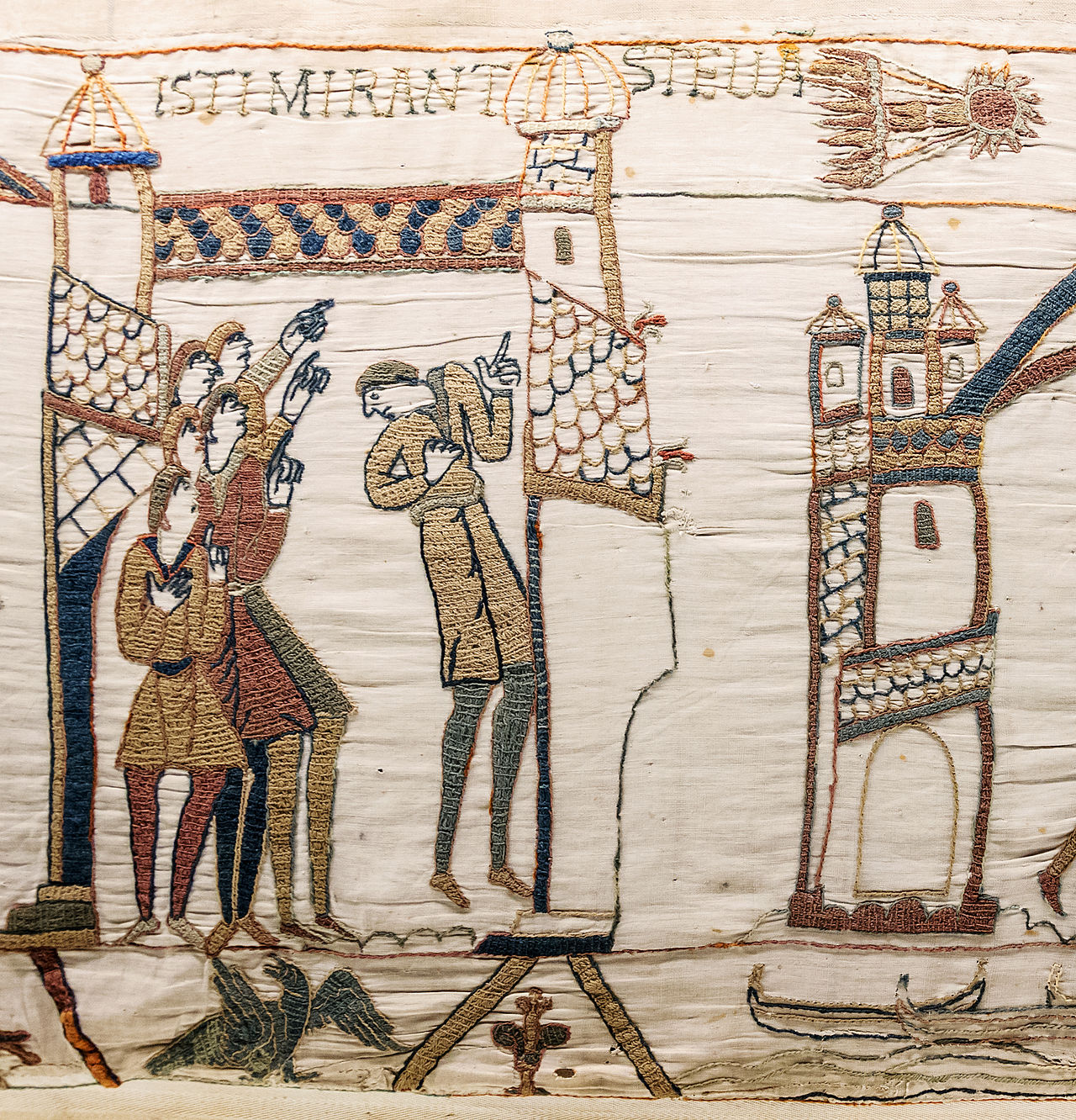
The comet has since been connected to ancient observations going back more than 2,000 years. It is featured in the famous Bayeux tapestry, which chronicles the Battle of Hastings in 1066.

  • The last time Halley visited Earth was in 1986 when we humans sent some spacecraft to take a look at it. The next time it will return is 2061 as Halley returns every 76 years. So if you are listening to this… we aren’t the luckiest generation when it comes to Halley’s comet sightings.
    • But have no fear, we can still laugh at the past generations reactions to it LOL
  • When historians and astronomers put their heads together they realized there is documentation of Halley’s sightings dating back over 2,000 years, just like that paragraph from NASA.com said. EXCITING STUFF!
Shih Chi and Wen Hsien Thung Khau chronicles from China 239BC
  • The first thought to observe Halley’s comet was the ancient Greeks in 466 BC
    • The first written observation was by ancient Chinese astronomers back in 239BC. It was written down in the Shih Chi and Wen Hsien Thung Khau chronicles.
  • The Babylonians noted seeing a bright comet in the sky in 164BC and 87BC.
    • I even put a picture on the blog of the tablet that apparently says so. It is one those artifacts the British “acquired” from other countries LOL.
According to this Museum in London, the Babylonians mentioned Halley’s Comet
Tapestry on men looking at comet.
A panel from the Bayeux tapestry showing people looking at what would later be known as Halley’s comet. Credit: By Myrabella – Own work, Public Domain
  • When you google historical Halley’s Comet sightings, the biggest and most undisputed documentation comes from 1066 AD.
    • William I, usually known as William the Conqueror and sometimes William the Bastard, was the first Norman king of England, reigning from 1066 until his death in 1087. A descendant of Rollo, he was Duke of Normandy from 1035 onward.
    • In 1066AD he invaded England successfully and during the invasion they saw Halley’s comet. William even thought it brought his success. The Tapestry that was made to document/honor William’s invasion shows Halley’s Comet.
    • LOL there are these peasant dudes with bowl cut hairstyles embroidered on the Tapestry pointing up at the sky where a cool looking comet is flying by. The warped dimensions of the tapestry makes the dudes pointing look like stoners to me and it makes me giggle.
      • Like, the Tapestry is showing a bunch of guys who snuck out of the castle for a doobage 420 break and all the sudden one of them was like “holy shit! look at that thing in the sky!”
      • and King William was like “oh damn! that’s wild. Put that shit on my Tapestry. That’s dope.”
Adoration of the Magi
Giotto
Original Title: Adorazione dei Magi
Date: c.1304 – c.1306
Style: Proto Renaissance
Series: Scenes from the Life of Christ
Genre: religious painting
Dimensions: 200 x 185 cm
  • When you look up Halley’s Comet in the Encyclopedia Britannica they mention the comets visit in 1301 could have inspired Giotto’s (old Italian artist) painting of the Star of Bethlehem in his “The Adoration of the Magi”
    • Which Magi refers to the Zoroastrians (3 wise men) who were at the nativity. Reference back to my Zoroastrian episode. Such a cool old religion.
    • Giotto would inspire the name of The European Space Agency’s Giotto craft that was able to get a close look at Halley’s comet back in 1986.
  • The comet’s pass in 1910 was particularly spectacular, as the comet flew by about 13.9 million miles (22.4 million kilometers) from Earth, which is about one-fifteenth the distance between Earth and the sun. On that occasion, Halley’s Comet was captured on camera for the first time.
    • According to biographer Albert Bigelow Paine, the writer Mark Twain said in 1909, “I came in with Halley’s Comet in 1835. It is coming again next year, and I expect to go out with it.” Twain died on April 21, 1910, one day after perihelion, when the comet emerged from the far side of the sun.
  • Keep in mind, all of these historical sightings (as far as the historical record suggests) were under the impression that they were seeing an isolated event.
    • Again, It wasn’t until 1705 when Edmond Halley connected all these observations
  • Here is some fun sciency facts about Halley from NASA

In 1986, an international fleet spacecraft met the comet for an unprecedented study from a variety of vantage points. The science fleet included Japan’s Suisei and Sakigake spacecraft, the Soviet Union’s Vega 1 and Vega 2 (repurposed after a successful Venus mission), the international ISEE-3 (ICE) spacecraft, and the European Space Agency’s Giotto. NASA’s Pioneer 7 and Pioneer 12 also contributed to the bounty of science data collected.

Each time Halley returns to the inner solar system its nucleus sprays ice and rock into space. This debris stream results in two weak meteor showers each year: the Eta Aquarids in May and the Orionids in October.

Halley’s dimensions are about 9.3 by 5 miles (15 kilometers by 8 kilometers). It is one of the darkest, or least reflective, objects in the solar system. It has an albedo of 0.03, which means that it reflects only 3% of the light that falls on it.

With each orbit around the Sun, a comet the size of Halley loses an estimated 3 to 10 feet (1 to 3 meters) of material from the surface of its nucleus. Thus, as the comet ages, it eventually dims in appearance and may lose all the ices in its nucleus. The tails disappear at that stage, and the comet finally evolves into a dark mass of rocky material or perhaps dissipates into dust.

Scientists calculate that an average periodic comet lives to complete about 1,000 trips around the Sun. Halley has been in its present orbit for at least 16,000 years, but it has shown no obvious signs of aging in its recorded appearances.

Comets are usually named for their discoverer(s) or for the name of the observatory or telescope used in the discovery. The official name is 1P/Halley. Since Halley correctly predicted the return of this comet ​– the first such prediction – it is named to honor him. The letter “P” indicates that Halley is a “periodic” comet. Periodic comets have an orbital period of less than 200 years.

  • A sobering side fact:
    • The astronauts aboard Challenger’s STS-51L mission were also scheduled to look at the comet… but the Challenger infamously exploded shortly after launch on national television.

THE PANIC

  • The first source I list on the blog (SetTheTape.com) was what turned me on to doing a Halley’s Comet episode because it pointed out the crazy crap people thought about this comet… but it isn’t a reliable source as it started with “In 1910, Edward Halley discovered a comet that was going to closely pass by Earth.” Well that’s odd because the dude died in 1742… LOL
    • So I threw out everything that article had (only 1 paragraph), but still felt it was right to mention it as this episode’s inspiration.
    • The main sources for the historical and scientific first portion of this episode are instead from NASA and Space.com
  • But for the latter half of this episode I used WIRED.com as their article focused on the societal impact of Halley’s comet instead of the science of it.

Below are the bits from WIRED.com‘s article that I liked most:

ON MAY 6, 1910, Halley’s comet approached Earth and killed England’s King Edward VII, according to some superstitious folk. No one could definitively say how it did, but it certainly did. And that wasn’t its only offense. The Brits also figured it was an omen of a coming invasion by the Germans, while the French reckoned it was responsible for flooding the Seine.

Writing to the Royal Observatory, one worrywart warned the comet would “cause the Pacific to change basins with the Atlantic, and the primeval forests of North and South America to be swept by the briny avalanche over the sandy plains of the great Sahara, tumbling over and over with houses, ships, sharks, whales and all sorts of living things in one heterogeneous mass of chaotic confusion.”

Throughout history, there’s always been a bit of panic when comets approached the sun, burning off into long, ominous tails. But in the months preceding Halley’s flyby of Earth on May 19, 1910, folks got real creative with their anxiety. It didn’t help that a few months earlier, The New York Times had announced that one astronomer theorized that the comet would unceremoniously end life as we know it.

French astronomer and author Camille Flammarion  circa 1890.

French astronomer Camille Flammarion sure knew how to part a head of hair. POPPERFOTO/GETTY IMAGES

He was a Frenchman named Camille Flammarion, and in typical French despair, he reckoned that as we passed through the comet’s tail, “cyanogen gas would impregnate the atmosphere and possibly snuff out all life on the planet,” The Times reported. Astronomers had detected the cyanogen in the tail using spectroscopy, which reveals an object’s composition by analyzing the light coming off it. “Cyanogen is a very deadly poison, a grain of its potassium salt touched to the tongue being sufficient to cause instant death,” the paper wrote. To its credit, though, The Times noted that most astronomers did not agree with Flammarion.

But other enterprising capitalists hatched more nefarious schemes. Fraudsters hawked anti-comet pills, with one brand promising to be “an elixir for escaping the wrath of the heavens,” while a voodoo doctor in Haiti was said to be selling pills “as fast as he can make them.” Two Texan charlatans were arrested for marketing sugar pills as the cure-all for all things comet, but police released them when customers demanded their freedom. Gas masks, too, flew off the shelves.

Writes Ridpath: “A shepherd in Washington State was reported to have gone insane with worry about the comet, while in California a prospector nailed his feet and one hand to a cross and, despite his agony, pleaded with rescuers to let him remain there.” Churches found themselves packed to the brim with worried followers, while at home people were going so far as to plug up keyholes to keep out the comet’s vapors. (Sound familiar? If you think these people were nuts, remember that in 2003 our government told us to seal our homes with duct tape in the event of a terrorist attack. In 2003. The 21st century.)

folks in Atlanta missed out on all the fun on account of pesky cloud cover, though The Atlanta Constitution seemed relieved, declaring the clouds had in fact saved the city.

Weirdly, two years after the event came an even more fanciful theory from Sze zuk Chang Chin-liang of the Imperial Polytechnic College in Shanghai: “It is obvious the comet has no tail at all and the so-called tail must be the Sun rays which, while passing through the body of the comet, look like a tail.” Should the comet itself be transparent it could form a convex lens, “then everything on the Earth will be burnt provided the sunlight passes through the body of the comet and the focus falls on the surface of the Earth.” Why the procrastinating worrier only got around to proposing it after the Earth had already survived is anyone’s guess.

  • I love history, what we can learn from it, what fantastic stories it can tell.
    • And Halley’s comet is a predictable metronome keeping rythm with the history of mankind. It has been here for longer than our societies are thought to have existed and it will be here long after anyone reading or listening to this will live
      • (assuming the Who’d a Thunk It? Podcast doesn’t just indefinitely live on in a server somewhere for millenia… LOL how cool would that be?!… “whats up future people! Did you like my multiple episodes on poop?) … Oh god, if some distant future society stumbles upon this blog/podcast like they will think we were all nuts!
    • But those same future people will hopefully regard Halley’s Comet as a wonder to behold.
    • I mean think about it: men the caliber of Mark Twain were happy to be born around the time of Halley’s Comet and die when it came back around.
    • This comet means so much to so many generations.
    • Sometimes it represents panic, others it represents something special… some generations it is both.

CREDIT:

Categories
Uncategorized

Income Taxes

The content below is from Episode #160 of the Who’d a Thunk It? Podcast

RECOMMENDATION SEGMENT

  • This week I recommend you watch the 1998 *classic Simon Birch
    • It only has 44% on rotten tomatoes from critics and 77% from audiences
    • It stars the kid from the first Jurassic Park movie Joseph Mazzello, Ian Michael Smith (as Simon Birch), Jim Carrey, Oliver Platt, and the forever-babe Ashley Judd.
  • Here’s the plot
    • Simon Birch (Ian Michael Smith) and Joe Wenteworth (Joseph Mazzello) are boys who have a reputation for being oddballs. Joe never knew his father, and his mother, Rebecca (Ashley Judd), is keeping her lips sealed, no matter how much he protests. Simon, meanwhile, is an 11-year-old dwarf whose outsize personality belies his small stature. Indeed, he often assails the local reverend (David Strathairn) with thorny theological questions and joins Joe on his quest to find his biological father.
  • SPOILER ALERT from here on out.
  • If you want to watch Simon Birch without knowing how it ends, skip to the main event on the blog or for the audio people, skip a minute or so ahead.
    • This movie is sad as hell. It hilariously traumatized me as a kid because of how tragic it is.
      • Simon Birch dies in the end. The main guy, whom the movie is named after dies. This lovable wisecracking philosopher you grow to love throughout the movie dies leaving his lonely friend behind. It’s sad as hell. … but that’s not the most traumatizing part.
    • Joe’s mom, played by Ashley Judd, dies a horribly traumatic death.
      • Throughout the entire movie Simon has a crush on Joe’s mom (and who wouldn’t… its 90’s Ashley Judd, shes a 12).
      • It is how she dies that was so shocking my mind repressed the memory.
      • You see, there were just about 4 things Simon Birch cared about in this movie: being pissed off at god for being born with dwarfism, his buddy Joe, Joe’s hot mom, and baseball.
        • but because of Simon’s condition, he can’t play sports. He is too small and fragile. It’s also why he thinks he will never get to be with a beautiful woman like Joe’s mom.
        • Well towards the middle or end of the movie there is a moment where Simon’s reluctant baseball coach is forced to put Simon in the game. Simon goes up to the plate and the audience can tell they are setting it up for Simon to actually hit a home run.
          • I remember watching with such anticipation and excitement for the Simon the underdog to slug one out the ball park. The movie goes to slow motion, the pitch is thrown, and little 11-year old dwarf Simon Birch smacks the ball harder than anyone had ever hit a baseball. It was epic. I remember my whole family watching this on VHS rental from Blockbuster at home and cheering for the little guy…
          • But the cheers didn’t last long…
          • Because the first positive thing to happen in Simon Birch’s life, this awesome home run he’d been dreaming about for so long turned out to NOT be a home run, but a fowl ball.
          • It went flying across the field and smacked Ashley Judd’s character (Joe’s mom, Simon’s crush, Simon’s bestfriend’s mom) right in the damn temple. She was dead instantly….
          • TRAUMATIZING for a little kid LOL. I was like 10 years old when I watched it.
          • I looked to my dad in shock saying “you can’t die from a baseball can you?!”
          • My mom, the nurse, said “oh yeah, blunt force trauma to the temple, you bet you can die from it.”
  • I mentioned how I repressed this memory. Well it all came flooding back a few months back when I saw a Facebook reel.
    • There was a meme going around where people took the Mentos Freshmaker commercial theme music and played it over various scenes from movies and TV shows. Welp… they did it to Simon Birch (click link below)

https://www.facebook.com/reel/735426717609601

I laughed so damn hard at that clip. I rewatched it so many times. I had to share with you guys, the Who’d a Thunkers. And I thought it would be a good recommendation segment.

It is definitely dark humor, but OMG I think it is comedy gold. Nay, comedy diamond.

NOW FOR THE MAIN EVENT

  • Everyone hates taxes.
    • Even those who think they are a necessary evil when living in society, and support them theoretically, still don’t enjoy paying them on a practical level.

“The power of taxing people and their property is essential to the very existence of government.”

James Madison, 4th President of the United States
Anyone remember a certain tea party?
  • Taxes and America have a weird relationship.
    • Being over-taxed is the main reason America exists as an independent nation. Think about the Boston Tea Party. America’s main source of revenue was import and export taxes.
    • But then America had a change of heart… unfortunately.
    • Income Tax specifically came around in the late 1800’s with the Civil War.
      • The country was hit hard by the bloodiest conflict it had ever seen and so the Revenue Act of 1861 was passed with the help of the Lincoln administration. It made anyone with yearly income of $800 or higher to pay a flat tax.
      • In 1872 the Revenue Act of 1861 was rescinded.
        • The income tax wasn’t proportional to population and some found it contradicted the constitution. So the government’s right to charge these kinds of taxes was disputed by the people.
        • Unheard of today to see a government be granted power during a crisis and when the crisis is over have the government let go of that power back to the people… remarkable.
    • But that didn’t last long. In 1913 the 16th Amendment was passed.
      • Like all amendments, tis a bit too wordy for the common man such as myself so let me give you the highlights:
        • “The Congress shall have the power to lay and collect taxes on incomes, from whatever source derived, without apportionment among the several States, and without regard to any census or enumeration.”
      • The dirty 16th allowed the government to charge our income and didn’t allow for any loopholes. And it seems this was sort of a pandora’s box moment. Sure, congress has repealed amendments before (refer to Prohibition [18th amendment] and the end of prohibition [21st amendment]).
        • But no one in their right mind is predicting the government to give up all that sweet cash money they make off the backs of the working man.
        • Honestly, (and I can’t believe I’m going to say this), but I can see income tax making sense on certain things. Like celebrities, politicians, and other professions we all collectively hate, but don’t take away the income of those blue-collar workers busting their asses all day long.
        • But I understand you can’t just tax some and not others. It’s either all or nothing, otherwise it opens the door to financially imposed prejudices.

“…but in this world nothing can be said to be certain, except death and taxes.”

Benjamin Franklin
  • Taxes and Death go hand in hand.
    • The 16th Amendment called for a 1% tax on people with incomes over 3Gs per year and a 6% tax on people with incomes over 500Gs per year.
    • Those percentages pale in comparison to just a few years later in 1918 when incomes over 1Million per year were taxed 77%… 77%!
      • Can you guess what would cause taxes to jump so much in so little time? What was happening in 1918?
      • Oh, just a little thing known as World War 1, the Great War, the War to end all Wars.
  • After the war in 1922 the top tax brackets were taxed 58%, which is lower… but still majority. The tax rate kept dropping until 1929 when the top bracket was taxed 24%, which is still alot, but much more manageable.
    • Until… can you guess what started to happen not long after WW1? … you may have actually gotten this one wrong…
    • In 1932 during the Great Depression the top margins were taxed 63% because the US government (and most of the world) was reduced to that of beggars because of the stock market crash.
The scary numbers
  • Right after the Great Depression was WW2 and you know the government wasn’t going to let up on the income tax when they needed to kick the crap out of the Krauts on one side and the Japs on the other.
    • It wasn’t until the 60’s (1960’s that is) when taxes started to drop again.
    • Where there is death, there are taxes. In times of war, in times of crisis, taxes go up.
  • I said that you can’t tax some and not others right… well that isn’t always the case.
    • Some rules make taxes lower for certain people. The poor are taxed less than the rich, that’s the basic one. But there are also tax breaks for college students (because the government allowed student loans to screw us financially already LOL). And Parents are taxed less because they have the future of America to look after. On a basic level, these tax breaks make sense. The government is investing in the country’s future by allowing those less fortunate or those trying to better themselves a little more wiggle room. On paper, it is a good move…. but practically it doesn’t always work that way.
    • There are concerns that these strategic tax breaks allow for unintended loopholes that make the system less fair. People worry the current tax system favors the mega-wealthy.
      • I’m talking about your Uncle who works in sales and owns a boat, he’s probably paying taxes out the wazoo. No, I’m talking about CEO’s of giant monopolies somehow paying less taxes than your little old grandma.
      • Reference this article on loopholes that benefit the rich.
  • I think it is overall a good thing that our government isn’t always run by the same people.
    • Everytime the administration changes they tweak the system one way or another.
    • They increase economic growth, close loopholes (such as with alternative minimum tax) to make the system more “fair”, or influence some combination of the two.
  • I remember the adults bitching about taxes even when I was a little kid and didn’t know what the heck taxes even were.
    • I remember the shit-eating grin on my Papa’s face (RIP Papa) when my mom told him I got my first paycheck from a legit job.
      • LOL he smiled a sinister smile, looked me right in the eye, and said “a Tax Payer huh? Welcome to the club!”
    • But when you look back you realize it could be worse.
      • Don’t get me wrong. I’m all for our bloated government having less power. I say stick it to the man every chance you get. Work with your local (non-big corp) accountant to make sure you aren’t giving those big wigs a penny more than you legally have to.
      • But recognizing that things could be worse does grant one a little bit of comfort of mind in the form of gratitude.

CREDIT:

Categories
Uncategorized

Unit 731

The content below is from Episode 159 of the Who’d a Thunk It? Podcast

ANNOUNCEMENT

  • This episode’s main topic is dark, very dark. In this episode, Unit 731, I will be talking about torture, mutilation, and treatment of human beings as if they were “logs.” But all of this actually happened and I think it is important for people to know about it.
    • You have been warned. This is mature content. Viewer and listener discretion is advised.

RECOMMENDATION SEGMENT

  • Before I get into the main topic, I would like to recommend something light and happy in contrast to how dark this episode is going to be.
    • This week I recommend you watch the Kill Tony. It is a live comedy podcast that I have been obsessed with.
    • The weekly live show recorded live from Austin Texas and the world, with your hosts Tony Hinchcliffe and Brian Redban.
    • It is hilarious. Tony has a live band, a couple of mics, and a live audience. He pulls names out of a bucket and gives whomever he pulls out, 60 seconds of uninterrupted time to do a comedy standup routine. When the 60 seconds are up, Tony and usually a guest comedian interview the aspiring comedian that probably just BOMBED on stage.
    • The show set up makes every episode unique and enjoyable.
    • If the aspiring bucket comedian does well (a rarity) then great. Everybody laughs.
    • If the aspiring bucket comedian does poorly (the usual outcome) Tony and the guest comedian rip into them. This also makes everyone laugh.

NOW FOR THE MAIN EVENT

Unit 731

Xinhua via Getty Images -Unit 731 personnel conduct a bacteriological trial upon a test subject in Nong’an County of northeast China’s Jilin Province. November 1940.

  • I’ve talked about World War 2 quite a bit on this podcast. It is important to know just how much suffering came out of the largest war this planet has ever seen. It killed 3% of the world’s population at the time.
    • “War is Hell” –General William Tecumseh Sherman, a leader of the Union army in the Civil War.
    • No part of WW2 lasted longer than the Pacific Theater. From Japan’s attack on Manchuria in 1931 to September 2nd, 1945 when Japan officially surrendered to the United States.
    • Japan’s invasion of China in 1937 drastically changed the country. It created a civil war, famine, and estimated 3.9 million Chinese (mostly civilian) perished as a direct result.
      • In the end 10.2 million Chinese died until the Soviets stepped in to “liberate” China in 1945.
    • During this genocide and mass rape of China, a biological warfare unit simply known as Unit 731 managed to stand out as even more cruel and brutal than what was already happening around them.
    • What started out as a truly beneficial public health research agency, eventually became a human disease factory. The diseases that were cultivated at Unit 731 had the ability to wipe out human life… all of it. And how did they create such biological weapons?
      • A virtually endless supply of human test subjects they saw as nothing more than “logs.”
    • Japan started its biological weapons program in the 1930s, partly because biological weapons were banned by the Geneva Convention of 1925; they reasoned that the ban verified its effectiveness as a weapon.[1] Japan’s occupation of Manchuria began in 1931 after the Japanese invasion of Manchuria.[11] Japan decided to build Unit 731 in Manchuria because the occupation not only gave the Japanese an advantage of separating the research station from their island, but also gave them access to as many Chinese individuals as they wanted for use as human experimental subjects.[11] They viewed the Chinese as no cost research subjects, and hoped that they could use this advantage to lead the world in biological warfare.[11] The majority of research subjects were Chinese, but many were of different nationalities.

This is another warning. The topics I’m about to discuss include rape, mutilation, and some of the most vile treatment of a human being. Please, if you don’t want to hear about these topics just turn off the podcast now.

Here are some of the worst experiments carried out by Unit 731. They are some of the most horrific war crimes ever committed and they basically received no punishment.

Unit 731’s Harbin facility.

  • Rape was common in Imperial Japan’s expanse across the Pacific Theater. Unit 731 was no exception.
    • But instead of the beastial lust driven rape common among Japan’s combat units, Unit 731 used rape as a tool to further their understanding of biological warfare.
    • If a female captive was the right age to become pregnant, the beings operating Unit 731 would have her forcibly impregnated. A pregnant human guinea pig has more potential for insight into a biological weapons effectiveness.
    • After the female captive was pregnant they would be intentionally infected with various diseases, have parts of their bodies crushed, shot, exposed to chemical weapons, and beaten. After this abysmal suffering, the mother would be disected and the fetus would be examined.
    • These experiments seemed to have drastically improved medicine for pregnant women after the war.
      • Documentation of the experiments were destroyed before Unit 731 was shut down. However, the witness accounts say it happened. And the innovations in healthcare for pregnant women that came out of Manchuria support witnesses’ claims.

Unit 731 Medical Table

A Unit 731 doctor operates on a patient that is part of a bacteriological experiment.

  • One part of Unit 731 was known as Maruta.
    • Their job was to study the effects of disease and injury on enemy combat units.
    • At first they took volunteers from the Imperial Army for non-lethal diseases that could be easily observed.
    • But as the Maruta team wanted to study more harmful diseases and injuries and as the volunteers started to not show up to be butchered/infected… they changed tactics.
    • Maruta is Japanese for “log.” This unit started using POWs for their research subjects and therefore no longer had to ask for consent.
      • They no longer used any semblance of ethical restraint.
    • Vivisection is defined as:
      • Vivisection is surgery conducted for experimental purposes on a living organism, typically animals with a central nervous system, to view living internal structure
    • The Maruta team didn’t use anethesia as they vivisected living victims.
    • Mostly Chinese Civillians were infected with cholera and the black plague. Then their organs would be removed before they died. This gave Unit 731 the best insight into the effects of each disease as the organs wouldn’t have started to decompose at all.
    • Other than disease, Maruta team would amputate limbs and sew them back on to other parts of the body to see what would happen. All while the victim was alive and without any sort of pain management.
      • Other victims would have parts of their bodies crushed, frozen, and/or circulation cut off to see how gangrene works on the body.
    • When a victim’s body, or “log” as they were referred to by the Japanese, could no longer provide any insight, they were shot or sometimes they didn’t even bothered… burying the POWs alive. Not a single Chinese, Mongolian, Korean, or Russian prisoner sent to Unit 731 left alive.

Unit 731 Frostbite Test

The frostbitten hands of a Chinese person who was taken outside in winter by Unit 731 personnel for an experiment on how best to treat frostbite.

  • There was a special interest in hypothermia at Unit 731. A man known as Yoshimura Hisato preferred to study what extreme cold did to limb injuries.
    • He would take POWs and force their limbs into freezing water until the flesh was solid. Yoshimura would inspect the frozen limb by striking it with something solid. Unless the limb sounded like striking lumber, the limb would go right back into the ice bath.
    • He would then rapid warm the frozen limb in different ways to see if he could get it to be functional again.
      • He would pour hot water over the frozen limbs. He would also sit the victim next to a fire or simply let it thaw over time.

Bayonet Practice

A Japanese soldier uses a Chinese man’s body for bayonet practice near Tianjin, China. September 1937.

  • To optimize Japan’s fighting forces, Unit 731 was tasked with testing various weapons on living targets.
    • There were many instances of lining POWs up on firing ranges and testing every firearm on them.
    • Unit 731 measured and documented the wound patterns and depths of dead and dying inmates.
  • Bayonets, swords, knives, flamethrowers, gas chambers, nerve gas, and blister agents were used on bound subjects.
    • The military wanted to know the effectiveness of a flamethrower or nerve gas on a clothed victim as opposed to bare skin.
    • They dropped heavy objects to see how the human body is crushed.
    • They deprived inmates of food and/or water to see what would happen to their bodies, to see how long it would take for them to die.
    • They made some subjects only drink seawater until death.
    • They injected animal blood into victims to see how it clotted differently.
  • The invention of the Xray was in 1895 and long term effects not fully known at the time.
    • Unit 731 exposed thousands to way too much Xray and were sterilized or killed from it.
    • The Xray is a complicated procedure. Often the plates weren’t calibrated correctly and victims burned to death on the table.
  • To see what the human body can endure in terms of GForce (to benefit the Imperial Airforce) Unit 731 spun people at forces that are unheard of today.
    • At around 10 to 15Gs subjects lost conciousness and died. They found the younger the child, the less tolerance for GForce…

Shiro Ishii

General Shiro Ishii, the commander of Unit 731.

  • The Imperial military was having a major problem with STDs as it raped its way across Asia. So Unit 731 was tasked with learning more about venereal diseases… especially sythilis.
    • Doctors infected POWs with syphilis and simply withheld treatment to see what would happen. Syphilis can be fatal if not treated.
    • Male inmates infected with syphilis would be forced to rape both female and male inmates to spread the disease. If it didn’t take on, they were forced to rape until the rape victim showed signs of having syphilis.

Children With Unit 731 Researchers

Unit 731 researchers conduct bacteriological experiments with captive child subjects in Nongan County of northeast China’s Jilin Province. November 1940.

  • The end goal was for Unit 731 to develop biological weapons against their enemies such as Allied and Soviet forces.
    • They used tens of thousands of prisoners to weaponize lethal pathogens like Yersinia Pestis (bubonic and pneumonic plague) and typhus. The thought was to drop these on enemy populations and thin out their numbers.
  • AllThingsInteresting.com reads:

To breed the most lethal strains possible, doctors monitored patients for rapid onset of symptoms and quick progression. Victims who pulled through were shot, but those who got sickest fastest were bled to death on a mortuary table, and their blood was used to transfect other captives, the sickest of whom would themselves be bled to transfer the most virulent strain to yet another generation.

One member of Unit 731 later recalled that very sick and unresisting captives would be laid out on the slab so a line could be inserted into their carotid artery. When most of the blood had been siphoned off and the heart was too weak to pump anymore, an officer in leather boots climbed onto the table and jumped on the victim’s chest with enough force to crush the ribcage, whereupon another dollop of blood would spurt into the container.

When the plague bacillus had been bred to what was felt to be a sufficiently lethal caliber, the last generation of victims to be infected were exposed to huge numbers of fleas, Y. pestis’ preferred vector of contagion. The fleas were then packed in dust and sealed inside clay bomb casings.

Germ Warfare

Japanese personnel in protective suits carry a stretcher through Yiwu, China during Unit 731’s germ warfare tests. June 1942.

  • In October of 1940 the Japanese airforce dropped casings filled with fleas that had sucked the blood from dying diseases prisoners over a Chinese village known as Quzhou.
    • Those who were there saw a red mist descend upon them and then feeling flea bites.
    • 2,000 died in Quzhou from the plague
    • 1,000 died in the next town over after it was brought their from commuters from Quzhou
    • 6,000 people died when the Japanese dropped anthrax on another town.
    • Plans were found that outlined Japan’s intent to do the same to US towns.
  • But in 1945 we dropped Fat Man and Little Boy on Hiroshima and Nagasaki.
    • The Soviets invaded Manchuria, destroying the Japanese army.
    • And Emperor Hirohito gave his surrender speech in August of 1945
    • Unit 731 was no more.
  • Unit 731 was responsible for some of the most notorious war crimes committed by the Japanese armed forces. It routinely conducted tests on people who were dehumanized and internally referred to as “logs”. Experiments included disease injections, controlled dehydration, hypobaric chamber experiments, biological weapons testing, vivisection, amputation, and standard weapons testing. Victims included not only kidnapped men, women (including pregnant women) and children, but also babies born from the systemic rape perpetrated by the staff inside the compound. The victims came from different nationalities, with the majority being Chinese and a significant minority being Russian. Additionally, Unit 731 produced biological weapons that were used in areas of China not occupied by Japanese forces, which included Chinese cities and towns, water sources, and fields. Estimates of those killed by Unit 731 and its related programs range up to half a million people, and none of the inmates survived.
  • It was officially known as the Epidemic Prevention and Water Purification Department of the Kwantung Army (関東軍防疫給水部本部, Kantōgun Bōeki Kyūsuibu Honbu). Originally set up by the Kenpeitai military police of the Empire of Japan, Unit 731 was taken over and commanded until the end of the war by General Shirō Ishii, a combat medic officer in the Kwantung Army. The facility itself was built in 1935 as a replacement for the Zhongma Fortress, and Ishii and his team used it to expand their capabilities. The program received generous support from the Japanese government until the end of the war in 1945. Unit 731 and the other units of the Epidemic Prevention and Water Purification Department operated biological weapon production, testing, deployment, and storage facilities.
  • While Unit 731 researchers arrested by Soviet forces were tried at the December 1949 Khabarovsk war crime trials, those captured by the United States were secretly given immunity in exchange for the data gathered during their human experiments.[6] The United States covered up the human experimentations and handed stipends to the perpetrators.[1] The Americans co-opted the researchers’ bioweapons information and experience for use in their own biological warfare program, much like what had been done with German researchers in Operation Paperclip.[7][8]
  • Its records were mostly burned, destroying any useful information the team had managed to generate in 13 years of research. Researchers mostly slipped back into civilian life in occupied Japan as if nothing had ever happened, many of them becoming prominent members of university faculty.
  • To this day, Japan has not apologized for, and China has not forgiven, the countless atrocities Japanese forces visited upon China between 1931 and 1945. As the last witnesses to this history grow old and die, it’s possible that the matter will never be addressed again.

CREDIT

R/HistoryMemes:

  • candiedloveappleOP:
    • The japanese abducted chinese civilians, put them into a heat chamber and blasted them with hot air until they had the consistency of Jerky and then they cross referenced the amount of evaprated and collected water with the mass of the corpse before and after being tortured to death.
  • baiqibeendeleted28x·
    • The Empire of Japan is a serious contender for the most evil regime in human history. Their atrocities are just overlooked because Japan is so well liked in the West now (“bu-bu-but this sub talks about them!”, this sub is not representative of real life, shocker).
    • Indiscriminate massacre of civilians. Slaughter of entire cities, torture, inhumane treatment of POWs, comfort women, etc.
    • Over the course of their conquest of East Asia, the Japanese Army forced around 200,000 women into the ranks of “comfort women“. These women mainly came from China, Korea, and the Philippines. Unfortunately this is the one thing I couldn’t dig up the source for, but I distinctly remember reading the firsthand account of a Filipino comfort women who was raped 10x a day. Japan has yet to even officially apologize to them.
    • You think that’s the worst? During the Rape of Nanking, as many as 300,000 Chinese civilians were massacred within a month in a single city. Japanese soldiers paraded around with babies skewered on their bayonets like kebabs. Two Japanese officers held a competition to see who could behead 100 people the fastest and when the score was 105-106 and no one knew who got to 100 first, they restarted the contest, this time to 150 people. Civilians were buried alive en masse. Prisoners were used as live bayonet practice, screaming as the final moments of their life was used for the Japanese to sadistically torment. Tens of thousands of women were raped, most of whom were executed afterward. They dragged entire Chinese families into public squares and forced fathers on their daughters and sons on their mothers for the amusement of Japanese troops. I’m not an easily disturbed guy, but reading this fact for the first time physically made my stomach sick.
    • You think that’s the worst? The Imperial Japanese Army ran Unit 731: a biological/chemical warfare research program in Manchuria where Japanese researchers performed human experimentation on a large scale, using Chinese civilians as the majority of their “logs” (test subjects).
    • Living humans were dissected alive, usually without anesthesia. Subjects had limbs amputated in order to study blood loss and pain tolerance. Those limbs were sometimes reattached to the opposite sides of the body. Subjects had their stomachs or esophagus surgically removed. Subjects were gotten pregnant via rape then infected with diseases to see the effect on their baby. Subjects were forced into the cold to research frostbite then had their frozen limbs chopped off. Subjects were placed in pressure chambers until their eyeballs popped out of their sockets. This one is unconfirmed, but supposedly they placed a women and her baby in a room then heated up the floor to see if she’d step on her own baby.
    • Back in 1995, an anonymous Japanese medical assistant who worked in Unit 731 sat down for an interview with the New York Times and described one such dissection:
    • The entire world still cries over the civilians of Hiroshima and Nagasaki to this day. But hardly anyone sheds a tear for the millions of victims of the Empire of Japan.
    • Unit 731, Imperial Japan’s biological/chemical warfare research program based in Manchuria, is among the most disgusting atrocities in human history. Japanese researchers performed human experimentation on a large scale, using Chinese civilians as the majority of their “logs” (test subjects).
    • Some particularly brutal experiments performed on prisoners included:
    • Frostbite testing (upon which the subject’s frozen limbs would be chopped off)
    • Intentional disease infection (infected prisoners were forced to have sex with uninfected to study the transfer of disease)
    • Live targets for weapon testing, including flamethrowers (pic from Nanking, no known pictures of human targets from Unit 731)
    • Forced pregnancy from rape
    • Bacteriological experiments on children
    • Pressure chamber (subjects were placed inside and the pressure turned up until their eyeballs popped out of their sockets)
    • Dissection of living humans beings without anesthesia
    • You read the last one right… the Japanese dissected living human beings. Subjects had limbs amputated, their stomachs or esophagus surgically removed, and all sorts of inhumane procedures to “study” blood loss and pain tolerance. That amount of agony probably can’t even be comprehended, but back in 1995, an anonymous Japanese medical assistant who worked in Unit 731 described a dissection.